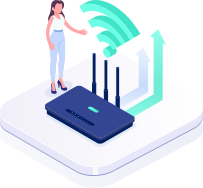
We can create a seamless, managed, end-to-end usability for an efficient and organized WiFi experience. Our Managed WiFi services provide a secure, scalable, and easy-to-use solution.
ExterNetworks wants to work with you to collaborate on the development of your wireless network alongside your business strategy, providing reliable and consistent connectivity to every user within your organization.
Our traffic analysis reporting and capacity planning will allow you to forecast the growing needs of your managed WiFi services.
A tailored, enterprise-grade security level wireless network for all your business needs. Enrich your business productivity and customer experience with a fast, reliable, and secure service for your company.
Seamless and easy access for both private and guest networks to maximize customer engagement.

The latest in 802.11ac technology ensures quick, efficient usability for employees and visitors from start to finish.

Custom pages for your business to drive customer engagement and increase visitors to your website.

Control and customize bandwidth allocation to ensure optimal and fair site access for each and every user.

Assess how many visitors you can accommodate and adapt as your WiFi grows with your business.
We provide experts with various skills, including business strategy, communications, and NOC support. Our global expertise, which includes experience supporting clients in regions such as the United States, allows us to offer a comprehensive service that can react to whatever network issues come your way. With us, there’s no need to juggle many vendors - just a single, simple service you can trust.
ExterNetworks provides a broad range of enterprise-grade Managed IT Services designed for organizations of all sizes.
Our team of highly qualified and trained professionals is always ready to assist you around the clock with guaranteed SLA performance.
Our NOC specialists help you in getting the right enterprise solution for your business within your budget. Fill the form & Get the best enterprise quotes with guaranteed SLAs.
Request a QuoteSome enterprise stories are better if shown than told! Request a free demo to experience how ExterNetworks enterprise-grade Managed IT services can benefit your large enterprise. Schedule a Demo Today!
Request a DemoHave Questions about our managed NOC Services? Fill out the form, and our enterprise experts are ready to offer 24/7 support with guaranteed SLAs. Call Us Today!
A Guide to Managed Technology Services and its Role in Solving Current IT Challenges.
DOWNLOAD NOW!
How to Meet Your Vision Through Core Strategic Operations Using Managed NOC
DOWNLOAD NOW!But if we didn't, just reach out to us and we'll be happy to answer your questions.
Contact UsManaged WiFi is a fully outsourced wireless network service where a provider designs, deploys, monitors, and maintains your organization’s WiFi infrastructure. It ensures reliable connectivity, optimal performance, and proactive issue resolution without requiring your internal IT team to manage day-to-day operations. This allows businesses to focus on core operations while experts handle wireless network management.
Managed WiFi services typically include wireless network design, access point deployment, configuration, performance monitoring, troubleshooting, firmware updates, and security management. It also covers ongoing optimization, remote support, and reporting to ensure consistent connectivity across offices, warehouses, retail locations, or enterprise environments.
Yes, Managed WiFi services include enterprise-grade security features such as encrypted connections, secure authentication, network segmentation, and continuous monitoring. Providers also implement regular security updates, threat detection, and access controls to protect sensitive business data and prevent unauthorized access.
Managed WiFi improves performance by optimizing access point placement, reducing signal interference, balancing network traffic, and continuously monitoring network health. Proactive maintenance and real-time troubleshooting help prevent downtime, ensure stable connectivity, and support bandwidth-intensive business applications like VoIP, cloud platforms, and video conferencing.
The cost of Managed WiFi depends on factors such as network size, number of locations, number of users, hardware requirements, and service level agreements. Most providers offer flexible monthly pricing models, allowing businesses to scale services as they grow while avoiding large upfront infrastructure and maintenance costs.
Managed WiFi is monitored, maintained, and optimized by a service provider, ensuring reliability, security, and performance. Unmanaged WiFi, on the other hand, is handled internally, requiring in-house IT resources for setup, monitoring, troubleshooting, and updates. Managed WiFi reduces operational burden and improves overall network efficiency.
Key components include wireless network assessment and design, enterprise-grade access points, centralized network management, performance monitoring, security configuration, firmware updates, and technical support. These components work together to deliver secure, scalable, and high-performance wireless connectivity.
Outsourcing Managed WiFi helps businesses reduce IT workload, lower operational costs, improve network reliability, and enhance security. It also ensures expert management, proactive issue resolution, and scalability, enabling organizations to support growing user, device, and digital workloads without network disruptions.
ExterNetworks delivers end-to-end Managed WiFi solutions, including network design, deployment, 24/7 monitoring, and proactive maintenance. Our team ensures secure, high-performance wireless connectivity tailored to your business needs, helping organizations improve uptime, enhance user experience, and reduce internal IT management overhead.
Businesses implement Managed WiFi services by first assessing their network requirements, office layout, user density, security needs, and coverage areas. A wireless site survey helps determine the ideal access point locations and equipment needed to deliver reliable connectivity. The provider then installs the required hardware, configures network settings, establishes security controls, and separates guest WiFi from internal business networks to protect sensitive information.
After installation, the network undergoes testing to verify signal strength, coverage, speed, and connectivity across devices and locations. Ongoing management includes continuous performance monitoring, firmware updates, troubleshooting, security maintenance, and capacity optimization. These steps help businesses maintain a secure, scalable, and reliable wireless network while reducing the workload on internal IT teams.
A Managed WiFi provider may supply wireless hardware, manage existing equipment, or offer both options depending on the service agreement. Typical services include WiFi access points, wireless controllers, network configuration, installation, security management, performance monitoring, and ongoing maintenance. Some providers supply hardware as part of a subscription, while others manage equipment the business already owns.
An Internet Service Provider (ISP) usually provides connectivity separately through fiber, cable, or other access technologies. However, some Managed WiFi providers can coordinate with ISPs or bundle internet connectivity with their services. Before signing a contract, businesses should confirm whether the service package includes hardware, installation, ISP charges, troubleshooting, equipment replacement, and ongoing support.
Yes, Managed WiFi suits small businesses with limited IT staff because it provides professional wireless network management without requiring a dedicated in-house networking team. A managed service provider can handle network setup, configuration, security updates, performance monitoring, and troubleshooting. This helps small businesses reduce IT workloads, minimize connectivity issues, and maintain secure, reliable WiFi for employees, customers, and business applications.
Managed WiFi also lets small businesses scale as they grow, whether they add employees, devices, or new office locations. Providers can optimize coverage, monitor bandwidth usage, implement security controls, and provide ongoing technical support. By outsourcing these responsibilities, small businesses can focus on their core operations while benefiting from enterprise-grade wireless networking capabilities and predictable management costs.
Managed WiFi providers handle outages and service disruptions through continuous network monitoring, automated alerts, and proactive troubleshooting. When a problem occurs, technicians identify the affected access points, network devices, or connectivity links and isolate the root cause, such as hardware failure, signal interference, configuration errors, or an ISP outage. They then follow established escalation procedures to involve the appropriate network engineers or internet service provider when necessary.
To restore services quickly, providers may restart affected devices, correct configurations, replace faulty equipment, or switch traffic to backup connections when available. After restoring connectivity, they verify network performance, document the incident, and investigate preventive measures to reduce recurrence. Service-level agreements (SLAs) can define response times, resolution targets, and availability commitments, helping businesses understand the level of support they can expect.
Businesses can choose from several enterprise wireless networking solutions based on their budget, security requirements, network size, and IT resources. Managed WiFi is operated by a service provider that handles monitoring, maintenance, troubleshooting, and security, making it suitable for businesses that want expert support without managing the network internally. Traditional Wireless Local Area Networks (WLANs) use wireless access points and controllers to connect devices across offices, campuses, and facilities, with management responsibilities determined by the deployment model. WiFi-as-a-Service (WiFiaaS) typically provides wireless hardware, software, and management through a subscription, helping businesses reduce upfront investment and simplify upgrades.
An organization's IT team operates internally managed wireless networks, providing greater direct control over configurations, security policies, and network changes. This approach can suit enterprises with experienced network engineers and specialized requirements. In contrast, Managed WiFi and WiFi-as-a-Service can benefit small businesses, retail stores, hotels, healthcare facilities, and multi-location organizations that need reliable connectivity with less operational effort. Before selecting a solution, businesses should compare total costs, scalability, support availability, security features, and hardware ownership.