What Are Satellite Network Environments in a NOC?
Satellite networks are essentially communication systems that employ satellites to transmit data over long distances. These systems utilize satellites positioned in Earth’s orbit to relay signals, thereby facilitating data communication across continents and oceans. Such transmission capability bypasses the limitations of terrestrial infrastructure, making satellite networks uniquely valuable for global connectivity.

The management of these networks falls predominantly within the scope of a Network Operations Center (NOC). A NOC might be thought of as the nerve center for managing satellite networks, where skilled professionals monitor and enhance the performance of these vast communication systems. Specifically, they ensure that satellite networks remain operational, secure, and efficient, which includes monitoring data traffic, managing network performance, and troubleshooting any issues that may arise. Additionally, NOCs help optimize satellite networks to maximize service quality and efficiency.
The importance of satellite networks is particularly evident in remote, mobile, or otherwise inaccessible regions. Many places around the globe lack the terrestrial infrastructure required for conventional communication systems. In such cases, satellite networks bridge the gap, offering reliable communication services where they’re needed. Furthermore, they are especially crucial for mobile environments such as on ships or aircraft, where conventional infrastructure is impractical.
Moreover, satellite networks find extensive applications across various critical domains. Among their major use cases are the transmission of voice and video data, which are essential for communication services across continents. Beyond commercial applications, they are integral to Intelligence, Surveillance, and Reconnaissance (ISR) operations, providing real-time data and facilitating decision-making in defense and security contexts. Similarly, in real-world defense applications, satellite networks support operations by enabling secure communication and effective coordination across geographically dispersed units.
As satellite networks play a pivotal role across numerous sectors, their monitoring and management through a NOC are fundamental to ensuring seamless and robust global communication. The ability to connect remote and mobile areas, as well as support critical operations, underscores the indispensable nature of satellite network environments today.
How Satellite Networks Support Voice and Video Data in a NOC
Satellite networks play a pivotal role in enabling real-time voice and video communications across vast distances. These systems prove particularly invaluable in remote areas or regions affected by disasters, where traditional communication infrastructures may not be available or operational. Utilizing satellites, data can be transmitted over thousands of miles instantly, allowing seamless communication even in the most challenging environments.
Ensuring Quality of Service (QoS) in a Network Operations Center (NOC)
Within a Network Operations Center (NOC), ensuring a high Quality of Service (QoS) for satellite networks is paramount. Real-time voice and video communications require a consistent connection that NOCs deliver by closely monitoring several crucial performance metrics. More specifically, they track latency, the delay in data transmission, which is vital for avoiding any perceptible delays in conversations or video feeds. Moreover, bandwidth optimization is central to maintaining uninterrupted, clear communications. By allocating bandwidth efficiently, NOCs ensure priority is given to voice and video data, which require a steady flow of information.
Applications Across Diverse Fields
The deployment of satellite networks in NOCs significantly impacts various sectors. In military communications, for instance, satellite technology ensures that personnel can maintain contact in all conditions, ensuring mission-critical information is relayed without interruption. Furthermore, in disaster recovery zones, these networks provide essential communication channels when terrestrial networks are compromised. This allows for effective coordination among emergency responders, enhancing relief efforts. Satellite networks are also crucial for remote corporate offices and oil rigs, where reliable communication is necessary for operations but infrastructure lies beyond the reach of conventional networks.
Technologies Powering Satellite Networks
Several technologies are instrumental in delivering the capabilities that satellite networks provide. Very Small Aperture Terminals (VSAT) are compact, cost-effective systems that facilitate two-way satellite ground station communication. These terminals are particularly adapted for providing reliable voice and video data transmission services. Additionally, satellite networks operating on various frequency bands, such as the Ka-band and L-band, also enhance communication capabilities. The Ka-band supports high bandwidth necessary for high-definition video, while the L-band, with its resistance to environmental disruptions, ensures reliable voice communication even in adverse conditions.
Notably, the combination of these technologies and the strategic management by NOCs ensures satellite networks remain indispensable for real-time voice and video communications across sectors. Therefore, these robust systems continue to enable vital connectivity where traditional networks fall short, contributing significantly to global communication solutions.
Satellite Networks in NOC for Intelligence, Surveillance, and Reconnaissance (ISR)
Understanding ISR
Intelligence, Surveillance, and Reconnaissance (ISR) systems are pivotal for collecting, processing, and distributing intelligence data, with satellites playing a crucial role in these activities. Essentially, ISR involves a comprehensive framework that delivers real-time information, gathered from diverse platforms, to support decision-making in various sectors. Satellite networks act as the backbone for ISR by providing a global and often instantaneous reach, enabling continuous monitoring and assessment regardless of geographical challenges.
Role of NOCs in ISR
Network Operations Centers (NOCs) have emerged as the nerve centers for managing ISR satellite feeds. They are responsible for the seamless monitoring, coordination, and processing of data relayed back to Earth. NOCs ensure that the information traversing through satellite networks is accurate, timely, and secure. They employ sophisticated technologies and highly trained personnel to oversee complex operations, ranging from signal integrity checks to error analysis in data feeds.
Moreover, through coordinated efforts within a NOC, ISR data from various satellites is integrated and synthesized, providing a holistic and comprehensive intelligence picture. This coordination includes managing bandwidth, ensuring secure transmissions, and troubleshooting any anomalies that arise during data acquisition and processing.
Applications of ISR Feeds
ISR feeds from satellites are indispensable across multiple domains:
- Border Surveillance: Satellite-based ISR enhances border security by providing detailed imagery and monitoring of vast and often inaccessible terrains. NOCs facilitate constant vigilance through real-time data that helps in predicting and quelling illegal border activities, such as human trafficking and smuggling.
- Maritime Tracking: Effective management of ISR feeds is crucial for maritime safety and security. Satellites provide critical data required to track vessels, monitor maritime traffic, and detect illicit activities like piracy or the illegal, unreported, and unregulated (IUU) fishing.
- Military Intelligence Gathering: ISR systems are integral to defense operations, offering strategic advantage and situational awareness. Through satellite imagery and signals intelligence gathered and managed at NOCs, military forces can gain insights into enemy movements, infrastructure, and activities, substantially aiding strategic planning and operational execution.
- Disaster Prediction and Monitoring: NOCs, through ISR satellite feeds, provide essential data for predicting and managing natural and man-made disasters. From tracking hurricane formations to assessing flood damage, NOCs enable rapid response and planning by analyzing and distributing critical information to relevant authorities.
Leveraging AI and Automation
To enhance the efficacy of ISR functions, NOCs increasingly leverage AI and automation technologies. By deploying advanced machine learning algorithms, these centers can perform threat detection and data analysis with unparalleled precision and speed. Automation in data processing allows for real-time analysis of massive datasets, identifying patterns and anomalies which might indicate potential threats.
Furthermore, AI-driven image analysis significantly reduces the time and effort required to process and interpret high-resolution satellite imagery. This not only speeds up the dissemination of crucial intelligence but also minimizes human error, ensuring that decision-makers receive the most reliable data possible.
Thus, satellite networks within NOCs are at the forefront of transforming how ISR operations are conducted, offering unmatched capabilities in intelligence gathering and distribution. The integration of cutting-edge technology reinforces the indispensable role of NOCs in advancing security, safety, and situational awareness across the globe.
Real-World Example: Artel (U.S. DoD Satellite Provider)
Introduction to Artel LLC: Secure Communication Pioneers
Artel LLC stands as a critical provider of secure satellite-based communications specifically tailored for the U.S. Department of Defense (DoD). As a leader in satellite communication solutions, Artel ensures that the DoD has access to resilient and secure communication links vital for national security and military operations worldwide. By leveraging advanced satellite technology, Artel helps maintain the operational superiority and security of defense communications.
Integration with Network Operations Centers (NOCs)
To further enhance the reliability of these secure communications, Artel closely integrates with Network Operations Centers (NOCs). Within this tightly knit collaboration, NOCs play a pivotal role in managing and monitoring the satellite links that are crucial for military operations. By doing so, they ensure that transmissions remain uninterrupted and resilient even under adverse conditions, providing secure and reliable pathways for mission-critical communications.
Varied Use Cases for Military Operations
Artel’s services encompass a wide array of applications within military operations:
- Secure Voice/Video Channels for Defense Personnel: By providing robust channels for voice and video communications, Artel enables real-time coordination among defense personnel. This ensures that crucial decisions can be made swiftly and effectively, with secure and reliable transmission of sensitive information.
- Data Uplinks/Downlinks for ISR Missions: For Intelligence, Surveillance, and Reconnaissance (ISR) missions, the need for reliable data transmission is critical. Artel facilitates robust data links for real-time uplinks and downlinks, ensuring that intelligence gathered from various assets is seamlessly transmitted to ground teams for analysis and action.
- On-the-Move Connectivity in Combat Environments: One of the hallmark offerings of Artel is providing on-the-move connectivity, ensuring that troops in combat environments maintain a constant and secure communication link. This capability is essential for both small unit operations and larger strategic movements during active missions.
Operational Capabilities: Teleport Facilities and Ground Systems
To maintain the highest levels of service, Artel operates with state-of-the-art teleport facilities and cutting-edge ground systems. These facilities act as critical hubs for satellite communication, ensuring seamless control and management of signals relayed between the satellite network and the ground units. Furthermore, Artel’s dedicated NOCs are tasked with the rigorous monitoring and management of satellite network uptime. This involves proactive measures to identify and address any signal interference or anomalies, thereby ensuring that satellite communication links remain robust at all times.
In light of these capabilities, Artel’s proactive approach in integrating technology and operational support stands as a model for secure satellite communication in defense operations, underscoring the essential role of robust and reliable satellite networks managed through adept NOC collaborations.
Challenges and Considerations in Managing Satellite Network Environments
Managing satellite network environments comes with a unique set of challenges and considerations that differ markedly from those encountered in terrestrial network management. These challenges arise primarily because of the inherent complexities and vulnerabilities of satellite communications.
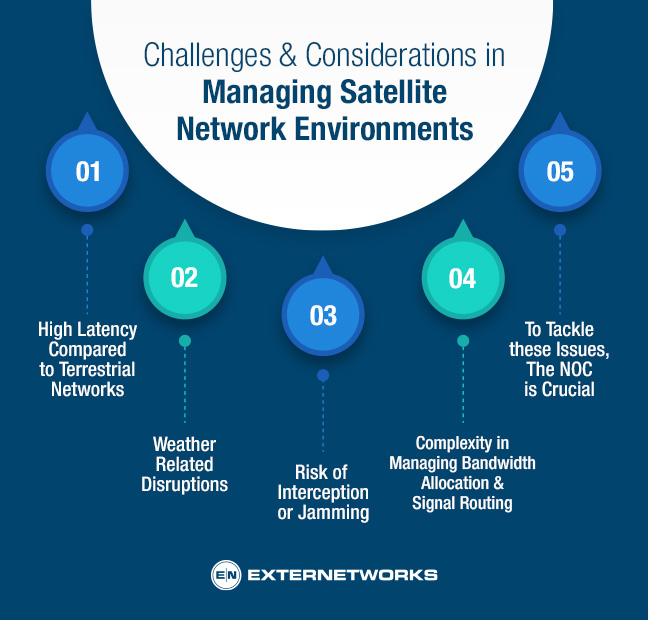
High Latency Compared to Terrestrial Networks
One significant challenge is the high latency associated with satellite communications. Latency refers to the time delay in data transmission, and it becomes more pronounced in satellite networks due to the vast distances signals must travel between the Earth and orbiting satellites. Unlike terrestrial networks, where latency is minimal due to shorter distances, satellite networks experience unavoidable delays. This can impact real-time applications like video conferencing and VoIP, which demand minimal lag to operate efficiently. Developing strategies to manage and mitigate this latency is crucial for maintaining effective communication.
Weather-Related Disruptions
Weather conditions, particularly rain, can significantly impact satellite transmissions, a phenomenon known as “rain fade.” This disruption occurs because rain absorbs or scatters the radio signals that satellites use to communicate. As a result, during heavy rainfalls, signal quality may degrade, leading to poor performance or complete outages. While other weather-related issues snow or cloud cover can also affect signal quality, rain is the most common adversary. Therefore, predicting weather patterns and incorporating weather-resistant technology can be vital in maintaining system reliability.
Security Concerns – Risk of Interception or Jamming
Moreover, security poses a noteworthy concern in satellite networks. Satellites broadcast signals over broad areas, making them susceptible to potential interception or jamming by malicious entities. Cybersecurity threats, such as unauthorized access or signal manipulation, can compromise the integrity of the data being transmitted. Implementing robust encryption protocols and continuously updating security measures are essential to safeguarding sensitive data and ensuring secure communication channels.
Complexity in Managing Bandwidth Allocation and Signal Routing
The complexity of managing bandwidth allocation, signal routing, and interoperability with ground stations adds another layer of challenge. Satellite networks demand meticulous management to optimize bandwidth usage and ensure efficient signal routing across multiple nodes. Moreover, interoperability with various ground stations, each potentially using different technologies, requires precise calibration and coordination. Balancing these elements to maximize performance while minimizing lag and data loss is a persistent challenge.
Role of the NOC in Mitigating These Challenges
To address these challenges, the Network Operations Center (NOC) plays an indispensable role. NOCs utilize redundancy protocols and failover systems to ensure continuous network availability, even if primary systems encounter problems. In addition, 24/7 monitoring allows for the immediate detection and resolution of issues, while preventive maintenance ensures systems are always in optimal condition. Combining advanced analytics with real-time monitoring capabilities enables NOCs to minimize disruptions, optimize bandwidth usage, and enhance overall network performance. Through these measures, NOCs effectively mitigate the inherent challenges of managing satellite network environments, ensuring reliable and secure communications.
The Future of Satellite Network Management in NOCs
The landscape of satellite network management within Network Operations Centers (NOCs) is on the cusp of a transformative era, driven by various technological advancements. These changes promise to enhance the efficiency, reliability, and reach of satellite communications, thus broadening their applications and influence across different sectors.
Rise of LEO Satellite Constellations
Firstly, the advent of Low Earth Orbit (LEO) satellite constellations, such as those deployed by Starlink and OneWeb, is revolutionizing satellite network management. Unlike traditional geostationary satellites, LEO satellites operate much closer to the Earth, resulting in lower latency and improved bandwidth for end-users. NOCs must adapt to this shift by incorporating new tracking mechanisms and algorithms to manage the increased number of satellites efficiently. Moreover, as these constellations expand, they facilitate the coverage of previously underserved or remote areas, thereby extending global connectivity.
AI-enhanced NOC Operations
Additionally, artificial intelligence (AI) is becoming a cornerstone in optimizing NOC operations. AI-enhanced systems provide faster anomaly detection, enabling proactive maintenance and reducing downtimes. Advanced AI algorithms can predict and counteract potential network disruptions, thus ensuring seamless service delivery. Furthermore, AI assists in more efficient bandwidth management through real-time data analysis, allowing NOCs to dynamically allocate resources based on demand and usage patterns.
Integration with 5G and Edge Computing
Coupled with these developments is the integration of satellite networks with 5G technology and edge computing. This synergy is crucial for supporting next-generation communication infrastructures that demand ultra-low latency and high-speed data transfer. Satellites, particularly those in LEO, can play a pivotal role in backhauling data for 5G networks, especially in rural and remote areas. Meanwhile, edge computing brings processing power closer to the end-user, reducing the burden on core networks and enhancing service efficiency.
Greater Dependency on Satellite-NOC Synergy
Lastly, as global connectivity needs continue to surge, there is a growing dependency on the synergy between satellite networks and NOCs. This relationship is vital in maintaining seamless operations across various sectors, from disaster management and remote healthcare to global communications and beyond. Satellites provide the necessary infrastructure to deliver consistent connectivity worldwide, while NOCs ensure that these systems work optimally, managing traffic and ensuring robust security measures.
In essence, the future of satellite network management within NOCs is geared towards greater efficiency, broader coverage, and enhanced service quality. The integration of LEO satellites, AI technologies, 5G networks, and edge computing signifies not just an evolution in technology but also a leap forward in achieving ubiquitous global connectivity. As these advancements unfold, NOCs will continue to be at the forefront, navigating complex networks and ensuring that the world stays connected, regardless of geographical boundaries.
Conclusion
The Essential Role of Satellite Networks and NOCs
To begin with, satellite networks have become a crucial backbone for various sectors, facilitating not only voice and video communication but also serving as pivotal tools for Intelligence, Surveillance, and Reconnaissance (ISR) operations. Their ability to deliver real-time data from across the globe has proven invaluable, particularly in the defense sector where timely and accurate information can make all the difference. These networks ensure that individuals and organizations remain connected, informed, and prepared, no matter where they are located.
Furthermore, the indispensable role of the Network Operations Center (NOC) cannot be overstated in this context. A NOC guarantees the seamless and secure operation of satellite networks by monitoring performance and immediately responding to any anomalies. By ensuring continuous surveillance and expert management, NOCs play a vital role in maintaining the integrity and reliability of communication, which is essential for operational success.
Thus, for organizations with remote or mission-critical requirements, the integration of satellite-backed NOC services should be a strategic consideration. By leveraging these services, businesses can achieve unparalleled connectivity and operational efficiency, extending their capabilities far beyond traditional terrestrial networks. Ultimately, as the world continues to evolve, adapting cutting-edge satellite technologies supported by robust NOC infrastructure will be crucial for sustained success and security in various fields.
Looking to enhance your global communication infrastructure?
Talk to our NOC experts to explore satellite-backed solutions tailored for your mission-critical operations.
Contact Us