Understanding Networking Environments in a NOC
A Network Operations Center (NOC) serves as a centralized location where IT professionals monitor, manage, and maintain an organization’s network infrastructure. It acts as the frontline defense, ensuring that all systems run smoothly, identifying and resolving issues swiftly to prevent downtime and ensure optimal performance. The significance of a NOC extends beyond mere monitoring; it is the hub where data flow is orchestrated, potential threats are mitigated, and network reliability is maintained.

The networking environment within an NOC is critical because it supports a myriad of functions that are crucial for the seamless operation of the IT infrastructure. Let’s delve into several key components that illustrate the importance of NOC networking environments.
Importance of Networking Environments within NOCs
In essence, the networking environment in a NOC is the backbone that supports the entire spectrum of network operations. It is designed to facilitate real-time communication between devices, manage traffic flow, and maintain data integrity. This environment enables the NOC to effectively monitor infrastructure by continuously assessing the health and performance of networks. Alerts are generated for any issues, allowing for immediate attention and resolution before they escalate.
Further, networking environments play a pivotal role in cybersecurity by providing the necessary tools and platforms for continuous monitoring of potential threats. A robust networking setup allows for the deployment of firewalls, intrusion detection systems, and other security protocols, which are critical for protecting sensitive data from cyber threats.
How Networking Environments Support Infrastructure Monitoring, Traffic Flow, and Cybersecurity
Infrastructure is a vital function of the NOC, and the networking environment is designed to support this through various technologies and protocols. By utilizing advanced monitoring tools, NOCs can track network performance metrics such as latency, packet loss, and bandwidth usage. This capability allows IT teams to ensure that network traffic is flowing efficiently and that potential bottlenecks are addressed proactively.
Moreover, effective traffic flow management is achieved through smart networking solutions that prioritize critical data transfers and optimize resource allocation. This ensures that essential services remain operational even during peak traffic periods. The networking environment also supports cybersecurity efforts by allowing the implementation of robust security measures. Through constant surveillance and proactive threat detection, it minimizes the risk of data breaches and ensures continuity.
Overview of the Types of Computing Infrastructure in NOCs
The computing infrastructure within a NOC is diverse and can range from basic setups to highly complex architectures. This diversity is crucial for meeting the varying demands of an organization’s network size and complexity. NOCs might leverage cloud-based solutions, on-premises servers, or a hybrid of both, depending on the specific requirements.
From a Single Computer to Millions of Servers
The scale of a NOC’s computing infrastructure can vary greatly, highlighting the flexible nature of these environments. Some NOCs might operate with just a few computers dedicated to monitoring a small network. In contrast, others might oversee vast networks, necessitating millions of servers worldwide. This variability is key to adapting the NOC’s capabilities to align with organizational goals and resources, ensuring an optimal balance between performance, cost, and efficiency.
Ultimately, understanding the networking environment within a NOC is crucial for recognizing its role in maintaining network reliability, efficiency, and security. From infrastructure monitoring to traffic management and cybersecurity, each aspect is interwoven, supported by a robust and scalable computing infrastructure tailored to an organization’s needs.
Component 1: The Role of the Computer in a NOC
In the intricate ecosystem of a Network Operations Center (NOC), every component plays a critical part in maintaining seamless operations, and at the heart of this system is the computer. As the core node, it orchestrates a myriad of vital tasks that ensure the NOC’s efficiency and effectiveness.
Single Computers as Nodes
Even a single computer can make a significant impact within the NOC environment. These devices can function as network monitors, gateways, or control points, crucially supporting the broader network infrastructure. Acting as nodes, computers contribute to the overall monitoring efforts by tracking network performance, detecting anomalies, and ensuring data integrity. By allocating specific network monitoring duties to individual computers, NOCs can distribute workload efficiently, allowing for detailed oversight of network traffic and performance metrics.
Computing Tasks in a NOC
The multitude of computing tasks performed by computers in an NOC underscores their indispensable role. Primarily, these computers run sophisticated monitoring software, such as Nagios or SolarWinds. These applications continuously gather data across the network, alerting technicians to any irregularities or potential issues that may arise.
Moreover, logging and alert systems are integral computing functions. Computers systematically log network activities, providing a detailed record that can be invaluable for troubleshooting and auditing purposes. Alerts are generated when network parameters deviate from predefined norms, enabling swift responses to issues before they escalate.
Furthermore, computers in a NOC support technician access terminals. Technicians rely on these machines to access network data, execute diagnostic tests, and manage network configurations. Efficiently managing these tasks is critical to maintaining network health and supporting the organization’s operational objectives.
Example Scenario: A Small Enterprise NOC
Consider a small enterprise NOC utilizing a handful of high-powered workstations to oversee its operations. These workstations can monitor cloud-based assets, ensuring that the organization’s digital resources are protected and performant. Through sophisticated software, the NOC staff is alerted to any potential threats or inefficiencies, enabling them to act swiftly. This scenario highlights how even a limited number of computers, strategically employed, can provide comprehensive oversight of complex network infrastructures.
Importance of Performance and Reliability
The necessity for performance and reliability in computing cannot be overstated within a NOC. Given the critical nature of network operations, computers must handle vast amounts of data, process it quickly, and do so with minimal downtime. Reliability ensures continuous network monitoring and rapid problem resolution, which are essential to maintaining organizational productivity and security. Performance optimization ensures that each task is executed swiftly, supporting real-time decision-making, a crucial capability for any successful NOC operation.
Ultimately, while sometimes underestimated, computers are the lifeline of any NOC. Their ability to monitor, manage, and sustain network integrity is paramount in supporting an organization’s technical infrastructure and overall business continuity.
Component 2: Scaling Up – From One to Millions of Servers
In the dynamic world of Network Operations Centers (NOCs), scalability is a crucial factor. As businesses grow and digital infrastructure becomes more intricate, NOCs must evolve from managing a handful of servers to potentially overseeing millions. The design, architecture, and practices within these NOCs differ significantly based on their scale. Below, we outline the characteristics and challenges associated with small-scale, medium-scale, and large-scale networking environments.
Small-Scale Environments: Regional or Local Focus
Small-scale NOCs typically manage dozens of servers, primarily supporting regional or local infrastructure. These environments are often dedicated to specific locales, allowing for focused and efficient monitoring of regional networks. The infrastructure is generally less complex, making it easier to handle network traffic and perform troubleshooting tasks swiftly.
Medium-Scale Environments: Managing Global Enterprises
As enterprises expand, their NOCs might grow to manage hundreds or even thousands of servers globally. These environments support a wider array of enterprise assets, usually distributed across multiple geographic locations. The complexity increases as connectivity and data consistency across regions must be maintained. Effective network segmentation helps manage traffic efficiently and ensures that security protocols can be enacted promptly across the enterprise.
Large-Scale Environments: Hyperscale NOCs
At the pinnacle of scalability are hyperscale NOCs, such as those operated by tech giants like Google, Amazon, and Microsoft. These massive environments manage millions of servers and are capable of supporting global operations at an unprecedented scale.
Challenges of Managing at Scale
Network Segmentation: As NOCs expand, managing network segments becomes crucial. This involves organizing and isolating parts of the network to enhance performance and security. Proper segmentation allows for targeted monitoring and stricter security controls.
High-volume Data Routing: The sheer volume of data flowing through large NOCs necessitates robust routing practices. Efficient data pathways must be established to ensure quick, reliable access to resources without bottlenecks.
Load Balancing and Failover Architecture: Load balancing is essential to distribute traffic efficiently across servers, ensuring no single server is overwhelmed. Simultaneously, comprehensive failover architectures guarantee continuity in case of server failures, maintaining uninterrupted service.
Use of Automation and AI:Automation and AI technologies play a pivotal role in managing large environments. They aid in real-time network monitoring, predictive maintenance, and automated response to incidents, dramatically reducing the burden of manual oversight.
Redundancy and Disaster Recovery Practices: Large NOCs incorporate extensive redundancy measures and disaster recovery plans. Redundant systems and backup procedures ensure data integrity and availability even in catastrophic scenarios.
Examples of Hyperscale NOC Practices
Google’s NOC: Google operates a colossal NOC that manages over 2 million servers worldwide. The complexity necessitates the use of advanced AI and machine learning tools to streamline operations and enhance network reliability and efficiency.
Microsoft Azure’s NOC: Supporting more than 200 data centers globally, Microsoft Azure’s NOC architecture leverages state-of-the-art technologies to ensure seamless cloud service delivery. The NOC’s ability to coordinate across vast distances and various climates is a testament to its robust design and strategic foresight.
The ability to scale NOC operations significantly impacts their effectiveness and the quality of service delivery. With the right blend of technology and design strategy, NOCs can successfully transition from a modest setup to handling millions of servers, continuously supporting and enhancing business operations worldwide.
Use Case Examples Based on Environment Size
In the landscape of Network Operations Centers (NOCs), the size and complexity of an organization significantly influence the design and functionality of its networking environment. Here are some use case examples based on different environment sizes:
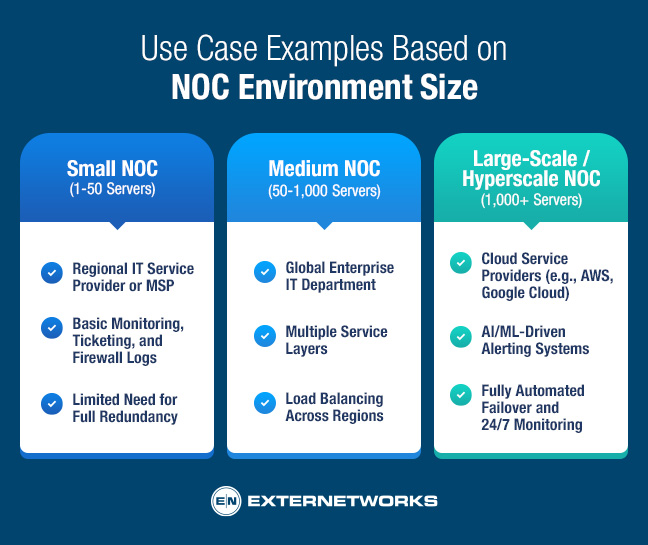
Small NOC (1-50 Servers)
For a small NOC, typical within regional IT service providers or Managed Service Providers (MSPs), the focus is on fundamental yet effective operational processes.
Regional IT Service Provider or MSP: These small NOCs primarily serve local or regional clients, ensuring that their networks are running efficiently and issues are swiftly addressed.
Basic Monitoring, Ticketing, and Firewall Logs: The operations tend to be straightforward, utilizing rudimentary monitoring tools that track network health and performance. A simple ticketing system helps manage incidents and service requests, while firewall logs are periodically reviewed to ensure network security.
Limited Need for Full Redundancy: Due to their smaller scale, these environments often lack the complex redundancy systems typically found in more extensive setups. They rely instead on essential failover mechanisms to handle network outages, but may not cover all single points of failure.
Medium NOC (50-1,000 Servers)
Medium NOCs, often found within global enterprise IT departments, require a more robust structure to manage larger networks that support extensive business operations.
Global Enterprise IT Department: These NOCs support large, possibly multinational organizations, necessitating a more complex oversight to ensure seamless connectivity across various offices.
Multiple Service Layers: Helpdesk, Tier 1-3 Support, Proactive Alerts: They incorporate structured support hierarchies, where helpdesk services manage initial client contact, while Tier 1 to Tier 3 support handles increasingly complex issues. Proactive alert systems are crucial in identifying and resolving potential issues before they affect network services.
Load Balancing Across Regions: To maintain optimal performance and reliability, medium NOCs often employ load balancing strategies. This technology distributes network traffic across multiple servers or data centers, ensuring that no single point in the network becomes overwhelmed, thereby maintaining service integrity across regions.
Large-Scale / Hyperscale NOC (1,000+ Servers)
Large-scale or hyperscale NOCs, found within cloud service providers such as AWS and Google Cloud, operate on a significantly different level of complexity and sophistication.
Cloud Service Providers (e.g., AWS, Google Cloud): These NOCs manage vast amounts of data and facilitate services for millions of users globally. Their operations require a high degree of precision and reliability to maintain user trust and satisfaction.
AI/ML-Driven Alerting Systems: To manage the immense complexity of their networks, large-scale NOCs integrate AI and machine learning technologies. These tools assist in analyzing massive data sets for trend recognition and predictive maintenance, enabling quicker resolution times and the ability to anticipate potential issues.
Fully Automated Failover and 24/7 Monitoring: Redundancy and automation are pillars of hyperscale NOCs. They deploy sophisticated failover systems that automatically reroute traffic in the event of server failures, ensuring continuous service availability. Around-the-clock monitoring ensures any anomalies are immediately detected and addressed without manual intervention.
Ultimately, the size and scope of a NOC’s operations inform its technological strategies and management structures. Understanding these nuances enables the development of effective solutions that enhance network integrity, performance, and resilience across various scales.
Key Technologies Used in NOC Networking Environments
A Network Operations Center (NOC) is the heartbeat of any organization’s IT infrastructure, vigilantly monitoring networks and ensuring seamless connectivity. To effectively manage and troubleshoot vast and complex networks, NOCs rely on a suite of advanced technologies. Here, we delve into some of the key technologies utilized in NOC networking environments.
Network Management Systems (NMS)
Network Management Systems are essential tools that provide comprehensive oversight of network performance and health. NMS platforms are designed to streamline the processes of monitoring, diagnosing, and resolving network issues. By offering real-time insights into network traffic, device status, and application performance, NMS helps prevent potential outages and enhances operational efficiency. They automate many routine tasks, reduce downtime, and optimize network usage, thus proving critical for maintaining high standards of service delivery.
SDN (Software-Defined Networking)
Software-Defined Networking (SDN) represents a paradigm shift in how networks are designed and operated. By decoupling the control plane from the data plane, SDN enables more flexible and programmable network management. In a NOC setting, SDN provides the agility to quickly adjust network configurations and policies in response to changing demands. This can significantly improve network responsiveness, streamline operations, and optimize resource utilization. SDN’s ability to centralize control over the entire network infrastructure leads to enhanced coordination and consistent policy enforcement across the network environment.
AI-Based Anomaly Detection Tools
With the increasing complexity of modern networks, proactive monitoring becomes indispensable. AI-based anomaly detection tools offer NOCs the ability to predict and identify irregular network patterns that could signify security threats or performance issues. These tools leverage machine learning algorithms to analyze vast sets of network data and identify deviations from normal behavior in real-time. By automatically flagging and even mitigating anomalies, AI-based solutions empower network operators to respond swiftly and effectively to potential incidents, thereby enhancing the overall security posture.
VPNs and Secure Access Gateways
Virtual Private Networks (VPNs) and secure access gateways are crucial for ensuring secure communications across networks. In NOC environments, VPNs create encrypted tunnels for data transmission, protecting sensitive information from potential interception. Secure access gateways enhance this security by providing controlled network access, ensuring that only authorized personnel can reach critical systems. This dual layer of protection is vital for safeguarding against cyber threats and ensuring compliance with industry regulations, particularly for organizations that handle sensitive or proprietary information.
Cloud Monitoring Platforms
As organizations increasingly migrate services and infrastructure to the cloud, robust cloud monitoring platforms become indispensable for NOCs. These platforms provide visibility into both public and private cloud environments, allowing network operators to monitor application performance, usage metrics, and potential security vulnerabilities. By integrating cloud monitoring with existing network oversight tools, NOCs can ensure that cloud-based resources perform optimally and securely. This integration is crucial in maintaining service continuity and promptly addressing any incidents that may arise in the rapidly evolving cloud ecosystem.
Each of these technologies plays a pivotal role in the effective management of networking environments within a NOC. By leveraging such cutting-edge tools, organizations can ensure optimal network performance, security, and reliability, thereby supporting their business objectives and customer satisfaction.
Best Practices for Managing NOC Networking Environments
In the dynamic world of Network Operations Centers (NOCs), effective management of networking environments is crucial for ensuring uninterrupted service and rapid issue resolution. Adhering to best practices not only enhances the operational efficiency of a NOC but also bolsters its resilience against unforeseen challenges. Below are some of the key practices essential for an optimized NOC networking environment:
Standardized Protocols (SNMP, NetFlow)
Implementing standardized protocols such as Simple Network Management Protocol (SNMP) and NetFlow is fundamental for effective network monitoring and maintenance.
SNMP: SNMP allows network administrators to gather and manage network performance data from various devices using a common protocol. Its ability to troubleshoot network problems, audit network usage, and track network performance makes it indispensable.
NetFlow: NetFlow, developed by Cisco, provides valuable insights into network traffic patterns and usage. It helps in understanding bandwidth consumption, highlighting potential congestion points, and identifying unusual patterns that might suggest security threats.
Together, these protocols facilitate better monitoring and analytics, allowing NOCs to maintain a high-performance network while quickly addressing any anomalies.
Use of Dashboards and Real-Time Metrics
Dashboards are powerful tools that provide NOCs with a centralized view of network activities, facilitating quick assessments and decision-making.
Real-time Metrics: By monitoring real-time metrics such as latency, packet loss, and throughput, NOC operators can swiftly identify and resolve performance issues before they impact end-users.
Visual Representation: The visual representation of data through dashboards enables a more intuitive understanding of complex data sets, ensuring quicker response times and informed troubleshooting.
Dashboards equip NOCs with the agility needed to manage complex networking environments efficiently, thus supporting continuous network health.
Scheduled Maintenance Windows
Regularly scheduling maintenance windows is a preventive measure that helps minimize downtime and protect network integrity.
Routine Checks and Updates: Scheduled maintenance allows for routine hardware checks, software updates, and the application of necessary security patches, keeping the network infrastructure robust and secure.
Minimizing Disruption: By conducting maintenance during off-peak hours, NOCs can minimize disruption to daily operations and enhance overall service reliability.
Proactively maintaining the network not only prevents potential issues but also extends the lifecycle of network components.
Network Segmentation for Better Control
Network segmentation is a strategic approach to improve security and manageability within a NOC’s networking environment.
Enhanced Security: By dividing the network into segments, each with its own security protocols, NOCs can limit unauthorized access and contain potential breaches within isolated sections.
Improved Performance: Smaller, segmented networks are easier to manage and can reduce congestion, thereby enhancing system performance.
Segmentation allows for more granular control over network traffic, simplifying oversight and troubleshooting operations.
Regular Staff Training and Certification
Keeping NOC staff well-trained and up-to-date with the latest certifications is vital for maintaining a proficient team capable of tackling evolving network challenges.
Skill Development: Regular training programs ensure staff are familiar with the latest technologies, tools, and methodologies essential for effective network management.
Certifications: Encouraging certifications like Cisco’s CCNA or CompTIA Network+ validate expertise and can foster a deeper understanding of network operations.
A knowledgeable and certified team can significantly reduce response times, improve incident resolution, and ensure the overall success of NOC operations.
By adopting these best practices, NOCs can create a resilient networking environment capable of withstanding the demands of modern-day digital networks. In turn, this leads to enhanced reliability, security, and performance, ultimately delivering consistent satisfaction to end-users.
Conclusion
Designing a Scalable, Secure NOC Networking Environment
In crafting a Network Operations Center (NOC) that is both scalable and secure, we must revisit the core principles that ensure its efficiency and efficacy. A well-designed NOC networking environment is crucial not just for immediate operational success but also for sustaining long-term growth and adaptability in the rapidly evolving tech landscape.
Flexibility is Key
At the heart of a scalable NOC is its flexibility. Whether you are managing a single computer or overseeing the performance of millions of servers globally, the infrastructure must accommodate dynamic scaling. This means having the capability to expand resources seamlessly as demand grows, without disrupting ongoing operations. Flexibility ensures that your NOC can adapt to new technologies and methodologies, integrating seamlessly with a wide array of devices and platforms. This adaptability becomes a cornerstone for handling both current and future challenges effectively.
The Pillars: Proactive Monitoring, Redundancy, and Scalability
An outstanding NOC environment relies heavily on some essential pillars: proactive monitoring, redundancy, and scalability.
Proactive Monitoring: Employing robust monitoring tools is vital for spotting potential issues before they escalate. This proactive approach not only minimizes downtime but also enhances the reliability of your operational services. By forecasting potential failures and addressing them preemptively, your NOC can maintain consistent performance.
Redundancy: Implementing redundant systems is crucial for maintaining uninterrupted service. Redundancy acts as a safety net against system failures. By duplicating critical components and ensuring alternative paths for data transmission, your NOC stays resilient against unexpected disruptions or hardware failures.
Scalability: A scalable NOC is built to grow with the organization. Designing a networking environment that can easily expand or contract as needed ensures that infrastructural investments align effectively with business growth and objectives. Scalable design allows for cost-effective management of resources, avoiding both underutilization and overextension.
Aligning Technology and Team Capabilities to Business Needs
Finally, the human element is just as crucial as the technological framework. Aligning your team’s capabilities with the technological tools at your disposal enhances overall effectiveness. Continuous training and development ensure that NOC personnel are well-versed in using advanced technologies to meet and anticipate business needs. This synergy between human expertise and cutting-edge technology not only empowers your NOC to exceed performance expectations but also allows it to quickly pivot and respond to emerging business requirements.
Ultimately, designing a scalable, secure NOC networking environment demands a harmonious blend of adaptable infrastructures, robust monitoring systems, and a skilled team. By adhering to these principles, organizations can ensure that their NOCs are prepared to meet current demands while remaining poised for future challenges. As technology evolves, so too should the strategies and structures that underpin your NOC, ensuring seamless operational effectiveness that aligns with overarching business goals.
Ready to Scale Your NOC Environment with Expert Support?
Contact ExterNetworks today to discuss tailored solutions for your business, whether you’re just starting out or managing global infrastructure.
Contact Us