 Managed IT Services
Staff Augmentation vs. Managed Services: The Definitive Guide to Strategic IT Resourcing



Editor’s Note: The article compares staff augmentation and managed services as IT resourcing strategies. Staff augmentation is ideal for short-term projects requiring specific skills, offering flexibility and direct... Read More
Downtime Draining Your Business? Fix It Before It Costs More
Missed alerts turn into outages, outages turn into lost revenue. ExterNetworks Inc. delivers 24/7 NOC & Help Desk support to keep everything running smoothly.
Get 24/7 IT Support NowIn today’s fast-paced digital economy, the efficiency and resilience of a company’s IT operations are directly tied to its success. As technology evolves, so do the demands on IT departments, creating a persistent challenge: how to access the right skills at the right time to support business growth. The global IT Staff Augmentation and Managed Services market was valued at over $245 billion in 2023, a testament to the critical role these outsourcing models play. Choosing the right IT resourcing strategy is no longer a simple operational choice; it’s a strategic decision that impacts agility, security, and the bottom line.
The Evolving Landscape of IT Demands and Talent Gaps
Modern businesses face a dual challenge: increasingly complex IT infrastructure and a widening talent gap. Critical initiatives like cloud migration, database administration, and implementing robust security protocols require specialized expertise that is often difficult to find and expensive to retain. This skills shortage is not just an inconvenience; it has real-world consequences. A 2024 IDC report found that for 66% of North American IT leaders, a lack of necessary skills has led to missed revenue goals and a decline in customer satisfaction. This gap forces companies to look beyond traditional hiring for their IT staffing needs.
Why Strategic IT Resourcing is Critical for Business Growth
How an organization sources its IT talent directly influences its ability to innovate and scale. A reactive approach, hiring only when a crisis occurs, leads to project delays and operational inefficiencies. A proactive IT outsourcing strategy, on the other hand, allows a business to flexibly manage project demands, control costs with greater predictability, and focus its internal staff on core business objectives. Strategic resourcing ensures that as the business grows, its IT capabilities can scale seamlessly to meet new challenges.
Demystifying Staff Augmentation and Managed Services as Core Outsourcing Models
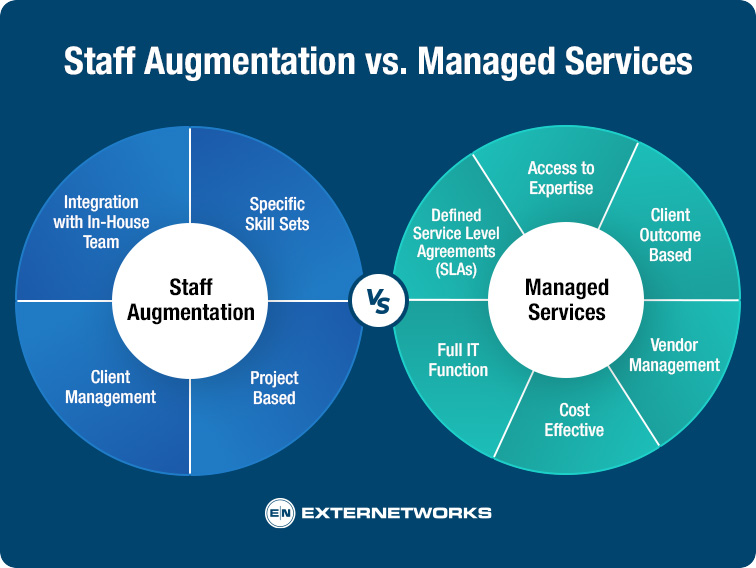
Two dominant IT outsourcing models have emerged to address these challenges: staff augmentation and managed services. While both involve leveraging a third party for IT talent, they operate on fundamentally different principles. Staff augmentation is about adding skilled external professionals to your existing team to fill specific gaps, while you retain full project management control. Managed services involve outsourcing entire IT functions or operations to a provider who takes full responsibility for delivering defined outcomes.
What This Definitive Guide Will Cover: A Roadmap for Informed Decisions
This guide will provide a comprehensive comparison of staff augmentation and managed services. We will delve into the core principles, benefits, and ideal use cases for each model. By analyzing key parameters side-by-side and offering a strategic decision-making framework, this article will equip you with the knowledge to select the IT resourcing model that best aligns with your unique business needs and long-term goals.
Understanding Staff Augmentation: Expanding Your Internal Capabilities
Staff augmentation is a flexible IT staffing solution designed to supplement your existing team with specialized skills. It allows businesses to hire tech talent globally and integrate them directly into their internal processes.
What is Staff Augmentation? Definition and Core Principles
Staff augmentation is an outsourcing strategy where a business hires external professionals on a temporary basis to augment the capacity of its in-house team. These professionals are technically employed by a third-party vendor but work under the direct management and supervision of the client company. The core principle is to surgically fill skill gaps without the overhead and long-term commitment of a full-time hire. The market reflects this value, with the IT Staff Augmentation Service Market projected to reach over $857 billion by 2031.
The Philosophy: Integrating External Professionals into Your Team
The philosophy behind staff augmentation is seamless integration. The goal is for the external professionals to function as if they were part of your internal staff. They adopt your company’s workflows, communication channels, and project management methodologies. This model is built on maintaining control; your managers direct the tasks, set priorities, and are ultimately responsible for the project’s success.
Key Benefits of Staff Augmentation
- Access to a Global Talent Pool: Quickly tap into specialized skills that may not be available locally. Research indicates that 74% of companies plan to use staff augmentation in 2024 to bridge these gaps.
- Enhanced Flexibility and Scalability: Easily scale your team up or down in response to fluctuating project demands, a key driver for business growth.
- Accelerated Time-to-Market: By bringing in pre-vetted experts, businesses can significantly reduce project start-up times. Organizations report an average reduction of 40% in project start-up time when using this model.
- Maintained Managerial Control: Your team retains direct oversight of the project and the augmented staff, ensuring alignment with your vision.
- Cost-Effectiveness: Avoid the long-term costs associated with hiring full-time employees, such as benefits, training, and administrative overhead.
Common Models of Staff Augmentation
Staff augmentation can be tailored to specific needs:
- Short-Term/Project-Based: Hiring experts for the duration of a single project.
- Long-Term: Integrating specialists for extended periods to support ongoing needs without adding permanent headcount.
- Specialized Skill Augmentation: Bringing in professionals with niche expertise (e.g., cybersecurity, specific programming languages) that your team lacks.
Ideal Scenarios for Choosing Staff Augmentation
This model excels when you need to:
- Quickly fill a critical skill gap for a specific project.
- Temporarily increase team capacity to meet an aggressive deadline.
- Access specialized knowledge without the long-term commitment of hiring.
- Maintain complete control over project management and execution.
Potential Challenges and Considerations
While powerful, staff augmentation requires careful management. Integrating external members into your company culture can be challenging. You are also responsible for their day-to-day management and the quality of their work. Furthermore, over-reliance on temporary staff for core functions can create knowledge silos that disappear when their contracts end.
Understanding Managed Services: Outsourcing Comprehensive IT Operations
Managed services represent a more holistic approach to IT outsourcing, where a business partners with a provider to take full responsibility for specific IT functions.
What are Managed Services? Definition and Core Principles
Managed services is an outsourcing model where a business delegates the responsibility for maintaining and anticipating the needs of a range of IT operations to a third-party managed service provider (MSP). The core principle is a shift from tactical support to strategic partnership. The MSP is responsible for delivering agreed-upon outcomes, governed by a Service Level Agreement (SLA), rather than simply providing personnel. The robust growth of this model is clear, with the global managed services market expected to exceed $731 billion by 2030.
The Philosophy: Strategic Partnership with a Third-Party Provider
The philosophy of managed services is built on partnership and accountability. You are not just hiring hands; you are engaging a partner to proactively manage your IT infrastructure and support your business goals. This allows your internal staff to offload complex, time-consuming tasks and focus on strategic initiatives that drive revenue. The MSP takes ownership of the function, from day-to-day IT support to long-term strategy and security.
Key Benefits of Managed Services
- Cost Predictability: Managed services typically operate on a fixed monthly fee, making IT expenses predictable and easier to budget.
- Proactive IT Support and Maintenance: MSPs focus on preventing problems before they occur, minimizing downtime and ensuring the health of your IT infrastructure.
- Enhanced Security and Compliance: Gain access to expert teams that manage security protocols, access control, and data backup, significantly reducing the risk of security breaches. Research shows that managed services can bolster cybersecurity measures by 40%.
- Access to Expertise and Advanced Tools: MSPs invest heavily in technology and training, giving you access to enterprise-grade tools and a broad team of specialists.
- Increased Operational Efficiency: By outsourcing IT management, businesses can see significant gains. Studies show that managed services can reduce IT costs by 25%-45% and increase operational efficiency by 45%-65%.
Core Types of Managed Services Offerings
MSPs offer a wide range of services, including:
- Managed IT Infrastructure: Covering servers, networks, and data centers.
- Managed Security: Providing comprehensive cybersecurity, from threat monitoring to backup recovery.
- Managed Cloud Services: Assisting with and managing cloud migration and ongoing cloud operations.
- Managed Communications: Handling VoIP, video conferencing, and other communication platforms.
- End-User Support: Providing help desk and technical IT support for your employees.
The Critical Role of Service Level Agreements (SLAs) in Managed Services
The Service Level Agreement is the cornerstone of any managed services relationship. This legally binding document defines the specific services to be provided, the performance metrics that will be tracked (e.g., uptime, response time), and the penalties for failing to meet those standards. A well-defined SLA ensures transparency, sets clear expectations, and holds the MSP accountable for delivering results.
Ideal Scenarios for Choosing Managed Services
This model is the ideal choice when your business:
- Lacks in-house IT expertise or wants to free up its internal team for strategic work.
- Requires predictable IT budgeting and cost control.
- Needs comprehensive, 24/7 IT support and proactive security management.
- Wants to offload the responsibility and risk associated with managing complex IT operations.
The Definitive Comparison: Staff Augmentation vs. Managed Services
While both are forms of IT outsourcing, the choice between them hinges on your specific needs for control, scope, and responsibility.
Head-to-Head Analysis Across Key Parameters
| Parameter | Staff Augmentation | Managed Services |
|---|---|---|
| Control & Management | Client retains full control over project management and daily tasks. | Provider assumes control and management of the outsourced function. |
| Responsibility | Client is responsible for project outcomes and deliverables. | The provider is responsible for outcomes, governed by an SLA. |
| Scope of Service | Provides skilled individuals to supplement an existing team. | Provides a comprehensive solution for an entire IT function. |
| Cost Structure | Typically based on an hourly or monthly rate per resource. | Usually a fixed, recurring fee for a defined set of services. |
| Integration | External professionals integrate directly into the client’s team. | Operates as a separate entity, delivering services as an external partner. |
| Strategic Focus | Tactical solution for filling immediate skill gaps or capacity needs. | Strategic partnership for long-term IT operational management. |
Strategic Decision-Making Framework: Choosing the Right Model for Your Business Needs
Selecting the correct outsourcing model requires a thorough evaluation of your organization’s specific context and strategic objectives.
Assessing Your Organization’s Unique Business Needs and Goals
Before choosing, ask these critical questions:
- Project vs. Function: Are you trying to complete a specific project with a defined end date, or do you need ongoing management of an entire IT function?
- Control vs. Outcome: Is it more important for your team to maintain direct control over day-to-day tasks, or to guarantee a specific outcome (e.g., 99.9% uptime)?
- Skills vs. Service: Do you need specific skills to augment your team, or do you need a complete service that includes people, processes, and technology?
Factors Guiding Your Outsourcing Strategy
Your decision should be guided by several key factors:
- Internal Expertise: If you have strong internal project management but lack specific technical skills, staff augmentation is a strong fit. If your IT team is small or overburdened, managed services can provide needed relief.
- Budgetary Approach: If your budget is flexible and project-based, the variable cost of staff augmentation may work. If you require cost predictability for long-term planning, the fixed-fee model of managed services is superior.
- Risk Tolerance: With staff augmentation, you retain the risk of project failure. Managed services transfer a significant portion of the operational and security risk to the provider.
Common Mistakes to Avoid in IT Outsourcing
- Choosing Based on Cost Alone: The cheapest option is rarely the best. Focus on value and alignment with your goals.
- Poorly Defined Scope: Whether writing a job description for an augmented staff member or an SLA for an MSP, ambiguity leads to failure.
- Lack of Partnership: Viewing your provider as a mere vendor instead of a strategic partner can limit the potential benefits of the engagement.
Beyond Binary Choices: Leveraging Hybrid IT Resourcing Approaches
The most effective outsourcing strategy is often not an “either/or” choice. A hybrid model can offer the best of both worlds, providing a flexible and robust solution tailored to diverse business needs.
The Power of Combining Staff Augmentation and Managed Services
A hybrid approach allows an organization to build a multi-layered IT resourcing strategy. You can leverage a managed service provider for core, predictable functions like IT infrastructure management, data backup, and cybersecurity, ensuring a stable and secure foundation. Simultaneously, you can use staff augmentation to bring in specialized talent for innovative, short-term projects like developing a new application or executing a complex cloud migration.
Practical Examples of Hybrid IT Strategy
- A Growing Tech Company: Might use an MSP to handle all their backend IT operations and employee IT support. At the same time, they could use staff augmentation to bring in three senior developers for six months to accelerate the launch of a new product feature.
- A Financial Institution: Could rely on an MSP for 24/7 security monitoring and compliance management. For a project to upgrade their core banking software, they might augment their internal team with external professionals who have specific experience with that platform. This strategy optimizes for both stability and agility.
Conclusion
Choosing between staff augmentation and managed services is a pivotal decision in forming a modern IT outsourcing strategy. Staff augmentation offers a tactical, flexible solution for businesses that need to quickly acquire specific skills while retaining direct project control. It is ideal for short-term projects and addressing immediate talent gaps. In contrast, managed services provide a strategic, long-term partnership, transferring the responsibility for entire IT functions to an expert provider. This model delivers cost predictability, proactive support, and enhanced security, allowing internal teams to focus on core business innovation.
The right choice is not universal; it depends entirely on your organization’s unique project demands, long-term goals, and appetite for control versus managed risk. For many, the optimal path lies in a hybrid approach, leveraging the stability of managed services for core operations and the agility of staff augmentation for specialized projects. By carefully assessing your business needs against the distinct advantages of each model, you can build a resilient, scalable, and strategic IT resourcing framework that fuels sustainable business growth.
FAQ
What is staff augmentation?
Staff augmentation is a flexible hiring strategy where businesses temporarily add skilled professionals to their existing teams. This model allows companies to quickly fill skill gaps, meet project deadlines, or handle increased workloads without the long-term commitment of permanent hires.
How do managed services differ from staff augmentation?
Managed services involve outsourcing entire IT functions or processes to a third-party provider. Unlike staff augmentation, where external resources work under the company’s management, managed services offer comprehensive management and strategic oversight, transferring responsibility for specific operations to the provider.
What are the primary benefits of staff augmentation?
The key benefits include access to a wide talent pool, flexibility in scaling teams up or down based on project needs, faster recruitment of specialized skills, and cost savings on long-term employee benefits and training.
Why might a company choose managed services over staff augmentation?
Companies may prefer managed services for their ability to provide end-to-end management of IT operations, offering predictable costs, enhanced security, proactive issue resolution, and allowing in-house teams to focus on core business activities rather than IT management.
Can both staff augmentation and managed services be used together?
Yes, a hybrid strategy combining staff augmentation and managed services can be effective. Businesses might use managed services for stable operations and staff augmentation for temporary projects requiring specialized expertise, thus balancing flexibility and stability.
What types of businesses benefit most from staff augmentation?
Fast-growing companies, startups with fluctuating project demands, and organizations needing specialized skills for short-term projects are ideal candidates for staff augmentation, as it provides agility without long-term commitment.
What types of projects are best suited for managed services?
Managed services are well-suited for ongoing IT operations such as network management, cybersecurity monitoring, systems maintenance, and cloud services. They offer strategic value on projects requiring constant monitoring and long-term management.
How does cost differ between staff augmentation and managed services?
Staff augmentation can make project costs more variable since you’re essentially paying for resource hours, whereas managed services usually involve a fixed monthly fee, offering better cost predictability and control over budgeting long-term IT operations.
How does each model handle risk management?
Managed services providers often implement proactive risk management and are fully accountable for the services they offer, including adherence to SLAs and compliance standards. With staff augmentation, the hiring company retains risk management responsibilities, overseeing the work of the augmented staff.
What should a company consider when choosing between these models?
Companies should assess their project-specific needs, duration, required expertise, internal capacity for management, cost implications, and strategic goals. A thorough understanding of these factors will guide the decision of whether to engage in staff augmentation, opt for managed services, or blend both in a hybrid model.
Related on ExterNetworks Right Now!