NOC Services
What Are Managed NOC Services? Your Definitive Guide to 24/7 IT Operations



Downtime Draining Your Business? Fix It Before It Costs More
Missed alerts turn into outages, outages turn into lost revenue. ExterNetworks Inc. delivers 24/7 NOC & Help Desk support to keep everything running smoothly.
Get 24/7 IT Support NowNavigating the Complexities of Modern IT Operations
In an era where digital operations are the lifeblood of business, the demand for constant connectivity and flawless system performance has never been greater. For any organization, downtime isn’t just an inconvenience; it’s a direct threat to revenue, reputation, and customer trust. This relentless pressure to maintain a 24/7/365 operational posture places an immense burden on internal IT teams, who are often stretched thin as they manage an increasingly complex technological landscape.
The Ever-Evolving Landscape of IT Infrastructure
Modern IT infrastructure is a dynamic and sprawling ecosystem. It’s no longer confined to a single data center but extends across hybrid clouds, diverse networks, countless endpoints, and a vast array of software applications. Managing this complexity requires continuous monitoring, specialized skills, and advanced tools—resources that are often in short supply for many businesses focused on their core mission. The challenge is to ensure every component of this intricate system works in perfect harmony, around the clock.
The Critical Need for 24/7 IT Operations and Vigilance
The global, always-on nature of the modern market makes the traditional 9-to-5 IT support model obsolete. A critical system failure at 2 a.m. can have just as much impact as one during peak business hours. This requires a state of perpetual vigilance, in which potential issues are identified and resolved before they affect the end user. Maintaining this level of support in-house is a significant operational and financial challenge, requiring round-the-clock staffing and deep technical expertise.
Unveiling Managed NOC Services: Your Strategic Partner for Operational Excellence
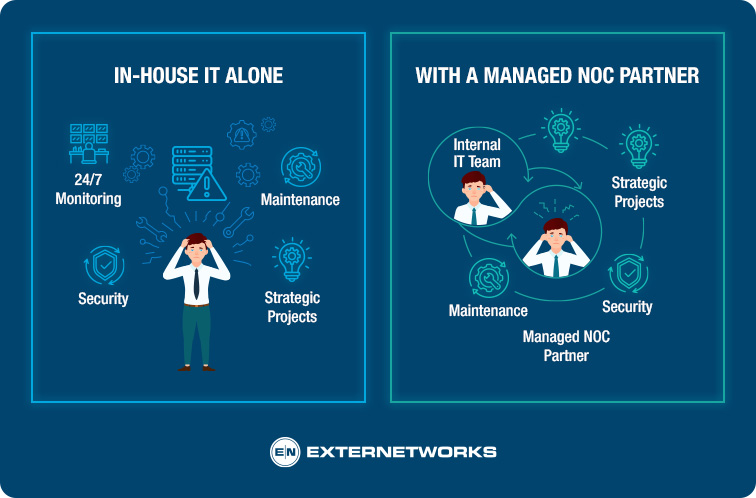
This is where Managed Network Operations Center (NOC) services emerge as a strategic solution. A Managed NOC provider acts as a dedicated, 24/7 extension of your internal IT department, taking on the relentless task of monitoring, managing, and maintaining your IT infrastructure. It’s a partnership designed to deliver operational excellence, enhance network performance, and ensure the stability and reliability your business depends on.
What This Definitive Guide Will Cover
This guide will provide a comprehensive overview of Managed NOC services. We will demystify what a Network Operations Center is, explore the profound difference the “managed” component makes, and detail the core functions and tangible business benefits. By the end, you will understand how these services can transform your IT operations from a reactive cost center into a proactive driver of business value.
Understanding the Foundation: What is a Network Operations Center (NOC)?
Before delving into the “managed” aspect, it’s essential to understand the foundation: the Network Operations Center, or NOC. A NOC is a centralized location where IT technicians and engineers monitor and manage an organization’s IT infrastructure to ensure optimal performance and availability.
Defining the Core: The Role of a Traditional NOC
The primary role of a traditional, in-house NOC is to serve as the first line of defense for IT operations. It is the central command hub responsible for overseeing the health and performance of networks, servers, applications, and other critical infrastructure components. The goal is to maintain operational normalcy and respond to any deviations that could affect service delivery to customers or users.
Essential Functions of a Standard NOC: Monitoring, Detection, and Response
A standard NOC performs three fundamental functions. First, it involves continuous monitoring of the IT environment using specialized software to track performance metrics and system health. Second, it focuses on detection, identifying anomalies, alarms, or error messages that signal a potential problem. Finally, it entails response, in which NOC staff acknowledge alerts, perform initial troubleshooting, and escalate complex issues to higher-level engineering teams in accordance with predefined procedures.
How NOCs Provide Visibility and Ensure Basic Operational Continuity
By centralizing monitoring, a NOC provides a unified view of the entire IT infrastructure. This visibility allows for quicker identification of performance bottlenecks or failures. In essence, a traditional NOC acts as the eyes and ears of the IT department, ensuring that when something breaks, someone is aware and can initiate the recovery process, thereby providing a baseline level of operational continuity.
The Limitations of an In-House NOC in Today’s Demanding Environment
Building and maintaining an effective in-house NOC is a formidable challenge. The costs are substantial, encompassing expensive monitoring software, physical space, and the significant recurring expense of hiring, training, and retaining skilled engineers for 24/7 coverage. Furthermore, internal teams often lack the breadth of expertise needed to manage a diverse technology stack. They may struggle to keep pace with evolving threats and industry best practices, limiting their ability to move beyond reactive firefighting.
Elevating Operations: The “Managed” Difference in Managed NOC Services
The term “managed” signifies a fundamental evolution from the traditional NOC model. A Managed NOC service isn’t just about outsourced monitoring; it’s about outsourcing the ownership, responsibility, and proactive optimization of your IT operations to a dedicated partner.
Beyond Basic Monitoring: What “Managed” Truly Entails
“Managed” means the service provider doesn’t just notify you of a problem—they take ownership of it. This involves a comprehensive approach that includes not only monitoring and alerting but also proactive incident management, root cause analysis, change implementation, and continuous performance optimization. The provider actively works to resolve issues and prevent recurrence, directly contributing to the stability of your IT infrastructure.
Strategic Partnership: From Reactive to Proactive IT Operations
A managed service transforms the relationship from a simple vendor transaction to a strategic partnership. The provider’s goal is to align with your business objectives, shifting your operations from a reactive “break-fix” cycle to a proactive, preventive model. They anticipate potential issues, perform routine maintenance, and recommend improvements, ensuring your networks and systems are not just running, but are optimized for future growth and resilience.
Key Characteristics of Managed NOC Services: SLAs, Dedicated Expertise, and Ownership
Three key characteristics define a true Managed NOC service. First is the commitment to Service Level Agreements (SLAs), which are contractually guaranteed metrics for response times and issue resolution, providing accountability. Second is access to a deep bench of dedicated expertise—specialized engineers with experience across a wide range of technologies, something difficult to replicate in-house. Finally —and most importantly —is ownership, where the provider assumes responsibility for outcomes, treating your infrastructure’s health as their primary mission.
How Managed NOCs Transcend Traditional In-House Capabilities
Managed NOCs transcend in-house limitations through economies of scale. They invest in enterprise-grade software, standardized processes aligned with industry frameworks such as ITIL, and a diverse team of certified professionals. This shared resource model provides businesses with a level of operational maturity and advanced capabilities that would be prohibitively expensive and complex to build and maintain independently.
Why Your Business Needs Managed NOC Services Now More Than Ever
In the current digital economy, the reliability of IT operations is a direct competitive advantage. The pressures to innovate, scale, and secure digital assets are immense, making a robust operational backbone a non-negotiable requirement for success.
The Escalating Challenges of Modern IT Management
Businesses today face a perfect storm of IT challenges: the rapid expansion of hybrid and multi-cloud environments, the increasing sophistication of cybersecurity threats, a persistent shortage of skilled IT talent, and tightening budgets. Managing these pressures while ensuring flawless service delivery is a monumental task that can easily overwhelm internal teams and divert their focus from strategic, growth-oriented projects.
Business Imperatives: Driving Resilience, Efficiency, and Strategic Focus
To thrive, businesses must build resilience into their operations, ensuring they can withstand disruptions. They need to drive efficiency by optimizing resource allocation and controlling operational costs. Most importantly, they need to maintain a strategic focus, empowering their valuable internal talent to work on innovation and business development rather than round-the-clock systems monitoring and routine maintenance. Managed NOC services directly address these imperatives.
Key Functions and Capabilities of a Comprehensive Managed NOC Service
A high-quality Managed NOC partner delivers a full spectrum of services designed to ensure the health, stability, and security of your entire IT infrastructure.
Proactive Network and Infrastructure Monitoring
This is the foundational service. The NOC uses advanced monitoring tools to maintain 24/7 surveillance over all critical components, including servers, networks, applications, and cloud resources. The focus is on proactive detection of performance degradation or potential failures before they impact the business or end-user.
Incident Management and Resolution
When an issue is detected, the NOC’s incident management process kicks in. This isn’t just about sending an alert. It involves creating a ticket, performing Level 1-3 troubleshooting to identify the root cause, executing predefined runbooks to resolve the issue, and managing the entire incident lifecycle until the service is fully restored, while adhering to strict SLAs.
Preventive Maintenance and Optimization
A key proactive function is performing routine, scheduled maintenance tasks. This includes patching systems, updating configurations, and managing backups. The NOC also analyzes performance trends to identify opportunities for optimization, making recommendations to improve capacity, enhance network performance, and increase overall efficiency.
Security Operations Support (NOC’s Contribution to Overall Security Posture)
While not a replacement for a dedicated Security Operations Center (SOC), a Managed NOC plays a vital role in security. It monitors infrastructure for anomalies that could indicate a security threat, ensures security devices, such as firewalls, are online and functional, and can assist in the initial response to security incidents by isolating affected systems or applying emergency patches.
Disaster Recovery and Business Continuity Support
The NOC is integral to an organization’s business continuity plan. It monitors backup systems to ensure they complete successfully and can execute disaster recovery protocols in the event of a major outage, helping bring critical systems back online at a secondary location to minimize business disruption.
Reporting, Analytics, and Continuous Improvement
A mature Managed NOC provides detailed reporting and analytics on infrastructure performance, incident trends, and SLA compliance. This data provides valuable insights into the health of the IT environment and serves as the basis for a continuous improvement cycle, enabling the provider and the customer to identify areas for improvement collaboratively.
The Tangible Benefits: How Managed NOC Services Drive Business Value and ROI
Partnering with a Managed NOC provider delivers significant, measurable business benefits and a strong return on investment.
Reduced Downtime and Enhanced System Resilience
With 24/7 proactive monitoring and rapid incident resolution, potential issues are often fixed before they can cause an outage. This drastic reduction in downtime protects revenue streams, improves the customer experience, and builds a more resilient IT infrastructure that can support business operations without interruption.
Significant Cost Savings and Predictable Expenditure
A Managed NOC converts the high, unpredictable capital and operational expenses of an in-house NOC into a predictable monthly fee. This eliminates the hidden costs of staff recruitment, training, benefits, and overtime, as well as the need for major investments in monitoring software and tools, leading to significant overall cost savings.
Access to Specialized Expertise and Advanced Technology
Engaging a Managed NOC gives your business immediate access to a team of certified experts across a wide range of technologies, from networking and cloud to virtualization and security. You also benefit from their investment in best-in-class monitoring and management software, gaining enterprise-grade capabilities without the enterprise-grade price tag. This allows your internal team to focus on strategic initiatives that drive core business growth, confident that the foundational operations are in expert hands.
Conclusion
In today’s hyper-competitive digital landscape, the performance and availability of your IT infrastructure are not just operational metrics; they are critical components of your business strategy. The complexity, cost, and specialized skills required to maintain 24/7 vigilance have rendered the traditional in-house NOC model unsustainable for many organizations. Managed NOC services offer a powerful, modern solution that transforms IT operations from a reactive burden into a proactive, strategic enabler.
By providing continuous monitoring, expert incident resolution, and proactive optimization, a Managed NOC partner delivers enhanced resilience, significant cost savings, and access to world-class expertise. This allows your business to mitigate risk, reduce costly downtime, and, most importantly, free your internal IT resources to focus on innovation and value creation. Adopting a Managed NOC service is more than an operational decision; it’s a strategic investment in the stability, efficiency, and future growth of your business.
Related on ExterNetworks Right Now!





Most Recent Posts