 Smart Hand Services
Crucial Red Flags: Don’t Hire an IT Smart Hands Provider Without Knowing These



Downtime Draining Your Business? Fix It Before It Costs More
Missed alerts turn into outages, outages turn into lost revenue. ExterNetworks Inc. delivers 24/7 NOC & Help Desk support to keep everything running smoothly.
Get 24/7 IT Support NowBusinesses need reliable IT Smart Hands services more and more. They depend on strong on-site technical support for critical infrastructure maintenance, installations, and problem resolution. While partnering with an IT Smart Hands provider can offer significant advantages, such as cost savings and access to specialized expertise, the risks associated with choosing the wrong vendor are substantial.
The consequences can range from prolonged downtime and data breaches to significant financial losses and reputational damage. To navigate this critical decision effectively, it’s imperative to recognize the tell-tale red flags that signal a potentially problematic vendor.
This article will help you spot warning signs in communication, technical skills, performance, security, and integration. It will help you make a smart choice and find a trusted IT partner.
The Foundation: Communication, Transparency, and Service Design Red Flags
The bedrock of any successful IT partnership is built on clear communication, absolute transparency, and a well-designed service offering. When these foundational elements are weak, it often foreshadows deeper issues that can cripple operations and strain your resources.
Vague or Non-Existent Communication Protocols
A fundamental red flag is a provider’s reluctance or inability to clearly define their communication channels, escalation procedures, and reporting mechanisms. If an IT Smart Hands vendor only gives vague promises about being “available” or “responsive,” that is a big concern. They should explain how they will keep you informed during issues, how they will handle them, and what regular updates you will receive. This lack of defined protocols can lead to confusion, delays in resolving critical issues, and a general feeling of being out of the loop.
Understanding their customer service approach before engaging is crucial; a provider that struggles to communicate clearly during the sales process is likely to perform similarly when faced with real-world IT challenges.
Lack of Transparent Pricing and Hidden Costs
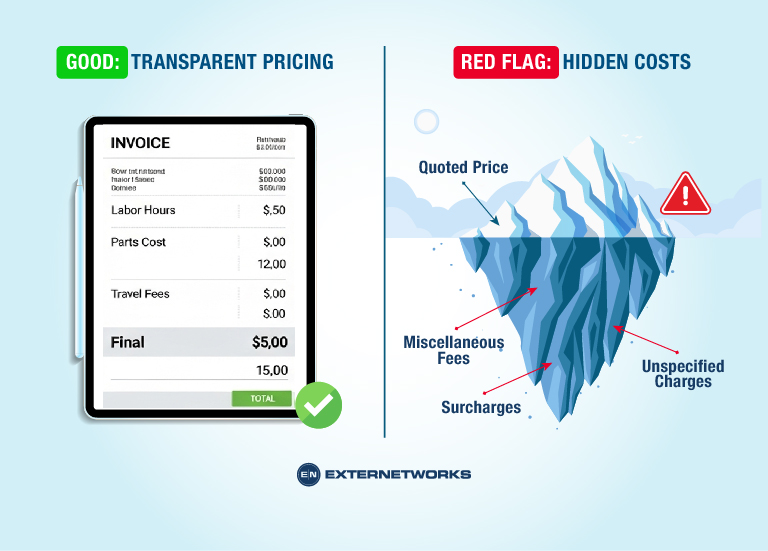
Financial transparency is essential and cannot be ignored. Any reputable IT Smart Hands provider will offer clear, itemized pricing structures. Red flags include overly vague proposals, a lack of detailed breakdowns of labor, parts, and travel expenses, or terms like “and other charges” without specific explanations.
The presence of hidden costs is a common pitfall that can drastically inflate your IT budget. Ensure the contract clearly outlines rates, billing cycles, and what constitutes billable time.
For instance, if a vendor cannot provide an estimate that includes a rough timeline and the expected materials, it raises concerns about their preparedness and their commitment to predictable service delivery. Remember, transparent pricing builds trust and allows for accurate budgeting.
Weak or Non-Existent Service Level Agreements (SLAs)
Service Level Agreements (SLAs) are the cornerstone of an IT partnership, defining service levels, response times, and performance metrics.
A provider who balks at providing a robust SLA, offers one that is overly simplistic, or contains vague guarantees, is a major red flag. A strong SLA should detail guaranteed response times for different severity levels, resolution targets, uptime commitments, and penalties for non-performance.
Without clearly defined SLAs, you have little recourse if the provider consistently underperforms, leading to extended downtime, which can cost the typical business close to $125,000 per hour ABB, 2023. A weak SLA indicates a lack of commitment to measurable results and accountability.
Red Flags in Technical Expertise and On-Site Competency
The core value of IT Smart Hands lies in the technical proficiency of its on-site personnel. Any weakness in expertise, preparedness, or capability poses a direct threat to your operational integrity.
Lack of Specific IT Smart Hands Expertise and Industry Knowledge
Not all IT support is created equal. A provider that offers general IT services but lacks specific experience with the hardware, software, and networking technology relevant to your industry or environment is a significant risk.
For example, if your business relies on specialized data center equipment or complex network configurations, a provider whose technicians lack this niche knowledge will be ill-equipped to handle tasks effectively.
Asking for details about their technicians’ specific skill sets, certifications, and experience with similar environments is critical. The 93% of UK businesses that report an IT skills gap (Forbes Advisor UK, 2023) underscore the importance of verifying specialized expertise rather than assuming it.
Inadequate Technician Training and Credentialing
The on-site technician’s competence is paramount. Red flags include a provider that cannot produce evidence of ongoing training, relevant certifications (e.g., CompTIA, Cisco, vendor-specific credentials), or a thorough vetting process for their staff.
Technicians who are not adequately trained or credentialed are more likely to make errors, cause further damage, or lack the knowledge to resolve complex issues efficiently.
This can lead to unnecessary downtime and potentially compromise data security. A responsible vendor will invest in continuous professional development for their team and be transparent about their credentialing standards.
Absence of Essential Tools, Materials, and Preparedness
A well-prepared IT Smart Hands provider arrives on-site equipped with the necessary tools, diagnostic equipment, and often, commonly needed replacement materials.
A vendor that frequently needs to make return trips because they “forgot” a tool, lacked a specific cable, or didn’t bring the right diagnostic software signals a lack of professionalism and preparedness.
This inefficiency directly impacts project timelines and can prolong outages. Furthermore, their ability to handle surge demand or unexpected issues is questionable if their initial readiness is poor.
Inability to Scale or Handle Surge Demand
Your IT needs can fluctuate. A provider that demonstrates an inability to scale their resources up or down to meet your demands, particularly during peak periods or emergencies, is a red flag.
This might manifest as long wait times for on-site dispatch during critical moments or an inability to staff larger projects. The global remote IT support services market is growing, according to Market Data Forecast’s 2025 report, indicating a general demand for scalable IT solutions. However, for Smart Hands, this scalability is about deploying trained personnel quickly and effectively to physical locations, not just remote access.
Performance, Reliability, and Accountability Red Flags
Beyond initial competence, consistent performance, unwavering reliability, and clear accountability are vital for a successful IT Smart Hands partnership.
Unrealistic Promises and Lack of Proven Track Record
Be wary of providers who make grandiose claims or guarantee outcomes that seem too good to be true without substantiation.
A lack of a verifiable track record, compelling case studies, or positive client references is a significant warning sign. A provider should be able to demonstrate past successes with clients similar to the current client and the challenges encountered.
Furthermore, unrealistic promises regarding resolution times or project completion timelines, especially without proper due diligence on your environment, should be treated with suspicion.
High Staff Turnover Affects Consistency
Frequent changes in the technicians assigned to your account can disrupt continuity and project momentum. High staff turnover within a Smart Hands provider often indicates underlying issues with management, training, or workplace culture.
This can lead to inconsistent service quality, loss of project knowledge, and a frustrating experience for your internal teams. When evaluating a vendor, inquire about their technician retention rates and how they ensure knowledge transfer during personnel changes. This directly impacts the quality of customer service and overall performance.
History of Downtime Incidents or Poor Resolution Rates
A provider’s past performance is often the best predictor of future results. If they are reluctant to discuss their history with downtime incidents, or if their resolution rates are low, it’s a clear red flag.
Poor resolution rates suggest that their technicians may struggle with diagnosing and fixing issues effectively. This can lead to repeated service calls for the same problems, increasing costs and impacting business continuity. Thoroughly vetting their performance metrics and past incident reports is crucial.
Critical Security, Compliance, and Data Protection Red Flags
In the realm of IT, security, compliance, and data security are paramount. Any provider that overlooks or compromises these areas poses an existential threat to your organization, particularly when they have physical access to your premises.
Inadequate Data Security Protocols for On-Site Work
When technicians are on-site, the risk of sensitive data exposure increases.
Red flags include a provider that doesn’t have robust data security protocols specifically for on-site work. This includes how they handle company materials, manage data transfer, secure their devices, and prevent unauthorized access to your systems and data. 73% of small business owners faced data breaches or cyberattacks last year, according to the Identity Theft Resource Center (ITRC), 2023. Also, 43% of all cyberattacks target small businesses, says BD Emerson, 2025.
This shows that providers must use strong security measures. They should implement proper encryption to protect any data.
Lax Physical Security and Access Control Procedures
On-site work necessitates strict physical security. A provider with lax procedures regarding technician identification, background checks, and adherence to your site’s access control policies is a significant risk.
They should have clear internal policies and be willing to integrate with your existing security protocols. Allowing untrained or poorly vetted personnel access to sensitive areas of your facility can lead to theft, damage, or unauthorized access to critical IT infrastructure.
Non-Compliance with Industry Regulations and Standards
Depending on your industry, you are likely subject to various compliance regulations (e.g., HIPAA, GDPR, PCI DSS). An IT Smart Hands provider must understand and adhere to these standards.
Red flags include a vendor that is unaware of relevant regulations or cannot demonstrate how their practices ensure compliance. Failure to comply can result in severe penalties, legal repercussions, and damage to your reputation. An audit trail of their compliance efforts is a positive indicator.
Lack of Proper Insurance and Licensing
Every trustworthy IT Smart Hands vendor should have enough liability insurance. This includes professional indemnity and cyber liability insurance. They should also possess all necessary business licenses. The absence of these is a glaring red flag, leaving your business exposed financially if something goes wrong. Always ask to see proof of their insurance coverage and verify their licensing.
Integration and Collaboration Red Flags
A Smart Hands provider should function as an extension of your IT team, not an isolated entity. Red flags in integration and collaboration can lead to friction, inefficiencies, and lost knowledge.
Failure to Integrate with Your Internal IT Team
A key differentiator for successful IT Smart Hands is their ability to collaborate seamlessly with your existing internal IT department.
If a provider seems resistant to working with your team, shows little interest in understanding your internal processes, or attempts to work in a silo, it’s a major red flag. Effective integration ensures that knowledge is shared, conflicts are minimized, and your internal team remains informed and in control. Their customer service philosophy should extend to supporting your in-house staff.
Poor Reporting and Documentation Post-Intervention
After any on-site intervention, comprehensive reporting and documentation are essential. This includes detailing the work performed, any issues encountered, solutions implemented, and recommendations for future action.
A provider who gives unclear or incomplete reports or does not document their work properly makes it hard for you to track IT assets. This also makes it challenging to fix future problems and maintain accurate technology records. This lack of documentation can be a significant issue during an audit.
Lack of Understanding of Your Specific IT Environment
While a provider may have broad IT expertise, they must demonstrate a genuine effort to understand your unique IT ecosystem. Red flags include a provider that approaches every task with a generic methodology and shows little interest in learning about your specific network topology, hardware, software, and business objectives.
Not understanding this can cause poor solutions, missed chances to improve, and setups that do not fit well. Effective onboarding processes are key to bridging this gap.
How to Choose a Reliable IT Smart Hands Provider
Choosing an IT Smart Hands provider is a decision that carries significant weight, impacting your operational efficiency, security, and bottom line. You can reduce vendor risks by watching for warning signs.
These include unclear communication and pricing, lack of technical skills, poor performance, and serious security mistakes. A good provider demonstrates honesty, strong service agreements, proven technical training, adherence to rules, and alignment with your internal processes.
These are not just nice-to-haves; they show a reliable partner. Remember, the global IT outsourcing market is substantial (Dreamix, 2025), but quality and trustworthiness are not universal.
Thorough due diligence, including verifying client references and scrutinizing their proposed contract and materials plan, is your most powerful tool. By addressing these crucial points proactively, you can secure an IT Smart Hands partner that enhances your operations, protects your valuable data, and contributes to your business’s continued success.
Related on ExterNetworks Right Now!


Why Smart Hands is the Secret to…
Written By Allan Stuke

Most Recent Posts