 Smart Hand Services
Essential Smart Hands Tasks for Seamless On-Site IT Support



In today’s rapidly evolving digital landscape, IT infrastructure is the backbone of virtually every enterprise. The sheer scale and complexity of modern IT environments, from sprawling data center facilities to distributed edge deployments, present significant management challenges. As organizations increasingly rely on remote IT teams and engineers, the need for skilled, on-site physical support becomes paramount.
This is where Smart Hands services play a crucial role, acting as the eyes, ears, and hands of remote IT professionals in physical locations. Without this essential layer of on-site support, critical IT infrastructure can suffer from prolonged downtime, inefficient operations, and missed opportunities for proactive maintenance and enhancement. The global IT market, forecast to hit $5.74 trillion by 2025 (Gartner, 2025), underscores the immense value and complexity of managing these systems, making the expertise of Smart Hands indispensable.
Defining Smart Hands: Bridging the On-Site Gap for Remote IT Teams
Smart Hands is a specialized IT support service in which highly skilled technicians provide on-site, hands-on assistance with a wide range of hardware and infrastructure-related tasks. These services are designed to bridge the physical distance between centralized IT teams and distributed IT assets, extending remote support capabilities. Unlike basic services that may only require physical presence, Smart Hands entails interventions that require technical knowledge, problem-solving skills, and the ability to execute complex directives from engineers or IT managers.
For Customers operating with lean IT teams or managing geographically dispersed infrastructure, Smart Hands services offer a cost-effective and efficient solution to ensure the smooth operation of their critical data center and network environments.
Differentiating Smart Hands from Remote Hands: Skill Sets and Intervention Levels
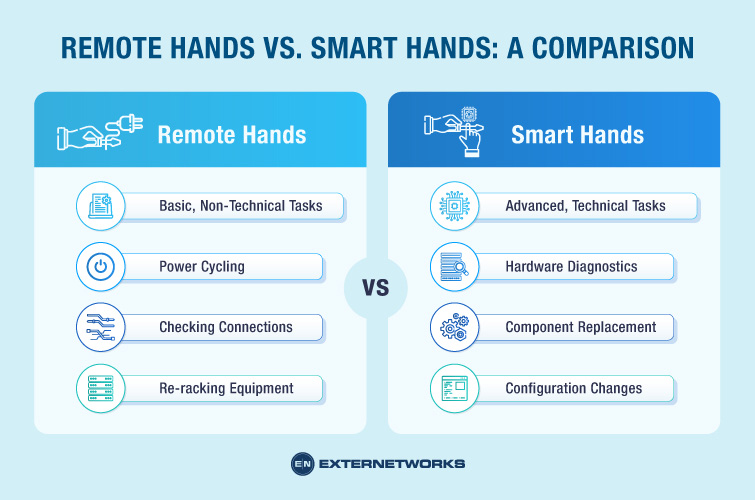
It is essential to distinguish Smart Hands from Remote Hands services. While both involve on-site personnel, their capabilities and the nature of their interventions differ significantly. Remote Hands typically perform basic, non-technical tasks such as re-racking equipment, checking physical connections, or cycling power at a data center facility. Their role is primarily that of an agent executing simple, predefined instructions.
In contrast, Smart Hands technicians possess a deeper level of technical expertise. They can perform diagnostics, troubleshoot hardware issues, replace components, execute configuration changes, and even undertake basic software installations or updates under guided supervision. This elevated skill set enables Smart Hands to handle more complex issues, reducing the need for engineers to travel to the site. The global IT infrastructure services market, valued at $104.35 billion in 2024 and projected to reach $236.18 billion by 2033 (Straits Research, 2025), highlights the extensive scope of work that requires skilled on-site intervention.
Why On-Site IT Support is More Critical Than Ever
The modern IT landscape is characterized by increasing complexity and decentralization. Enterprises operate intricate infrastructures spanning on-premises data center environments, cloud platforms, and distributed edge locations. Managing this multifaceted IT infrastructure purely through remote access presents significant limitations. Physical issues with servers, network devices, or cabling often require immediate, on-site intervention that remote tools cannot fully address.
The IT Support Services market is growing substantially, projected to reach a significant value by 2033 at a CAGR of 7.69% datainsightsmarket.com, 2025, reflecting the amplified need for specialized support. Without readily available on-site support like Smart Hands, troubleshooting can be delayed, leading to extended downtime and impacting business continuity. This makes skilled technicians on the ground a vital component of any robust IT strategy.
The Value Proposition: Ensuring Operational Continuity and Efficiency
The core value of Smart Hands services lies in their ability to ensure uninterrupted operational continuity and enhance the Customer’s overall IT efficiency. By providing immediate, skilled on-site support, Smart Hands significantly reduces mean time to repair (MTTR) for hardware-related issues, minimizing costly downtime. This is particularly critical in environments where every minute of downtime can translate into substantial financial losses.
Furthermore, Smart Hands frees up internal IT teams and engineers to focus on strategic initiatives, innovation, and core business functions, rather than being bogged down by routine or complex physical IT tasks. This division of labor optimizes resource allocation and boosts productivity. The ability to scale Smart Hands resources up or down based on demand provides flexibility, making it a cost-effective solution for managing dynamic IT environments.
Core Smart Hands Support for Data Center & IT Infrastructure
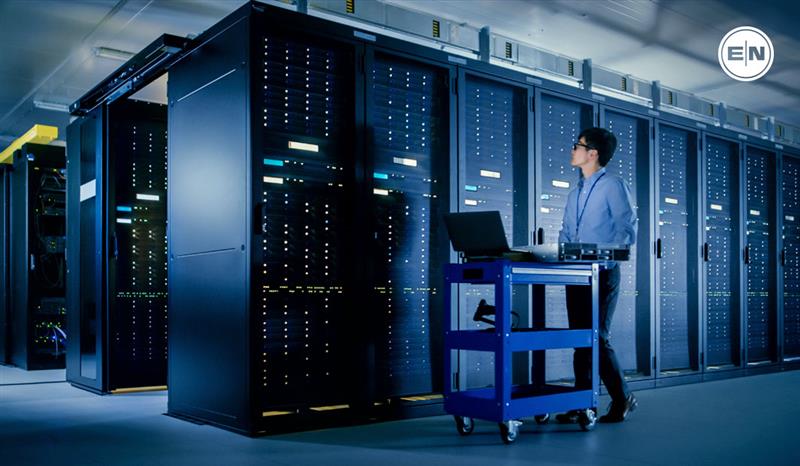
The foundational tasks performed by Smart Hands technicians are critical for the day-to-day operational health of any data center or IT infrastructure. These services, while seemingly basic, are indispensable for maintaining system integrity and preventing minor issues from escalating into major problems.
Hardware Installation, Racking, and Cabling
A fundamental responsibility of Smart Hands is the physical installation and setup of IT equipment. This includes racking and un-racking servers, network switches, storage devices, and other hardware components within racks in data center environments. Precise mounting and securing of equipment are crucial for airflow, accessibility, and structural integrity. Equally important is the meticulous management of cabling. Smart Hands technicians are responsible for deploying, connecting, labeling, and organizing network and power cables to ensure clean, efficient cable management. Proper cabling is vital for network performance, ease of maintenance, and preventing potential connection failures.
Device Diagnostics, Power Cycling, and Resets
When servers or other devices exhibit anomalies, Smart Hands technicians are often the first line of defense for initial diagnostics. They can physically inspect devices for indicator lights, listen for unusual sounds, and confirm component seating. Performing power cycles—gracefully shutting down and restarting equipment—is a common and often effective troubleshooting step for resolving transient software or hardware glitches. They can also execute hard resets or unplug/replug specific components as directed by remote engineers, which can resolve issues that are not accessible remotely. These actions are critical for a swift response to operational problems.
Asset Management and Inventory Control
Accurate asset management is the cornerstone of efficient IT operations. Smart Hands play a vital role in maintaining an up-to-date inventory of all hardware assets within a facility. This includes initial tagging and labeling of new equipment, conducting regular physical audits to reconcile inventory records with actual assets, and documenting the location and status of all devices. When equipment is decommissioned or needs to be shipped out, Smart Hands manages the process, ensuring proper handling, documentation, and secure transit of data-containing hardware. This meticulous tracking is essential for security, compliance, and future planning.
Advanced & Specialized Smart Hands Interventions
Beyond foundational tasks, Smart Hands services extend to more complex interventions that require a higher degree of technical skill and diagnostic capability, acting as a crucial extension of IT specialist teams.
In-Depth Troubleshooting and Component Replacement
When initial diagnostics point to a faulty component, Smart Hands technicians are equipped to perform component-level troubleshooting. This can involve swapping out identified faulty parts such as RAM modules, hard drives (HDDs/SSDs), power supply units (PSUs), network interface cards (NICs), or server blades. They follow detailed instructions from remote engineers to safely remove and replace these components, testing the system afterward to confirm the resolution. This hands-on capability is vital for swiftly restoring servers and other critical hardware to operational status.
Configuration Changes and Software Support
While specialized teams typically handle deep software configuration, Smart Hands can execute predefined configuration changes under direct guidance. This might include configuring basic switch ports, updating firmware on network devices or servers, or deploying specific software agents that require physical access. They can also assist with the initial setup of operating systems or with software updates that require physical media insertion or console access. Their role ensures that configuration directives are accurately implemented on the physical hardware.
Data Management and Storage Support
In the realm of data management and storage, Smart Hands can perform critical physical tasks. This includes the secure handling of physical data media, such as inserting or removing hard drives, optical discs, or backup tapes. They can also assist in basic checks of storage arrays or network-attached storage (NAS) devices, reporting on physical status indicators. In specific scenarios, under strict supervision and following established protocols, Smart Hands may facilitate tasks like imaging drives or preparing data for secure disposal, ensuring the integrity and security of sensitive information.
Strategic Integration: Leveraging Smart Hands for Broader IT Initiatives
Smart Hands are not merely for reactive troubleshooting; they are strategic assets that can significantly contribute to large-scale IT projects and initiatives, enabling IT teams to achieve ambitious goals.
Support for Data Center Builds, Migrations, and Moves
Undertaking a new data center build, migrating existing infrastructure, or executing physical Moves is a complex undertaking that heavily relies on precise on-site execution. Smart Hands technicians are indispensable for racking and stacking thousands of devices, running and organizing extensive cabling infrastructure, and performing detailed asset tracking throughout the process. Their physical presence ensures that each piece of hardware is correctly installed, connected, and accounted for, facilitating a smooth transition and minimizing disruption.
Edge Computing and IoT Deployments
The rise of edge computing and the Internet of Things (IoT) involves deploying devices in geographically dispersed locations, often remote or resource-limited. Smart Hands services are crucial for the physical installation, initial configuration, and ongoing maintenance of these edge devices. This includes setting up gateways, sensors, and small servers at locations such as retail stores, manufacturing floors, and utility sites, providing the on-site support that remote IT teams cannot deliver. Ensuring the physical security and connectivity of these distributed assets is a key role for Smart Hands.
Disaster Recovery and Business Continuity Execution
In the event of a disaster, Smart Hands are vital for executing predefined disaster recovery (DR) and business continuity (BC) plans that involve physical intervention. This can include powering up backup servers, connecting new infrastructure, verifying the status of data backups, and physically relocating critical hardware. Their rapid response capability ensures that critical systems can be brought back online quickly, minimizing the impact of unforeseen events on the Customer‘s operations.
Network Infrastructure Enhancements
Upgrading or expanding network infrastructure often requires physical intervention within data center facilities or remote sites. Smart Hands technicians can install new network switches, routers, firewalls, and other hardware, run and terminate cabling, and perform initial connectivity tests. They act as the on-site presence that allows engineers to implement network improvements efficiently and accurately, ensuring minimal disruption to ongoing network services.
The Human Element: Skills, Collaboration, and Trust in Smart Hands Services
While technology and task lists are essential, the actual value of Smart Hands services is amplified by the human element – the skills, collaborative spirit, and trustworthiness of the technicians themselves.
Essential Qualities of a Smart Hands Support Technician
An effective Smart Hands technician possesses a blend of technical proficiency, meticulous attention to detail, and strong problem-solving abilities. They must be adept at understanding and executing complex technical instructions from remote engineers, troubleshooting physical issues systematically, and accurately documenting their work. Physical dexterity, the ability to work safely in data center environments, and a proactive approach to identifying potential issues are also crucial. Their reliability is paramount, as they are the physical manifestation of the Customer‘s IT support.
Seamless Collaboration with Remote IT Teams
Effective collaboration between Smart Hands technicians and remote IT teams is the linchpin of successful on-site support. Clear, concise, and timely communication is essential. Technicians must be able to articulate the physical situation accurately, provide detailed progress updates, and ask clarifying questions when needed. This two-way flow of information ensures that remote engineers have a clear understanding of the on-site reality, enabling them to make informed decisions. This partnership fosters a unified approach to IT management.
Ensuring Security and Compliance On-Site
Maintaining stringent security protocols and compliance standards is non-negotiable for Smart Hands services. Technicians must adhere to strict access control policies, data handling procedures, and site-specific security regulations. They act as trusted custodians of the Customer‘s physical IT infrastructure, safeguarding against unauthorized access, potential breaches, and ensuring that all interventions comply with industry regulations and internal policies. This commitment to security builds confidence and trust with the Customer. Cybercrime is projected to cost the world $10.5 trillion annually by 2025 (DeepStrike, 2025), underscoring its critical importance.
Optimizing Smart Hands Services for Maximum Value
To fully realize the benefits of Smart Hands, organizations must approach their engagement strategically, focusing on clear expectations, performance measurement, and strong provider partnerships.
Service Level Agreements (SLAs) and Performance Metrics
Establishing robust Service Level Agreements (SLAs) is fundamental. SLAs should clearly define key performance indicators (KPIs), including response times, task completion windows, reporting accuracy, and availability. Agreeing on metrics such as MTTR reduction, first-time fix rates, and uptime contributions helps quantify the value delivered by Smart Hands services. Regular performance reviews against these metrics ensure accountability and drive continuous improvement.
Leveraging Technology for Enhanced Service Delivery
Modern Smart Hands providers leverage technology to enhance service delivery. This includes utilizing ticketing systems for task management, remote monitoring and management (RMM) tools for device visibility, and customer portals for real-time status updates and reporting. The help desk software market, expected to reach $21.8 billion by 2027 FlairsTech, 2025, demonstrates the investment in these technologies. These tools improve transparency, streamline workflows, and provide valuable data for performance analysis.
Strategic Partnership with a Smart Hands Provider
Selecting the right Smart Hands provider is a strategic decision. Organizations should look for partners with proven technical expertise, a strong track record in their specific industry, a commitment to security and compliance, and a culture of excellent communication and collaboration. Building a strategic partnership rather than a transactional relationship fosters a deeper understanding of the Customer’s needs. It enables Smart Hands to become a proactive extension of the internal IT teams. This relationship is key to unlocking the full potential of these services.
Conclusion:
Smart Hands as an Enabler for Seamless IT Operations
Smart Hands services are no longer a mere supplementary IT function but a critical component of a robust and resilient IT strategy. In an era defined by increasingly complex and distributed IT infrastructure, the ability to provide skilled, immediate on-site support is paramount. These services act as the indispensable physical extension of remote IT teams and engineers, bridging the gap between digital command and physical execution.
Reiteration of Smart Hands’ Indispensable Role: Empowering Remote IT with On-Site Agility
The comprehensive suite of Smart Hands tasks, from foundational hardware installation and cabling to advanced diagnostics, component replacement, and configuration changes, ensures that IT infrastructure operates at peak performance. By handling these essential functions with precision and expertise, Smart Hands technicians empower remote IT teams with the on-site agility needed to manage diverse environments effectively.
This support is crucial for maintaining operational continuity, minimizing downtime, and ensuring the integrity of critical data and systems. Worldwide IT spending is projected to reach $5.43 trillion in 2025 (Gartner, 2025), underscoring ongoing investment in IT and the need for efficient support mechanisms.
Future-Proofing IT Infrastructure with Expert On-Site Support
As organizations embrace digital transformation by adopting technologies such as edge computing, IoT, and hybrid cloud models, reliance on specialized on-site support will only grow. Smart Hands services are instrumental in facilitating data center builds, migrations, Moves, and disaster recovery efforts, ensuring that strategic IT initiatives are executed flawlessly.
The skills, collaborative spirit, and unwavering commitment to security demonstrated by Smart Hands technicians build the trust necessary for a seamless partnership. By optimizing Smart Hands services through clear SLAs and strategic provider relationships, businesses can future-proof their IT infrastructure, enhance operational efficiency, and gain a significant competitive advantage in the digital age. Addressing the prevalent technology skills gap, where 81% of organizations report a challenge iMocha, 2025, further emphasizes the value of leveraging external expertise.
Related on ExterNetworks Right Now!
Crucial Red Flags: Don’t Hire an IT…
Written By Allan Stuke


Why Smart Hands is the Secret to…
Written By Allan Stuke
Most Recent Posts