 Smart Hand Services
Smart Hands vs. Remote Hands: Which Data Center Service is Right for You?



The modern IT landscape is characterized by rapid evolution, increasing complexity, and an ever-present demand for robust, always-on infrastructure.
At the heart of this digital ecosystem lie data centers, the physical powerhouses driving businesses forward. Within these critical facilities, managing physical servers, equipment, and intricate cabling presents unique challenges, especially for organizations operating across multiple locations or those aiming to optimize their internal IT teams‘ bandwidth.
Ensuring the smooth operation of this vital IT infrastructure requires a strategic approach to on-site support. This is where the distinctions between “Remote Hands” and “Smart Hands” become paramount. Understanding these services is not just about technical jargon; it’s about making informed decisions that safeguard your operations, mitigate downtime, and ultimately support your business objectives.
The Evolving Role of Data Center Infrastructure and IT Teams
The role of the data center has transformed from a mere storage facility to a dynamic, mission-critical hub. As infrastructure becomes more sophisticated, with increasing power densities the average rack power density has surged from 8 kW to 17 kW and is projected to reach 30-50 kW by 2027 [Source: Land Values Insider, 2025] and complex interdependencies, the demands on internal IT teams escalate.
These teams are often stretched thin, tasked with strategic planning, cybersecurity, application development, and managing an increasingly distributed IT infrastructure. This leaves less capacity for fundamental, on-site physical tasks that are nevertheless crucial for maintaining operational integrity.
Why Strategic Support is More Critical Than Ever
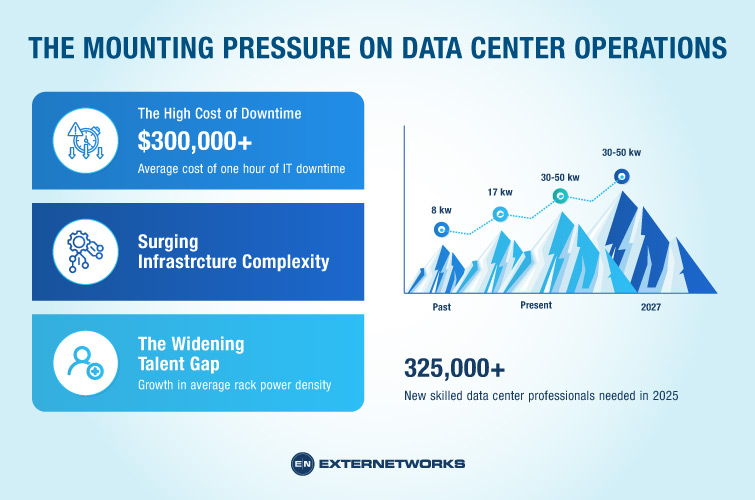
In today’s business environment, every minute of downtime can translate into significant financial losses. A staggering 90% of firms report that an hour of IT downtime costs them over $300,000 [Source: E-N Computers / MEV team, 2025]. This reality underscores the need for proactive and responsive support mechanisms.
Furthermore, the global demand for skilled data center professionals is projected to necessitate over 325,000 new full-time positions in 2025, highlighting a talent gap that specialized support services can help bridge. Strategic support isn’t a luxury; it’s a necessity for ensuring business continuity, maintaining performance, and enabling growth.
Introducing the Spectrum of On-Demand Data Center Services
To address these evolving needs, colocation facilities and data center providers offer a spectrum of on-demand IT services and IT support. These services are designed to extend the capabilities of your internal IT teams by providing qualified on-site technicians when and where they are needed.
Among these, “Remote Hands” and “Smart Hands” are two distinct categories of support, each tailored to different levels of complexity and expertise. Understanding their differences is key to selecting the right service for your specific operational requirements. The global data center services market is projected to reach USD 320.89 billion by 2030, growing at a substantial CAGR of 22.6% [Source: MarketsandMarkets, 2025], indicating robust demand for specialized support.
Remote Hands: The Essentials of Basic On-Site Support
Remote Hands represent the foundational level of on-site data center support. They are the physical presence that executes direct, often simple, instructions given by a remote Customer or their IT teams.
Defining Remote Hands: What It Is and What It Isn’t
Remote Hands are essentially the eyes and hands within the data center facility for your IT teams who are located elsewhere. Their primary function is to perform basic physical tasks that do not require advanced technical knowledge or complex problem-solving skills. They are typically not authorized or equipped to diagnose complex issues or implement complex solutions independently. Their role is strictly task-oriented, guided by detailed, step-by-step instructions provided by the Customer.
Core Remote Hands Services: Quick, Simple, and Cost-Effective Tasks
The typical services provided by Remote Hands include:
- Power cycling of servers and other equipment.
- Performing basic cabling tasks such as plugging or unplugging network cables.
- Visual inspections of equipment status lights or physical damage.
- Rebooting servers or network devices.
- Receiving or shipping equipment from or to the Customer.
- Escorting personnel into secured areas of the data center.
These tasks are often critical for initial troubleshooting and routine maintenance, providing a cost-effective way to address straightforward physical requirements.
Ideal Scenarios for Leveraging Remote Hands
Remote Hands are best suited for organizations that have clearly defined, simple tasks that require a physical presence but do not necessitate in-depth technical expertise. This includes situations where an internal IT team can troubleshoot an issue remotely and only needs someone on-site to perform a specific action, such as restarting a server or verifying a network connection. They are also helpful for regular, scheduled maintenance that involves basic physical interventions.
Limitations and Potential Pitfalls of Relying Solely on Remote Hands
The primary limitation of Remote Hands is its lack of advanced technical skills and diagnostic capabilities. If a problem requires more than a basic reboot or cable check, Remote Hands will likely be unable to resolve it independently. This can lead to prolonged downtime as the Customer must provide increasingly complex instructions or dispatch more specialized personnel. Relying solely on Remote Hands for anything beyond the most basic tasks can become inefficient and costly, especially when dealing with critical IT infrastructure.
Smart Hands: Expert On-Site Support as an Extension of Your IT Team
Smart Hands elevates on-site data center support by bringing a higher level of technical proficiency and problem-solving acumen to the physical tasks performed within colocation facilities.
Defining Smart Hands: Bringing Expertise to Your Colocation Facility
Smart Hands are qualified on-site technicians with a deeper understanding of IT infrastructure, servers, networking, and various hardware components. They act as a direct extension of your IT teams, capable of performing more complex tasks, troubleshooting issues independently within predefined parameters, and executing advanced Installation procedures. Their expertise allows them not only to follow instructions but also to interpret situations and take informed action.
Advanced Smart Hands Services: Beyond the Basic Physical Task
The scope of Smart Hands Services is significantly broader and includes:
- Diagnosing and replacing faulty equipment components (e.g., hard drives, RAM, power supplies).
- Performing firmware updates on servers and network devices.
- Completing complex cabling installations and structured cabling projects.
- Assisting with server and network Installation and configuration.
- Troubleshooting network connectivity issues beyond simple cable checks.
- Performing in-depth hardware diagnostics and making informed repair recommendations.
- Assisting with rack and stack operations for new equipment deployments.
The “Intelligence” Differentiator: Why Expertise Matters
The “smart” in Smart Hands signifies technical intelligence and problem-solving capability. These technicians are trained to understand the intricate relationships within IT infrastructure. They can analyze error messages, interpret system logs, and apply their knowledge to resolve issues more efficiently than someone merely following instructions. This proactive, informed approach is crucial for minimizing downtime and ensuring optimal performance of critical systems.
Strategic Value: Smart Hands for Modern & Emerging Technologies
The increasing complexity of modern IT environments, driven by advanced technologies, necessitates the sophisticated support that Smart Hands provides.
Supporting High-Performance Computing (HPC) and AI Infrastructure
The demands of High-Performance Computing (HPC) and Artificial Intelligence (AI) infrastructure are immense. These systems often involve dense configurations of powerful servers, specialized GPUs, and high-speed networking.
Managing and maintaining such equipment requires specialized knowledge. Smart Hands can be instrumental in the Installation, configuration, and troubleshooting of these complex systems, ensuring that critical computational workloads are not interrupted by hardware issues or connectivity problems.
Enabling Edge Computing and IoT Deployments
As businesses embrace Edge Computing and the Internet of Things (IoT), the need for distributed IT management grows. Deploying and maintaining servers and equipment at remote or less accessible locations requires reliable on-site support.
Smart Hands can be deployed to these edge sites for Installation, maintenance, and troubleshooting, bridging the gap between centralized IT management and distributed infrastructure without requiring constant travel from internal teams.
Facilitating Data Center Builds, Moves, and Technology Rollouts
Large-scale projects like data center builds, significant equipment upgrades, or technology rollouts involve intricate logistical and technical challenges. Smart Hands technicians play a vital role in these initiatives, from initial Installation and racking of new servers and equipment to de-racking and migrating existing assets. Their expertise ensures these complex projects are executed efficiently and with minimal disruption to ongoing operations.
Smart Hands vs. Remote Hands: A Detailed Feature Comparison
A direct comparison highlights the fundamental differences and ideal use cases for each service.
Skillset and Scope of Work: Technical Depth vs. Basic Assistance
Remote Hands are trained to perform basic physical execution of predefined, simple tasks. Their scope is limited to following explicit instructions. Smart Hands, conversely, possess advanced technical skills allowing them to perform diagnostics, troubleshoot, repair, and implement complex technical solutions. Their scope encompasses a much wider range of technical interventions.
Problem Solving and Diagnostics: Reactive Action vs. Proactive Resolution
Remote Hands are reactive; they perform actions as instructed. If the instruction doesn’t solve the problem, they await further direction. Smart Hands are proactive problem solvers. They can diagnose issues, identify root causes, and implement solutions, often anticipating potential future problems and taking preventative measures.
Response Times and Urgency: Meeting Critical SLAs and Avoiding Downtime
While both services aim to reduce downtime, their approaches differ. Remote Hands are suitable for standard response times for basic tasks. For critical issues requiring immediate, expert intervention, Smart Hands with defined Service Level Agreements (SLAs) delivers faster, more effective resolution, preventing costly disruptions. The ability of Smart Hands to resolve complex issues quickly directly impacts the financial implications of downtime.
Cost Structure and ROI: Understanding the True Value Beyond Hourly Rates
Remote Hands typically have lower hourly rates, making them cost-effective for simple, occasional tasks. However, if used for complex issues, the cost can escalate due to extended downtime and the need for repeated interventions.
Smart Hands have higher hourly rates but can offer a superior Return on Investment (ROI) by resolving issues faster, reducing downtime, and optimizing IT infrastructure performance. For instance, Smart Hands with rapid-response SLAs might cost more per hour but can save hundreds of thousands of dollars per critical hardware failure.
Impact on Security and Compliance: On-Site Protocols vs. Remote Oversight
Both services operate within the data center‘s security framework. However, Smart Hands technicians are often more rigorously vetted and trained in advanced security protocols, potentially including handling sensitive equipment or assisting with firewall configurations within their scope. Their technical expertise can also ensure that Installation and maintenance procedures are performed in a manner that maintains compliance with industry regulations and internal security policies.
Making the Right Choice: A Strategic Decision Framework
Choosing between Smart Hands and Remote Hands requires a thorough assessment of your organization’s specific needs and operational context.
Assess Your Current IT Infrastructure Complexity and Criticality
The complexity and criticality of your IT infrastructure are primary drivers. Highly complex, mission-critical systems that require constant uptime and sophisticated maintenance will benefit more from Smart Hands’ advanced capabilities. Remote Hands might adequately cover simpler, less critical equipment or routine tasks.
Evaluate Your Internal IT Capabilities and Available Resources
Consider the existing expertise and capacity of your internal IT teams. If your team lacks specific on-site skills or is overburdened with strategic initiatives, outsourcing these tasks to Smart Hands can be a strategic decision to augment your capabilities. If your team is highly skilled and only requires basic physical assistance, Remote Hands might suffice.
Determine Your Operational Needs and Future Growth Plans
Align your support needs with your operational demands. Do you require ongoing, complex Installation and troubleshooting, or occasional basic physical interventions? Consider your future growth trajectory, including potential adoption of HPC, AI, or edge technologies, which will likely necessitate the expertise of Smart Hands.
Prioritize Security, Compliance, and Data Protection
For organizations with stringent security and compliance requirements, the qualifications and protocols followed by on-site technicians are paramount. Smart Hands providers often offer a higher assurance of adherence to strict security measures and compliance standards, ensuring that sensitive data and critical infrastructure are handled appropriately.
Partnering for Success: Selecting and Managing Your Smart Hands Provider
Selecting the right partner for your Smart Hands or Remote Hands needs is crucial to ensuring reliable, practical support. Look for providers with a proven track record, clear SLAs, and a commitment to technician training and development. Understand their response times, escalation procedures, and how they integrate with your existing IT support structure. A strong partnership ensures that these services truly act as an extension of your IT teams, contributing to the overall health and efficiency of your data center operations. The growth of managed IT services to USD 878 billion by 2032 further indicates the importance of choosing strategic partners for these functions.
Conclusion
In the dynamic realm of data center operations, the choice between Smart Hands and Remote Hands is a strategic one that directly impacts operational efficiency, security, and your organization’s ability to minimize downtime.
Remote Hands provide essential, cost-effective support for basic physical tasks, acting as remote eyes and hands. Smart Hands, however, offers a more sophisticated, expert-driven service, serving as a critical extension of your internal IT teams capable of complex diagnostics, troubleshooting, and advanced installation. By carefully assessing your IT infrastructure complexity, internal resource capabilities, operational needs, and security requirements, you can confidently select the service that best aligns with your business objectives. Ultimately, leveraging the right blend of these on-site technicians empowers your IT teams to focus on strategic initiatives, ensuring your data center remains a resilient and powerful engine for innovation and growth.
Related on ExterNetworks Right Now!
Crucial Red Flags: Don’t Hire an IT…
Written By Allan Stuke


Why Smart Hands is the Secret to…
Written By Allan Stuke
Most Recent Posts