 NOC Services
Why Modern NMS Architectures Fail Without Ops Alignment



Downtime Draining Your Business? Fix It Before It Costs More
Missed alerts turn into outages, outages turn into lost revenue. ExterNetworks Inc. delivers 24/7 NOC & Help Desk support to keep everything running smoothly.
Get 24/7 IT Support NowThe Shift from Tool Management to Network Operations Management
Most IT teams today aren’t suffering from a lack of monitoring tools; they’re drowning in them, and that distinction is what’s quietly breaking modern network infrastructure management.
The “set it and forget it” model was never realistic, but hybrid environments and multi-vendor stacks have made it a genuine liability. A single mid-size enterprise might run separate tools for performance monitoring, configuration management, flow analysis, and alerting, each generating its own noise, its own dashboards, and its own escalation gaps. The result isn’t visibility. It’s chaos with a UI.
Tool fatigue is now a primary driver of network blind spots. When engineers spend the majority of their shift triaging false positives and toggling between platforms, the actual signal the early warning of a degrading link or a misconfigured device gets buried. Network management vendors have grown significantly over the last few years, reflecting just how fast infrastructure complexity is outpacing the teams responsible for managing it. More tools haven’t solved the problem. In many cases, they’ve amplified it.
The shift that actually moves the needle is a change in operational philosophy. Moving from feature evaluation to outcome accountability means asking different questions: not “does this tool detect anomalies?” but “does our team have a clear, practiced response when one is detected?” That reframing is where most NMS deployments stall.
And the complexity isn’t slowing down. Multi-vendor environments, SD-WAN overlays, and cloud-native workloads mean the attack surface for operational failure keeps expanding. Understanding how modern NMS architectures are actually built and where they structurally fall short is the foundation for fixing that.
Modern NMS Architecture: Beyond the Three Pillars
Modern network management architecture isn’t just about collecting data; it’s about unifying the right data sources so your team can act on what matters before users feel the impact.
The traditional three pillars of network monitoring fault, performance, and configuration management still hold structural value. But today’s infrastructure has outgrown them. Hybrid environments, distributed workloads, and cloud-native services demand a network management platform that reconciles decades-old protocols with modern operational realities.
So, is SNMP still relevant? Absolutely, but it’s the foundation, not the ceiling. SNMP remains the backbone of device polling and state monitoring across most enterprise environments. However, it wasn’t designed for the speed or complexity of today’s networks. Modern architectures layer API-based integrations and streaming telemetry on top of SNMP, filling the gaps that legacy polling can’t cover.
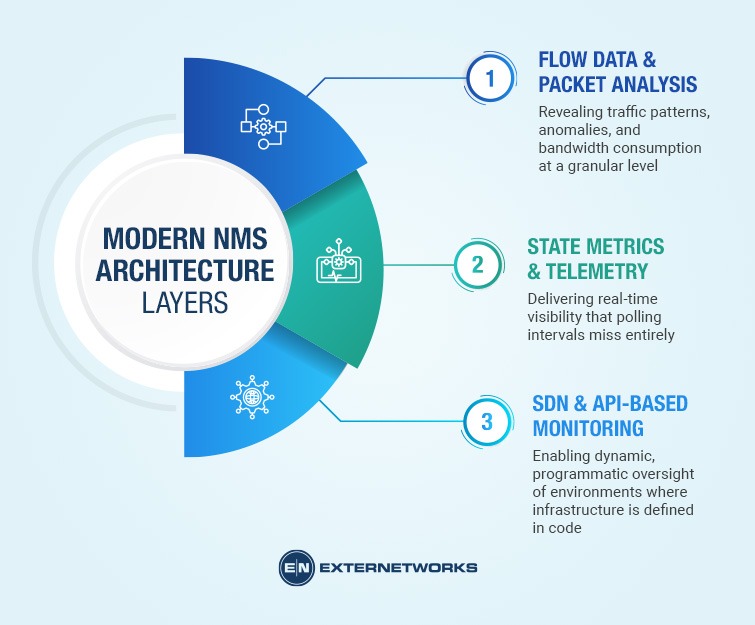
What makes a truly modern NMS architecture coherent are the layers that extend beyond the basics:
- Flow data and packet analysis revealing traffic patterns, anomalies, and bandwidth consumption at a granular level
- State metrics and telemetry streaming delivering real-time visibility that polling intervals miss entirely
- SDN and API-based monitoring enabling dynamic, programmatic oversight of environments where infrastructure is defined in code, not hardware
As Cisco’s architectural guidance highlights, modern NMS must support MPLS, Wireless, and Software-Defined Networking to maintain architectural leading practice. Without that breadth, you’re flying partially blind.
Centralized visibility is the connective tissue. In a distributed network environment spanning on-premises infrastructure, cloud workloads, and remote sites, fragmented monitoring tools create dangerous blind spots. A single pane of glass is an operational necessity. When flow data, packet analysis, and state metrics converge in one place, your team stops context-switching between dashboards and starts making decisions with confidence.
That architectural coherence sounds straightforward in theory. In practice, achieving it carries a cost that most organizations don’t fully account for when they’re evaluating tools, and that’s exactly what we’ll unpack next.
The Hidden Cost of Tool Ownership: PRTG and SolarWinds Analysis
The real cost of enterprise network monitoring tools is the ongoing human labor required to keep them running.
Most IT leaders budget for software. Few budget for the operational overhead that comes with it. SNMP network management platforms and enterprise-grade NMS solutions are powerful, but that power doesn’t turn itself on. Someone has to configure discovery rules, build dashboards, tune alert thresholds, and keep device templates updated as the environment changes. That work is never finished.
Teams feel this overhead first. What’s marketed as “automated” monitoring still requires substantial manual input to be meaningful. Sensors need to be mapped to business-critical services. Alert conditions need calibration: set them too low, and your team drowns in noise; too high, and real issues slip through. In practice, organizations often spend weeks or months after deployment just reducing false positives to a manageable level.
“You’re committing to the headcount required to run it effectively, and that cost rarely appears in the initial procurement conversation.”
Alert tuning compounds into a maintenance burden that grows with your infrastructure. Every new device, application, or network segment you add creates new configuration work. Without dedicated NOC expertise to own this function, the tool gradually drifts out of alignment with your actual network, producing alerts that no longer reflect real risk.
And that drift creates a dangerous blind spot. When performance and security monitoring live in separate silos, gradual throughput degradation can mask early-stage lateral movement or data exfiltration. Unifying these data streams into a single architecture is a security necessity.
Unifying Security and Performance in a Single Architecture
When security and performance monitoring run on separate tracks, your infrastructure has blind spots that neither team can see, and that’s where incidents turn into outages.
Effective network operations management depends on treating performance data and security signals as two sides of the same coin. Traffic anomalies don’t always announce themselves as security events. A sudden spike in outbound bandwidth looks like a capacity issue until it doesn’t, and by the time your security team investigates, the damage is already done. Siloed monitoring creates exactly this risk: performance issues can mask active security breaches, leaving your infrastructure exposed while two separate teams debate whose dashboard should have caught it first.
Performance data as a security signal. Baseline traffic monitoring is your earliest warning system. Unusual protocol behavior, unexpected lateral movement, or degraded throughput on a critical segment these are performance metrics that double as threat indicators. When your NMS aggregates these streams into a unified view, your team can correlate anomalies in real time rather than piecing together a post-mortem from two disconnected toolsets.
The cost of divided ownership. Separate teams using separate tools for the same infrastructure don’t just create inefficiency; they create accountability gaps. One team optimizes uptime while the other chases threats, and neither has the full picture. A unified data stream closes that gap. It gives every stakeholder, whether they’re focused on reliability or risk, the same ground truth to act from.
Building a resilient posture isn’t just a technical decision. It’s an operational one. And that unified visibility becomes even more critical as infrastructure extends beyond your perimeter, which is exactly where cloud connectivity introduces its own set of challenges.
Solving the Cloud Visibility Gap in Hybrid Connectivity
Most local NMS architectures weren’t built for hybrid environments, and that gap between your on-premises monitoring stack and your Azure or SaaS dependencies is exactly where outages hide.
When your monitoring toolset stops at the network edge, you’re effectively flying blind across the most business-critical paths your teams rely on every day. Enterprises moving to the cloud need end-to-end connectivity tracking to close the visibility gap between local and cloud providers. Yet, most traditional NMS deployments still treat cloud connectivity as someone else’s problem. It isn’t.
The middle mile is where performance problems actually live. Latency spikes and packet loss between your users and cloud-hosted applications don’t show up in datacenter dashboards. They show up as help desk tickets, frustrated remote workers, and degraded SaaS performance that your internal team can’t pinpoint or fix quickly. Incorporating Azure Network Watcher into a broader managed monitoring strategy closes this gap, but only when it feeds into a unified operational workflow rather than sitting as a standalone tool that nobody actively manages.
For distributed and remote workforces, consistent connectivity isn’t optional. The critical cloud metrics your monitoring strategy must cover include:
- Round-trip latency on business-critical application paths
- Packet loss rates across ISP and cloud provider handoff points
- SaaS reachability and response times for productivity platforms
- VPN tunnel health and throughput for remote access infrastructure
SDN network management adds another layer of complexity here. Software-defined overlays abstract the physical network, which means your monitoring architecture needs to track logical paths, not just physical links, to diagnose where performance is degrading accurately.
What ties all of this together isn’t more tooling. It’s operational alignment, making sure someone is actively watching, interpreting, and acting on the data those tools produce. That’s the foundation for transforming raw network visibility into genuine business uptime.
The Bottom Line: Transforming Chaos into Proactive Advantage
A modern NMS architecture delivers real value only when it translates raw telemetry into decisions that protect uptime, reduce risk, and free your team to focus on what moves the business forward.
The shift isn’t just technical; it’s operational. Collecting data is easy. Knowing what to do with it at 2:00 AM, under pressure, when three alerts are firing simultaneously? That’s where most internal teams hit a wall. You don’t close the gap between tool capability and business continuity by adding more dashboards. It closes that gap by pairing the right architecture with the right operational model.
Managed NOC services bridge exactly that gap. Rather than leaving your team to interpret alert noise in real time, a specialized partner owns the monitoring layer, filters signal from noise, escalates what matters, and resolves issues before they reach your users. As ExterNetworks’ brand mission states, the goal is to operate as an extension of the client’s team, not just another vendor. That distinction changes everything about day-to-day infrastructure management.
Proactive monitoring isn’t a feature; it’s a philosophy. When your NMS is built around actionable insights rather than raw data collection, your team stops reacting and starts anticipating. Fewer incidents escalate. Fewer nights get interrupted. And the internal IT bandwidth you reclaim shifts to strategic priorities instead of repetitive triage.
The takeaways from this shift are worth stating plainly:
- Architecture without operational alignment produces alert fatigue, not infrastructure confidence.
- Managed NOC services convert monitoring capability into measurable uptime outcomes, reducing staffing pressure without reducing visibility.
- Proactive issue detection prevents revenue-impacting outages not occasionally, but systematically.
- Modern NMS is a business enabler, not a back-office utility, and it should be evaluated on business metrics accordingly.
The path forward isn’t about choosing a better tool. It’s about deciding whether you want your infrastructure managed reactively or proactively, under constant pressure or with predictable stability. That decision shapes everything else, which is exactly what the next section will help you work through.
Choosing the Right Path for Your Infrastructure Evolution
The real question isn’t whether your NMS architecture needs modernization; it’s whether your internal team can operate it at the level modern SDN environments demand.
Most IT leaders already sense the gap. The tools exist. The telemetry is there. But translating that raw data into proactive decisions, every hour of every day, requires staffing depth, escalation discipline, and institutional knowledge that stretched, alert-fatigued internal teams can’t sustain alone.
That’s where the decision to build or partner becomes a genuine business calculation. Building out NOC capacity internally means hiring overnight staff, maintaining tooling expertise, and absorbing the operational risk of coverage gaps. Outsourcing NOC functions to a specialized provider like ExterNetworks converts unpredictable staffing costs into a reliable operational model where escalation playbooks, visibility workflows, and incident response run continuously without adding headcount.
The practical next step is an audit of your current visibility gaps. Where does your monitoring coverage break down at the cloud boundary, during off-hours, or when an alert fires with no clear owner? Those gaps aren’t just technical deficiencies. They’re business risks tied directly to downtime, SLA exposure, and customer trust.
ExterNetworks acts as the operational extension your team needs not another vendor to manage, but a partner who follows your escalation paths, reports in your metrics, and treats your infrastructure uptime as a shared outcome. We handle the alerts so you can focus on growth. If you’re ready to replace firefighting with operational confidence, request an operational audit and take the first step toward predictable, proactive infrastructure management.
Related on ExterNetworks Right Now!





Most Recent Posts