Editor’s Note: This article explains how artificial intelligence (AI) is revolutionizing cybersecurity with advanced threat detection, behavioral analytics, and automated incident responses. AI helps security teams ... Read More
Missed alerts turn into outages, outages turn into lost revenue. ExterNetworks Inc. delivers 24/7 NOC & Help Desk support to keep everything running smoothly.
Get 24/7 IT Support NowAs technology advances, so do the methods and advanced hacking tools hackers use. With the rise of artificial intelligence (AI), cybersecurity faces a new era of challenges and threats. Are you prepared for the future of hacking?
In recent years, AI has revolutionized various industries, and cybersecurity is no exception. Hackers and cybersecurity professionals are using AI-powered tools and algorithms to gain an edge in the ongoing battle for digital security. This has led to a new arms race in the cyber world, where traditional security measures may no longer be enough to protect sensitive data.
The future of hacking is here, and it is fueled by the power of AI. Hackers are using AI technologies to launch sophisticated attacks that can bypass traditional defenses, while cybersecurity professionals are harnessing AI to detect and respond to threats in real time.
In this article, we will explore the implications of AI in cybersecurity, the potential risks it poses, and how organizations can stay one step ahead in this rapidly evolving landscape.
Artificial Intelligence (AI) is becoming increasingly important in today’s digital landscape. As cyber threats evolve at an alarming rate, traditional security measures are no longer enough to protect sensitive data and critical systems. AI brings a new level of sophistication and automation to threat detection and response, making it the future of cybersecurity.
AI-based systems employ advanced algorithms, such as neural networks and machine learning models, to detect and mitigate cyber threats in real time. These systems constantly monitor and analyze vast amounts of data to identify patterns and anomalies that may indicate malicious activity. By leveraging AI, cybersecurity professionals can enhance their surveillance systems and detect suspicious activities that could pose a potential threat.
One key benefit of using AI in cybersecurity is its ability to rapidly detect unknown threats and vulnerabilities. AI algorithms can recognize patterns in network traffic and identify potential attack vectors that would otherwise go unnoticed. Additionally, AI systems can reduce false positives, minimizing the number of security incidents that need human intervention.
In the future, AI will play a critical role in strengthening security controls and enhancing organizations’ overall security posture. By enabling faster malware detection and response times, AI can help prevent costly cyberattacks and save billions of dollars in potential damages.
The cybersecurity field continues to evolve, and integrating AI will be essential for cybersecurity experts and personnel to stay ahead of the constantly changing threat landscape. Ultimately, using AI in cybersecurity empowers organizations to effectively combat cyber threats and protect their valuable assets in today’s digital age.
AI can enhance threat detection and mitigation in several ways. For example, AI-powered systems can detect suspicious network activity by analyzing traffic for anomalies and patterns that may indicate malicious behavior. Additionally, AI-based systems can classify data and make decisions based on it, enabling faster response times and more accurate threat detection.
Moreover, AI can automate patching and updating security software, reducing manual work. This can help eliminate vulnerabilities and ensure systems stay up to date with the latest security patches.
AI can also analyze suspicious user behavior on networks, helping detect potential malicious activity early. By monitoring user activity, AI-based systems can recognize patterns in data and flag suspicious behavior before it becomes a major threat.
AI is quickly becoming the future of hacking, and organizations must embrace AI-driven cybersecurity solutions to protect their valuable assets.
One key advantage of AI in cybersecurity is its ability to detect malicious or suspicious behavior in real time. AI-powered systems continuously analyze huge amounts of data and identify suspicious activities that might indicate a potential attack. As a result, these systems can detect cyber threats that traditional security controls might miss.
Furthermore, AI enables security teams to respond effectively to security incidents. It can augment human intelligence by providing context and insight into the incident, allowing cybersecurity personnel to act swiftly.
Additionally, AI can automate repetitive tasks, reducing the risk of detection in human error and freeing up cybersecurity experts to focus on more strategic and complex challenges.
Another significant advantage of AI in cybersecurity is its capability to keep pace with evolving cyber threats. Traditional security solutions often struggle to adapt to new attack vectors and unknown threats. However, AI-powered systems can continuously learn and update their machine learning models to detect and respond to emerging cyber attacks.
From an individual perspective, the potential threat of AI-driven cyber attacks is alarming. Malicious actors can use AI algorithms to launch real-time, targeted attacks that bypass traditional security measures. AI can also automate malicious activities, making it harder for security teams to detect and respond to threats effectively.
On a business level, organizations must be aware of the emerging risks posed by AI-driven cyberattacks. As AI algorithms learn and adapt, they can identify and exploit vulnerabilities in network security and other critical systems. This can lead to devastating consequences, including data breaches, financial loss, and reputational damage.
To stay secure in this changing AI environment, organizations must review and update their cybersecurity protections. This includes implementing strong passwords, enhancing data privacy measures, and educating individuals about personal cybersecurity and the risks of social engineering. Risk management must be a priority, and organizations must continuously adapt their security controls to address evolving threats.
Implementing artificial intelligence (AI) in security systems can significantly enhance threat detection and response capabilities. However, it is crucial to consider several best practices to ensure the effectiveness and reliability of AI-powered security solutions.
Transparency and interpretability: AI algorithms should be transparent and explain their decision-making processes. This is important to build trust and enable cybersecurity professionals to understand and verify the system’s actions.
Bias and fairness concerns: AI systems must be developed and trained with fairness in mind. Biases within the training data can lead to discriminatory outcomes and increased vulnerability to certain types of attacks. Regular audits and diverse training data can help address bias issues.
Integration with existing security systems: AI solutions should integrate seamlessly with existing security systems to leverage the power of AI while maintaining continuity. This requires careful planning and testing to ensure compatibility and avoid disruptions to current security measures.
Continuous monitoring and improvement: Continuously monitor AI models for accuracy, false positives, and false negatives. Regular updates and retraining are necessary to keep up with emerging threats and address potential vulnerabilities.
Evaluation and validation: Before deployment, thoroughly evaluate and test AI-based security solutions in realistic scenarios. This includes assessing their effectiveness, performance, and compatibility with existing security controls.
Ongoing human oversight: Despite AI’s capabilities, human intervention and oversight remain critical in cybersecurity. Humans can provide context, analysis, and decision-making in situations that AI may not fully comprehend.
Businesses should evaluate their security needs, existing infrastructure, data quality, integration requirements, privacy obligations, and human oversight before adopting artificial intelligence (AI) cybersecurity solutions. The goal is to determine whether AI addresses a specific security problem and whether the organization can operate, monitor, and validate the solution effectively.
AI cybersecurity tools can help analyze security data, prioritize alerts, and support investigation workflows. However, their effectiveness depends on the quality of available data, the security products they integrate with, and the processes used to verify their findings.
Before selecting a solution, businesses should identify the specific security challenges they want AI to address. These challenges may include detecting phishing emails, identifying unusual account activity, analyzing endpoint behavior, or prioritizing security alerts.
A clearly defined objective helps businesses select an appropriate solution instead of adopting AI simply because the technology is available. For example, an organization that receives a high volume of security alerts may benefit from AI-assisted alert prioritization, while a business experiencing frequent phishing attempts may focus on email threat detection.
Businesses should also establish measurable objectives, such as reducing false-positive alerts, improving threat detection speed, or shortening investigation times. These objectives provide a baseline for evaluating the solution after deployment.
AI cybersecurity solutions rely on data to identify patterns and distinguish suspicious behavior from normal activity. Incomplete, outdated, or inconsistent data can reduce detection accuracy and lead to misleading results.
Before deployment, businesses should assess the quality of their security logs, endpoint telemetry, network activity records, and identity data. They should also understand what information the AI system collects, processes, stores, and shares.
Privacy and compliance requirements matter just as much. Organizations should review data retention policies, access permissions, encryption practices, and any requirements governing sensitive or regulated information. They should also determine whether a vendor uses customer data to train its models and what controls prevent unauthorized use.
A clear data governance process helps businesses protect sensitive information while giving AI systems the information they need to support security operations.
AI cybersecurity tools should work with the security systems and workflows a business already uses. Depending on the environment, these systems may include security information and event management (SIEM) platforms,endpoint detection and response (EDR) tools, firewalls, identity management systems, email security platforms, and ticketing systems.
Businesses should verify whether the AI solution can collect relevant data, exchange alerts, and pass investigation findings to the appropriate systems. They should also evaluate integration requirements, configuration effort, compatibility limitations, and ongoing maintenance needs.
Poor integration can create additional alerts, fragmented investigations, and manual work for IT and security teams. Testing integrations before full deployment helps identify these issues early and determines whether the solution fits existing security operations.
AI-generated alerts and recommendations should not automatically be treated as confirmed security incidents. Businesses need procedures to validate important findings, approve high-impact actions, and escalate uncertain cases to qualified security personnel.
For example, an AI system may automatically classify a suspicious email or prioritize an alert for investigation. However, actions such as deactivating a critical business account, isolating an essential server, or blocking legitimate network traffic may require additional validation, depending on the organization’s risk tolerance and automation controls.
Businesses should define escalation procedures, approval requirements, and responsibilities for reviewing AI-generated findings. They should also monitor the system for inaccurate recommendations, unexpected behavior, and changes in detection performance.
The NIST AI Risk Management Framework can help organizations structure their approach to identifying, assessing, and managing risks associated with AI systems.
Businesses should evaluate the total cost of adopting and maintaining an AI cybersecurity solution, not just its subscription or licensing fee. Expenses may include implementation, integration, data preparation, staff training, ongoing maintenance, and additional infrastructure requirements.
They should also determine whether their existing IT and security teams have the expertise to configure the solution, review its findings, manage integrations, and maintain its effectiveness. Organizations with limited internal resources may need vendor assistance or external security support.
Comparing these costs with expected improvements in threat detection, investigation time, and operational efficiency helps businesses determine whether the investment meets their security objectives and budget requirements.
Businesses should validate an AI cybersecurity solution in a controlled environment before deploying it across their entire infrastructure. A pilot program can help teams assess detection accuracy, false-positive rates, integration performance, response workflows, and the system’s ability to identify relevant threats.
Testing should use representative security data and, where possible, realistic scenarios. Teams should also compare the results with existing security tools and established performance baselines.
The evaluation should identify when the AI system performs well, produces unreliable results, or requires human intervention. Businesses can use these findings to adjust configurations, refine workflows, and establish appropriate monitoring procedures before expanding deployment.
Small and mid-sized businesses can use AI cybersecurity capabilities to improve threat detection, reduce repetitive security tasks, and use limited IT resources more effectively. Depending on the tools they already use, AI can support email security, account monitoring, endpoint protection, alert prioritization, and incident investigations.
However, AI should complement, not replace, essential security controls such as multifactor authentication (MFA), regular patching, secure backups, access management, and employee security awareness training.
Phishing emails and business email compromise attempts can expose small and mid-sized businesses to credential theft, financial fraud, and unauthorized access. AI-enabled email security tools can analyze message content, sender behavior, links, attachments, and communication patterns to identify potentially malicious messages.
For example, a system may flag an email that imitates a senior executive, uses an unusual sender address, or requests an unexpected payment or credential change. AI can also help identify suspicious messages that differ from an employee’s normal communication patterns.
These capabilities can help businesses detect potential threats more efficiently, but they do not guarantee that every phishing attempt will be identified. Employees should still verify unusual payment requests and report suspicious messages through established security procedures.
AI-based security tools can analyze account logins, endpoint activity, and other security events to identify behavior that differs from established patterns. Depending on the available data and configured capabilities, these tools may flag unusual login locations, unexpected access attempts, suspicious process execution, or activity that could indicate compromised credentials or malware.
For example, a user account that normally accesses business applications during regular working hours may generate an alert after an unusual login followed by attempts to access sensitive resources. Security teams can investigate the activity to determine whether it represents legitimate behavior or a potential compromise.
Businesses should configure monitoring according to their operating environment and risk profile. Unusual activity does not automatically indicate an attack, so teams need appropriate validation and escalation procedures before taking disruptive action.
Small security teams may struggle to investigate every alert generated by endpoint protection, firewalls, email security systems, and other monitoring tools. AI can help organize alerts by analyzing factors such as severity, asset importance, observed behavior, and relationships between security events.
For example, multiple alerts involving a privileged account and a critical server may require faster investigation than an isolated low-risk event. AI-assisted prioritization can help analysts focus on events that may pose a greater risk to business operations.
Prioritization quality depends on the accuracy of the underlying data, the system’s configuration, and the organization’s risk criteria. Security teams should periodically review alert rankings to ensure they don’t overlook important threats and that excessive false positives don’t undermine the process.
AI can help security teams summarize alerts, correlate related events, organize investigation findings, and prepare incident reports. These capabilities can reduce repetitive administrative work and help analysts understand what happened, which systems may be affected, and what actions may be necessary.
For example, when investigating a suspected compromised account, an AI-assisted tool may summarize related login events, identify connected alerts, and present a timeline for analyst review. The analyst can then validate the evidence, determine the incident scope, and follow the organization’s response procedures.
Treat AI-generated summaries and recommendations as investigative assistance, not confirmed evidence. Businesses should verify important findings against original logs and records, particularly before making decisions that could affect business operations or compliance.
AI tools can help small and mid-sized businesses improve security monitoring, but they do not eliminate the need for qualified security personnel. Organizations may still lack the resources to investigate complex alerts, respond to incidents outside business hours, maintain security integrations, or manage an expanding threat environment.
Businesses should assess whether their internal teams can review alerts, investigate suspected compromises, contain threats, and document incidents within the required response times. If these responsibilities exceed available capacity, external security support may help close the gaps.
Depending on business requirements, an organization may consider managed security services, security monitoring, incident response assistance, or a security operations center (SOC) service. Before selecting a provider, businesses should evaluate monitoring coverage, escalation procedures, response responsibilities, service-level agreements (SLAs), reporting, and access to qualified personnel.
The goal is to combine suitable AI capabilities with reliable security processes and the expertise needed to act on important findings.
Businesses should evaluate AI cybersecurity solutions using measurable outcomes rather than relying on the number of alerts processed or the amount of activity automated. Relevant metrics can show whether the solution identifies threats accurately, reduces investigation delays, improves analyst efficiency, and operates reliably within the existing security environment.
Organizations should select metrics based on their security objectives, available data, and the capabilities of the solution being evaluated.
Detection precision measures the proportion of alerts identified as threats that are confirmed to represent genuine threats. Higher precision generally means analysts spend less time investigating benign activity the system incorrectly flags.
The false-positive rate measures how frequently legitimate activity is incorrectly classified as suspicious within the evaluated population. High false-positive rates can increase analyst workload, delay investigations, and cause teams to overlook important alerts.
Businesses should measure these indicators using reviewed alerts and clearly defined evaluation criteria. They should also examine results across different threat types and environments because strong performance in one area does not necessarily indicate consistent accuracy across all security use cases.
Businesses should evaluate whether AI cybersecurity tools detect relevant threats or miss activity that should have triggered an alert. Missed threats can leave security incidents undetected and allow attackers to continue operating within the environment.
Detection coverage assesses how effectively the solution monitors the systems, data sources, and threat scenarios within its intended scope. Depending on the deployment, businesses may evaluate coverage across endpoints, user accounts, email systems, network activity, and critical applications.
Testing should use suitable datasets, controlled scenarios, or validated incident records where available. Organizations should document the limits of their testing because a system that performs well against known scenarios may not identify every new or previously unseen threat.
Mean time to detect (MTTD) measures the average time to identify a security incident after a defined starting point, such as the start of the incident or the first observable malicious activity.
Mean time to respond (MTTR) measures the time taken to respond to an incident. Because organizations define response differently, they should specify whether their metric measures time to begin a response, contain the threat, or resolve the incident.
AI may help reduce these times by identifying suspicious patterns, correlating related events, and prioritizing alerts for investigation. Businesses should compare detection and response times before and after deployment while accounting for incident severity, complexity, and changes in staffing or procedures.
Consistent definitions and measurement periods are essential for meaningful comparisons.
AI cybersecurity tools may reduce the manual effort required to review alerts, gather evidence, correlate events, and prepare incident reports. Businesses should measure whether these capabilities help analysts complete investigations more efficiently without compromising accuracy.
Useful indicators include average investigation time, the number of alerts requiring manual review, analyst hours spent on repetitive tasks, and the time needed to prepare incident documentation. Organizations may also track the proportion of AI-generated findings that analysts accept, modify, or reject.
Interpret these metrics alongside detection quality and incident outcomes. Reduced investigation time is not necessarily an improvement if analysts miss threats or spend extra time correcting inaccurate AI recommendations.
AI cybersecurity solutions must operate consistently and exchange information reliably with the systems that support security operations. Integration or availability problems can prevent relevant events from reaching the AI system or stop its findings from reaching the appropriate teams.
Businesses should monitor service availability, data ingestion delays, integration errors, failed automated actions, and alert delivery to ticketing or incident management systems. They should also assess whether the solution continues to perform effectively when data volumes increase or system configurations change.
Tracking these indicators helps organizations identify technical issues that could affect threat detection and incident response. Businesses should establish acceptable performance thresholds and procedures for handling outages, failed integrations, and other operational problems.
Businesses should establish baseline measurements before introducing an AI cybersecurity solution. These measurements provide a reference point for determining whether the system improves security performance after deployment.
The following table summarizes useful metrics and how organizations can apply them.
| Metric | What It Measures | How Businesses Can Use It |
|---|---|---|
| Detection precision | Proportion of flagged threats confirmed as genuine | Assess the accuracy of security alerts |
| False-positive rate | Frequency of legitimate activity incorrectly flagged | Identify unnecessary investigation workload |
| Missed-threat rate | Proportion of relevant threats not detected in the evaluated set | Identify gaps in detection performance |
| Mean time to detect (MTTD) | Time taken to identify an incident | Assess how quickly threats become visible |
| Mean time to respond (MTTR) | Time taken to reach a defined response milestone | Evaluate incident response efficiency |
| Analyst investigation time | Time required to review and investigate alerts | Determine whether AI reduces manual effort |
| Integration reliability | Consistency of data exchange and security workflow execution | Identify technical issues affecting operations |
Businesses should compare these metrics across consistent reporting periods and use comparable incident categories wherever possible. They should also account for changes in alert volume, threat activity, staffing, security controls, and investigation procedures that could affect results.
No single metric fully assesses AI cybersecurity performance. A solution may reduce investigation time while generating more false positives, or improve alert precision while missing certain threats. Evaluating accuracy, detection coverage, response efficiency, analyst workload, and operational reliability together provides a more balanced view of its effectiveness.
Ultimately, businesses should retain AI cybersecurity solutions that demonstrate measurable improvements against their security objectives while meeting their requirements for accuracy, oversight, privacy, and operational reliability.
The future in cybersecurity holds immense potential to revolutionize threat detection and response. With advances in artificial intelligence and machine learning, security systems can now analyze and interpret vast amounts of data in real time, detecting and mitigating potential threats before they cause significant damage.
AI can identify patterns, monitor suspicious activity, and analyze cyber threats with high accuracy, allowing security teams to proactively protect their networks.
This advanced technology can transform the cybersecurity landscape by improving incident response times, reducing human error, and strengthening overall security posture.
As the threat landscape continues to evolve, AI will play an increasingly crucial role in helping cybersecurity professionals stay one step ahead of malicious attacks and safeguard valuable information.
By combining AI’s strengths with human intelligence and ongoing oversight, organizations can strengthen their security defenses and ensure a safer digital future.
Artificial intelligence (AI) in cybersecurity is not just limited to protecting against traditional cyber threats. It can also be seamlessly integrated with other emerging technologies, such as 5G mobile networks and the Internet of Things (IoT), to enhance the overall security posture.
5G mobile networks, with their ultra-low latency, high bandwidth, and massive capacity, enable a connected world where devices can communicate and share data faster than ever before. This integration lets AI in cybersecurity access real-time data from IoT devices, enabling faster threat detection and response.
The Internet of Things (IoT) connects a vast network of devices, from smart home appliances to industrial machinery. These devices collect and transmit data, opening up potential vulnerabilities. By combining IoT’s data collection and remote management capabilities with AI’s decision-making abilities, organizations can strengthen cybersecurity. AI can analyze the data collected from IoT devices, detect patterns, and identify potential threats.
Moreover, AI can efficiently handle the huge amounts of data generated by IoT devices, enabling security teams to focus on the most critical security issues. It can also learn from previous incidents and adapt to evolving threats, continuously improving cybersecurity defenses.
Integrating AI in cybersecurity with other emerging technologies like 5G and IoT has promising implications. It allows for real-time threat detection systems, faster incident response times, and more intelligent security controls. By leveraging these technologies together, organizations can enhance their security posture and stay ahead in the constantly evolving cyber landscape.
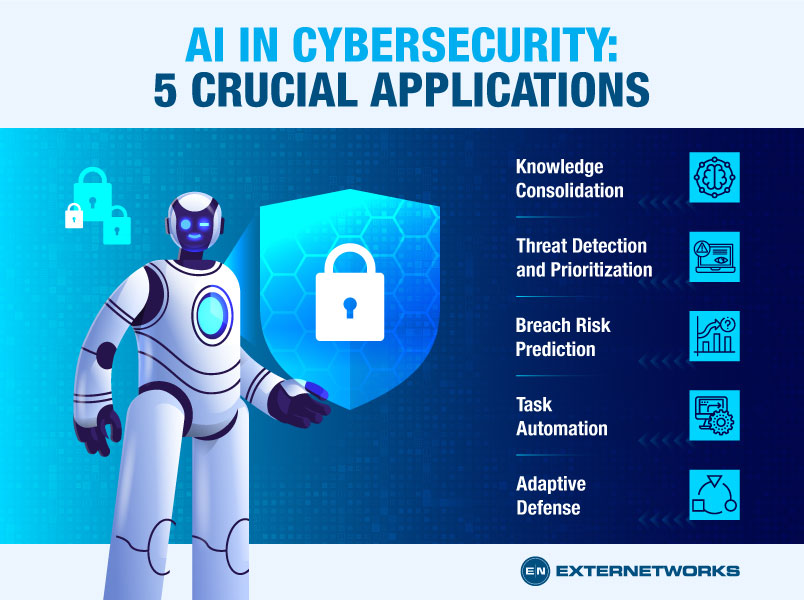
AI in cybersecurity has transformed how organizations prevent cyberattacks and secure their digital systems. Here are five crucial applications of AI in cybersecurity:
Knowledge Consolidation: AI analyzes system usage patterns and consolidates vast amounts of security data from various sources. By using advanced machine learning systems and algorithms, AI can identify patterns and correlations that human analysts may miss, improving threat detection and response.
Threat Detection and Prioritization: AI can quickly detect and prioritize new threats in real time. By continuously monitoring network traffic and analyzing security logs, AI can identify suspicious online activities and potential threats with minimal false positives. This lets security teams focus on the most critical threats and reduce response times.
Breach Risk Prediction: AI can predict breach risks by analyzing historical data and identifying potential vulnerabilities. By learning from previous incidents, AI can identify patterns and predict future malware attack vectors. This helps organizations proactively secure their systems and prevent potential attacks.
Task Automation: AI can automate repetitive tasks, such as vulnerability management and incident response. By automating these tasks, organizations can reduce human error and accelerate response times, mitigating potential risks more effectively.
Adaptive Defense: AI continuously learns and adapts to evolving threats, improving cybersecurity defenses over time. By leveraging deep learning techniques and neural networks, AI can uncover unknown threats and zero-day attacks, enhancing organizations’ overall security posture.
AI brings several advantages to cybersecurity. One key benefit is its ability to accurately detect cyberattacks. By leveraging advanced machine learning algorithms, AI can analyze vast amounts of data in real time, identifying patterns and correlations that human analysts may miss. This improves organizations’ overall threat detection and response capabilities.
Another advantage is AI’s capability to identify and flag suspicious emails in phishing campaigns. Phishing attacks remain a major cybersecurity concern, and AI can play a crucial role in mitigating this risk. By analyzing the content and behavior of AI-generated phishing emails, AI algorithms can accurately spot potential phishing attempts, alert users, and help prevent them from falling victim to such attacks.
AI can also simulate social engineering attacks, helping organizations assess and strengthen their security posture. By mimicking the tactics hackers use in social engineering campaigns, AI can identify potential vulnerabilities and weaknesses in an organization’s defenses. This allows security teams to implement proactive measures to prevent successful malware attacks.
Furthermore, AI excels at rapidly analyzing large amounts of incident-related data. This enables organizations to swiftly identify security breaches and respond effectively to minimize the impact. AI algorithms can process and make sense of data much faster than human analysts, enabling quicker incident response times.
Lastly, AI improves penetration testing by simulating malware attacks and identifying potential entry points that adversaries could exploit. This allows organizations to proactively address vulnerabilities and strengthen their security controls before actual attacks occur.
While AI brings significant advantages to cybersecurity, it also has downsides to consider. First, building and maintaining an AI system requires substantial resources and financial investment. Setting up the infrastructure, acquiring and training the machine learning models, and continuously updating and monitoring the system can be costly for organizations.
One major challenge is acquiring diverse, comprehensive datasets to train AI systems effectively. To achieve accurate results, the AI models need access to a wide range of real-world data, including various types of cyber threats and attacks. However, obtaining this data can be difficult because of privacy concerns and limited availability.
Additionally, relying on AI in cybersecurity can lead to incorrect results and false positives. Despite advancements in machine learning, AI algorithms may sometimes misinterpret or misclassify certain activities, leading to false alarms. This can cause security professionals to waste valuable time investigating non-existent threats or overlook genuine risks.
Moreover, cybercriminals can leverage the same AI technology that enhances cybersecurity. Hackers can use AI algorithms to launch more sophisticated, targeted attacks that evade traditional security measures. This poses a significant risk, as malicious use of AI can cause greater damage and create harder-to-detect cyber threats.
Conclusion
In conclusion, integrating AI technology into cybersecurity brings both opportunities and challenges. While AI can enhance security by preventing cyberattacks and detecting malicious activity in real time, it can also produce incorrect results and false positives.
Additionally, the reliance on AI in cybersecurity highlights the need for dedicated cybersecurity teams and budgets. Human expertise remains essential to interpret and verify AI-generated insights and respond effectively to security incidents.
Integrating AI technology in cybersecurity can significantly enhance overall security posture. It enables faster threat detection, reduces incident response times, and enhances vulnerability management. By automating repetitive tasks and reducing human error, AI helps cybersecurity professionals focus on more strategic and complex security concerns.
While it brings new capabilities and opportunities, it also requires careful attention to data quality, dedicated cybersecurity teams, and continued investment in security budgets. By harnessing AI, organizations can strengthen their security posture and better protect against evolving cyber threats.
At ExterNetworks, we understand the importance of staying one step ahead in the ever-evolving cyber threat landscape. With our proactive monitoring services, you can rest easy knowing we identify and address potential threats before they impact your organization. Our team of cybersecurity experts brings years of experience, ensuring your systems stay protected against the latest threats.
We offer customized solutions to fit your unique cybersecurity needs, ensuring you receive the level of protection your organization requires. We also help keep your organization compliant with industry regulations and standards, giving you peace of mind that your data is secure.
By choosing ExterNetworks for cyber threat monitoring services, you can save on the cost of hiring an in-house security team while still getting top-notch protection. Don’t wait until it’s too late—contact ExterNetworks today to learn more about how our services can benefit your organization.
See how ExterNetworks can help you with Managed NOC Services
Contact Us