Missed alerts turn into outages, outages turn into lost revenue. ExterNetworks Inc. delivers 24/7 NOC & Help Desk support to keep everything running smoothly.
Get 24/7 IT Support NowEvery 39 seconds, a cyberattack occurs somewhere in the world, putting personal information, business secrets, and financial records at risk. Data protection is the practice of safeguarding digital information from unauthorized access, corruption, or loss throughout its entire lifecycle—from creation to deletion. Think of it as a comprehensive security system for your digital assets, combining technical measures, organizational policies, and legal frameworks to keep sensitive information safe.
At its core, data protection addresses three fundamental challenges: preventing data breaches that expose confidential information, ensuring business continuity when systems fail, and complying with increasingly strict privacy regulations. Whether you’re handling customer payment details, employee records, or proprietary research, the stakes have never been higher. A single breach can cost millions in fines and irreparable damage to trust.
The landscape extends far beyond simple password protection. It encompasses encryption technologies, access controls, backup systems, and strategic policies that govern who can view, modify, or delete information. Modern data protection also requires understanding regulatory frameworks like GDPR and CCPA that define legal obligations for handling personal data—turning what was once purely a technical concern into a business-critical priority that touches every department.
Data security forms the backbone of data protection, focusing on the technical safeguards that prevent unauthorized access to information. Think of it as building layers of defense—from encryption that scrambles data into unreadable code, to access controls that ensure only authorized individuals can view sensitive information.
However, data protection extends beyond just security measures. According to the European Commission, it encompasses the entire lifecycle of data management—how information is collected, stored, processed, shared, and eventually deleted. This holistic approach means organizations must consider both the “how” (technical measures) and the “why” (legitimate purposes for data use).
The relationship between data security and broader protection practices creates a comprehensive shield. Security tools like firewalls, encryption protect against external threats, and while governance policies ensure internal processes respect privacy rights. Data protection requires both technological solutions and human accountability—a robust system combines secure infrastructure with clear policies about who accesses data, for what purpose, and under what circumstances. Proofpoint emphasizes that effective protection strategies must address three core elements: confidentiality (keeping information private), integrity (maintaining accuracy), and availability (ensuring authorized access when needed).
At the heart of effective data protection lie several foundational principles that guide how organizations should handle information responsibly. These principles, formalized in regulations like the General Data Protection Regulation (GDPR), establish clear rules for collecting, storing, and processing data while respecting individual rights.
Data privacy demands that organizations collect only the information they truly need—a concept known as data minimization. Rather than hoarding vast amounts of personal details “just in case,” companies should gather the minimum necessary to accomplish their stated purpose. This reduces risk exposure and builds trust with users who increasingly question why businesses need their information.
Transparency represents another cornerstone principle. Organizations must clearly communicate what data they collect, how they use it, and who has access to it. No hidden agendas or buried terms—just straightforward explanations that anyone can understand. According to Imperva, this openness helps individuals make informed decisions about sharing their information.
Purpose limitation ensures data serves only its original, specified function. If you collect email addresses for order confirmations, you can’t suddenly use them for marketing campaigns without explicit consent. This principle protects against buffer overflow attacks and other unauthorized data uses that compromise user trust and security.
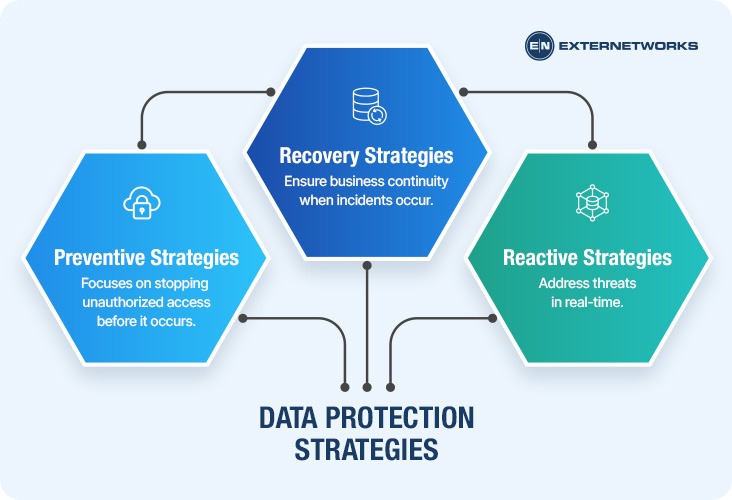
Organizations implement multiple layers of information security strategies to protect data throughout its lifecycle. These approaches work together to create comprehensive protection against various threats and compliance requirements.
Preventive strategies focus on stopping unauthorized access before it occurs. Access controls limit who can view or modify data based on roles and permissions. Encryption transforms data into unreadable formats for unauthorized users, while firewalls and network segmentation create barriers between sensitive information and potential threats. Strong authentication requirements—including multi-factor authentication—add additional verification layers before granting access.
Recovery strategies ensure business continuity when incidents occur. Regular data backups create copies stored in separate locations, allowing organizations to restore information after loss or corruption. Disaster recovery plans outline specific procedures for restoring operations following catastrophic events, while implementing ransomware protections helps prevent malicious encryption attacks.
Reactive strategies address threats in real-time. Intrusion detection systems monitor networks for suspicious activity, triggering alerts when unusual patterns emerge. Security teams conduct regular vulnerability assessments to identify weaknesses before attackers exploit them. However, reactive measures prove most effective when combined with preventive approaches—waiting to respond until after an attack begins typically results in higher costs and more extensive damage.
Organizations deploy multiple technical safeguards to protect personal data and other sensitive information from unauthorized access or loss. Encryption stands as the most fundamental technique—transforming readable data into coded format that requires specific keys to decrypt. According to IBM, encryption should protect data both “at rest” (stored on devices or servers) and “in transit” (moving across networks). Modern encryption algorithms like AES-256 create virtually unbreakable barriers around sensitive information.
Access control mechanisms ensure only authorized individuals can view or modify specific data sets. Role-based access control (RBAC) assigns permissions based on job functions, while multi-factor authentication adds extra verification layers beyond simple passwords. Proofpoint emphasizes that organizations should implement the principle of least privilege—granting users only the minimum access necessary for their responsibilities.
Data masking and tokenization provide additional protection layers. Masking replaces sensitive data elements with fictional values in non-production environments, allowing teams to work with realistic datasets without exposing actual personal data. Tokenization substitutes sensitive values with unique identifiers, making intercepted data worthless to attackers. These techniques prove particularly valuable for handling payment information and health records, where safeguarding sensitive data transmission becomes critical to preventing breaches.
Despite robust technical safeguards and comprehensive frameworks, organizations face persistent obstacles in protecting sensitive data effectively. The evolving threat landscape presents a moving target—cybercriminals continuously develop sophisticated techniques to circumvent existing defenses, making yesterday’s solutions insufficient for today’s threats.
Human error remains the most significant vulnerability in data protection systems. According to IBM, employees accidentally expose confidential information through misconfigured databases, falling victim to phishing schemes, or mishandling data during routine operations. No amount of encryption or access controls can fully compensate for these human factors.
Resource constraints create additional barriers, particularly for smaller organizations. Implementing enterprise-grade protection requires substantial investment in technology, personnel training, and ongoing maintenance. Many businesses struggle to balance security needs against operational budgets, often leaving gaps in their defenses.
The complexity of modern IT environments compounds these challenges. Organizations typically manage data across multiple platforms—cloud services, on-premises servers, mobile devices, and third-party applications. Each system introduces potential vulnerabilities, and coordinating protection across this fragmented landscape demands considerable expertise. What typically happens is that account takeover attacks exploit these integration points where security controls weaken.
Legacy systems present another persistent limitation. Older infrastructure often lacks compatibility with current security tools, creating protected islands within otherwise secured networks that ransomware can target.
The General Data Protection Regulation (GDPR) represents the most comprehensive data protection framework globally, establishing strict requirements for organizations processing personal data of EU residents. Implemented in 2018, GDPR transformed how businesses approach data protection by making privacy a fundamental right rather than an afterthought.
GDPR enforces seven core principles that align with technical safeguards like the CIA triad. Organizations must demonstrate lawfulness, fairness, and transparency in data collection; limit processing to specified, legitimate purposes; and collect only data adequate and relevant for their stated purpose. The regulation mandates data accuracy, storage limitation, and security through appropriate technical measures, creating accountability frameworks that extend beyond EU borders.
The regulation’s extraterritorial reach means any organization serving EU customers must comply, regardless of physical location. Non-compliance carries substantial penalties—up to €20 million or 4% of global annual revenue, whichever is higher. However, GDPR isn’t merely punitive. It empowers individuals with rights to access, rectify, and erase their data while requiring organizations to report breaches within 72 hours. This framework has inspired similar legislation worldwide, from California’s CCPA to Brazil’s LGPD, establishing GDPR as the de facto global standard for data privacy protection.
Understanding data protection becomes clearer when examining how organizations apply these principles in everyday situations. Consider a healthcare provider managing patient records. The organization implements confidentiality controls by encrypting electronic health records and restricting access to authorized medical staff only. When a patient transfers to another facility, the healthcare provider verifies the recipient’s identity before transmitting records through secure channels, demonstrating both integrity and controlled data sharing.
In another scenario, an e-commerce company experiences a ransomware attack targeting customer payment information. Because the organization maintained encrypted backups stored separately from primary systems, they quickly restored their operations without paying the ransom or losing customer data. This illustrates how backup strategies and security measures work together to maintain availability during incidents.
A financial institution provides a third example when processing loan applications. The bank collects only necessary information—income verification, credit history, and employment details—rather than requesting unrelated personal data. Applicants receive clear explanations about how their information will be used, and the institution automatically deletes application records after regulatory retention periods expire. This scenario demonstrates data minimization, transparency, and purposeful retention working in concert to protect customer privacy while fulfilling business requirements.
Data protection stands as a fundamental pillar of modern digital operations, combining technical safeguards with legal compliance to secure sensitive information throughout its lifecycle. Organizations must balance protecting data from cyber threats and unauthorized access with maintaining operational efficiency and meeting regulatory obligations.
Remember these core principles as you implement data protection strategies: confidentiality ensures only authorized parties access information, integrity maintains data accuracy and reliability, and availability guarantees information remains accessible when needed. Success requires implementing multiple protective layers—from encryption and access controls to regular backups and employee training programs.
The evolving threat landscape and expanding regulatory requirements make data protection an ongoing commitment rather than a one-time project. Organizations that prioritize data protection not only reduce their risk exposure but also build customer trust and competitive advantage in an increasingly privacy-conscious marketplace.
Start your data protection journey today by assessing your current practices against regulatory requirements, identifying your most critical assets, and establishing clear policies that align technical controls with business objectives. Whether you’re protecting customer information, intellectual property, or operational data, the principles outlined here provide a roadmap for developing comprehensive protection strategies that evolve with emerging threats and opportunities.
See how ExterNetworks can help you with Managed NOC Services
Contact Us