Missed alerts turn into outages, outages turn into lost revenue. ExterNetworks Inc. delivers 24/7 NOC & Help Desk support to keep everything running smoothly.
Get 24/7 IT Support NowThink of middleware as the digital translator that makes your technology speak the same language. When you stream a movie, book a flight, or check your bank balance online, middleware is working behind the scenes—connecting systems that were never designed to work together. It’s the software layer that sits between your operating system and the applications you use, orchestrating seamless data flow across distributed systems that might span continents.
Here’s what makes middleware essential: modern businesses don’t run on single, monolithic platforms anymore. According to Red Hat, organizations typically operate dozens or even hundreds of different applications simultaneously. Your customer relationship management tool needs to talk to your inventory system. Your mobile app needs to sync with your database. Your legacy accounting software needs to share data with your cloud-based analytics platform.
Middleware bridges these gaps—it’s the connective tissue that transforms isolated software components into a cohesive digital ecosystem. Without it, developers would need to write custom integration code for every single connection between systems, a process that’s both expensive and error-prone.
At its core, middleware provides standardized services like messaging, authentication, API management, and data transformation. These building blocks let different applications communicate regardless of where they’re hosted, what programming languages they use, or when they were built. The result? Your tech stack works as one unified system, even when it’s actually a patchwork of different vendors, platforms, and technologies.
Now let’s explore the specific types of middleware that power these critical connections.
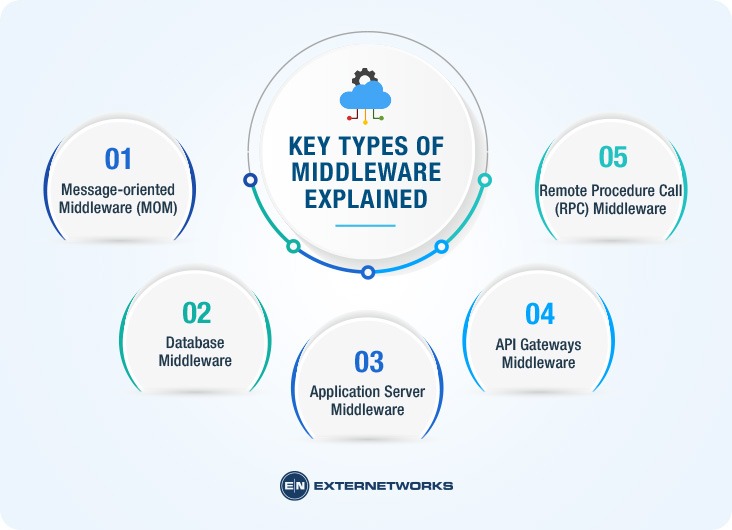
Understanding what is middleware becomes clearer when you see how different types solve specific challenges. Each category tackles distinct problems in modern software architecture—from connecting databases to managing API traffic across continents.
Message-oriented middleware (MOM) handles asynchronous communication between applications. When one system sends data but doesn’t need an immediate response, MOM queues that message and delivers it when the receiving application is ready. Think of email systems or order processing workflows where instant responses aren’t critical. Popular implementations include RabbitMQ and Apache Kafka, which process millions of messages daily.
Database middleware creates a unified layer between applications and multiple databases. Rather than your application connecting directly to PostgreSQL, MySQL, and MongoDB separately, this middleware presents a single interface. It’s particularly valuable for enterprises managing legacy systems alongside modern cloud databases.
Application server middleware provides the runtime environment where business logic lives. These platforms handle transaction management, security, and resource allocation—letting developers focus on features instead of infrastructure concerns.
API gateways and integration middleware act as traffic controllers for microservices architectures. They authenticate requests, route traffic intelligently, and transform data formats on the fly. However, they introduce a potential single point of failure if not properly designed with redundancy.
Remote Procedure Call (RPC) middleware makes calling functions on remote servers feel like local function calls, abstracting away network complexity entirely. This streamlines distributed application development considerably.
Each type addresses different architectural needs—and many systems employ multiple middleware categories simultaneously to create robust, scalable solutions.
When your banking app synchronizes across your phone, tablet, and laptop, middleware software orchestrates that seamless experience behind the scenes. In distributed systems—where applications run across multiple servers, locations, and platforms—middleware becomes the essential glue that holds everything together.
Here’s the critical challenge: modern applications often need to communicate with dozens of services simultaneously. Your ride-sharing app, for example, must coordinate GPS services, payment processors, driver databases, and mapping systems—all in real-time. Without middleware, developers would need to write custom integration code for every single connection, creating a maintenance nightmare.
Middleware acts as the communication backbone, handling message routing, data transformation, and protocol translation automatically. Think of it as a sophisticated post office that not only delivers messages but also translates them into the recipient’s preferred format, tracks delivery status, and ensures nothing gets lost along the way.
The efficiency gains are substantial. According to AWS, middleware enables organizations to build distributed applications faster by providing pre-built functionality for common tasks like authentication, logging, and error handling. Instead of reinventing the wheel, development teams can focus on building features that directly serve their users.
The payoff? Applications that scale across continents while maintaining consistency, security, and performance—all managed through standardized middleware layers rather than fragile point-to-point connections.
Despite its critical role in modern software architecture, middleware remains widely misunderstood. One persistent myth suggests that application middleware exists as a single, monolithic product you simply install and configure. In reality, middleware encompasses diverse technologies—from message queues to API gateways—each addressing specific integration challenges. There’s no one-size-fits-all middleware solution.
Another common fallacy? That middleware only matters for enterprise-scale operations. Small development teams frequently dismiss middleware as “unnecessary complexity.” However, even modest applications benefit from middleware components. That authentication layer protecting your startup’s API? Middleware. The caching mechanism speeding up your blog? Also middleware. Scale doesn’t dictate middleware’s relevance; architectural needs do.
Many developers conflate middleware with APIs themselves, assuming they’re interchangeable terms. This oversimplification obscures middleware’s true function: middleware enables and manages APIs but operates at a different architectural layer. It’s the infrastructure that makes API communication reliable, secure, and scalable.
Perhaps the most damaging misconception? Viewing middleware as purely technical plumbing—just code connecting other code. This perspective ignores middleware’s strategic value. The right middleware choices directly impact application performance, security posture, and development velocity. When distributed systems fail, middleware configurations are often the culprit, not the applications themselves.
Understanding these distinctions matters because misconceptions lead to poor architectural decisions. Teams either over-engineer simple projects with unnecessary middleware layers or under-invest in critical integration infrastructure, creating technical debt that compounds over time.
Understanding middleware concepts becomes clearer when you see how organizations solve real problems with these essential tools. Let’s examine practical scenarios where the middleware layer transforms complex technical challenges into manageable solutions.
Consider an online retailer processing thousands of transactions daily across multiple payment providers. Their middleware layer acts as the orchestration hub, routing payment requests to PayPal, Stripe, or traditional credit card processors based on customer preference and availability. When one provider experiences downtime, the middleware automatically reroutes transactions to backup systems—ensuring customers never see a failed checkout page. The shop’s internal inventory system, shipping platform, and accounting software all receive synchronized updates through this same middleware backbone.
A regional hospital network demonstrates middleware’s critical role in patient care coordination. Their system integrates electronic health records across five facilities, each using different legacy systems installed over two decades. Message-oriented middleware enables real-time sharing of lab results, medication lists, and treatment plans. When a patient visits the emergency room, physicians instantly access their complete medical history—regardless of which facility originally created those records.
Video streaming platforms showcase API gateway middleware managing millions of simultaneous requests. The middleware handles user authentication, selects optimal content delivery networks based on geographic location, and manages subscription verification—all within milliseconds. This invisible infrastructure ensures smooth playback whether you’re watching on your television, phone, or laptop.
While middleware serves as essential software glue connecting disparate systems, it introduces specific challenges that architects must navigate carefully. Understanding these limitations helps you make informed decisions about when and how to deploy middleware solutions.
Every middleware layer adds processing time to your application stack. According to Microsoft Azure’s middleware documentation, each additional abstraction layer can introduce measurable latency, particularly problematic for real-time applications requiring millisecond-level responsiveness. Organizations must balance the benefits of integration against potential performance degradation.
Middleware introduces architectural complexity that requires specialized expertise to maintain. TechTarget notes that troubleshooting becomes more challenging when multiple middleware layers interact, as errors can propagate unpredictably through the stack. Your team needs specific skills to manage these systems effectively—knowledge that may not transfer easily when staff changes occur.
Proprietary middleware platforms can create dependency relationships that limit your architectural flexibility over time. Migration costs escalate quickly when business logic becomes deeply embedded in vendor-specific APIs and frameworks.
Each middleware component represents an additional attack vector that requires monitoring and patching. A compromised middleware layer can potentially expose all connected systems, making security oversight absolutely critical but increasingly complex as your middleware footprint grows.
Before implementing middleware, assess whether simpler alternatives—like direct API integration or microservices patterns—might solve your specific problem without introducing these trade-offs.
Middleware stands as the critical software layer that powers modern application integration and enables digital transformation across industries. Whether you’re managing a small business or architecting enterprise systems, understanding middleware fundamentals positions you to make smarter technology decisions.
Remember these essential points:
Middleware solves connectivity challenges by acting as intermediary software between applications, databases, and services—eliminating the need for direct point-to-point connections that become unmanageable at scale. Amazon Web Services defines middleware as the foundation for building scalable, resilient systems.
Multiple middleware types serve specific needs: message-oriented middleware for asynchronous communication, API management for service exposure, integration platforms for complex workflows, and authentication middleware for security. Choosing the right type depends on your architectural goals and business requirements.
Implementation requires strategic planning: successful middleware deployment balances performance optimization, security protocols, and vendor considerations. Organizations that treat middleware as critical infrastructure—not just technical plumbing—see measurable improvements in system reliability and development velocity.
As cloud-native architectures and microservices continue reshaping technology landscapes, middleware evolves from traditional monolithic platforms to lightweight, containerized solutions. Your next step? Assess your current integration challenges, evaluate how middleware patterns could simplify your architecture, and explore modern platforms that align with your strategic vision. The right middleware choice today becomes your competitive advantage tomorrow.
See how ExterNetworks can help you with Managed NOC Services
Contact Us