Missed alerts turn into outages, outages turn into lost revenue. ExterNetworks Inc. delivers 24/7 NOC & Help Desk support to keep everything running smoothly.
Get 24/7 IT Support NowEvery second, billions of data packets navigate complex networks to reach their destinations—a feat impossible without routing protocols. These fundamental communication standards determine how routers share network topology information and select optimal paths for data transmission. Think of routing protocols as the GPS systems of the Internet, constantly updating and recalculating the best routes between source and destination.
At their core, routing protocols enable routers to build and maintain routing tables—databases that map network destinations to specific forwarding paths. Without these protocols, network administrators would need to manually configure every route on every router, an impossible task in modern enterprise environments with hundreds or thousands of network segments.
The landscape of routing protocols spans from legacy systems like RIP (Routing Information Protocol), which uses simple hop counts to determine paths, to sophisticated protocols that manage traffic between autonomous systems. Different protocol types serve distinct purposes: some excel within single organizations (interior gateway protocols), while others connect separate networks across the global Internet (exterior gateway protocols).
Understanding how routing protocols function reveals a critical truth: network reliability depends entirely on how well routers exchange and process routing information. The protocol choice directly impacts convergence speed, bandwidth consumption, and network scalability.
Network administrators categorize routing protocols based on how they operate and where they function within a network infrastructure. Understanding the types of routing protocols enables organizations to select the right approach for their specific network architecture and performance requirements.
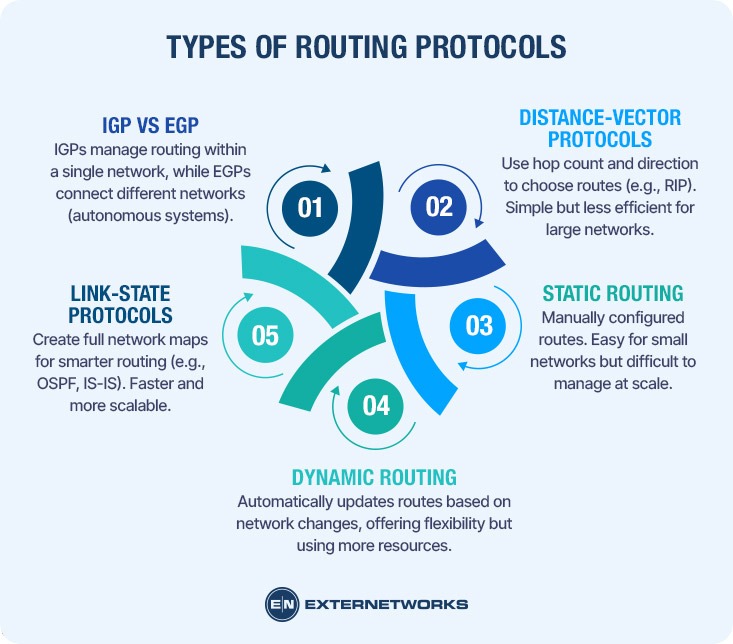
Routing protocols divide into two fundamental categories: Interior Gateway Protocols (IGPs) and Exterior Gateway Protocols (EGPs). IGPs manage routing within a single autonomous system—essentially a network under one administrative control—while EGPs handle routing between different autonomous systems. This distinction determines where and how each protocol operates.
Within IGPs, protocols are further subdivided into distance-vector and link-state categories based on their algorithmic approaches. Distance-vector protocols like RIP make routing decisions based on hop count and direction, sharing routing tables with neighboring routers. In contrast, link-state protocols such as OSPF and IS-IS build complete network topology maps, enabling more sophisticated path calculations. IS-IS particularly excels in large service-provider networks due to its scalability and fast convergence.
Another classification separates static from dynamic protocols. Static routing requires manual configuration of every route—practical for small networks but unmanageable at scale. Dynamic protocols automatically discover routes and adapt to network changes, though they consume more processing resources. Organizations often implement hybrid approaches combining both methods to balance control with automation.
Several routing protocols have become industry standards, each designed to solve specific networking challenges. Among the most widely deployed distance vector protocols, RIP (Routing Information Protocol) remains common in smaller networks despite its age. RIP uses hop count as its sole metric, limiting scalability with a maximum of 15 hops before declaring a destination unreachable.
OSPF (Open Shortest Path First) dominates enterprise environments as a link-state protocol that computes shortest paths using Dijkstra’s algorithm. Unlike RIP, OSPF considers bandwidth, delay, and reliability when determining optimal routes, making it significantly more sophisticated for complex networks.
BGP (Border Gateway Protocol) serves as the backbone routing protocol for the Internet, connecting autonomous systems worldwide. This path vector protocol evaluates multiple attributes beyond simple metrics, including policy-based routing decisions that network administrators configure based on business requirements.
EIGRP (Enhanced Interior Gateway Routing Protocol), originally Cisco-proprietary but now partially open, combines distance-vector and link-state routing. It uses composite metrics that incorporate bandwidth, delay, load, and reliability—enabling faster convergence than traditional distance-vector protocols while maintaining lower overhead than pure link-state alternatives.
Each protocol balances convergence speed, scalability, and resource consumption differently, making the selection process critical for network architecture decisions.
Operating at the network layer of the OSI model, Layer 3 routing protocols determine optimal paths for IP packets across interconnected networks. These protocols function at the same layer where IP addressing occurs, making them fundamental to Internet and enterprise network operations.
Layer 3 protocols fall into two primary operational categories. Link-state protocols, such as OSPF, maintain a complete network topology by exchanging detailed information about all router connections. Each router independently calculates the shortest path to every destination using algorithms like Dijkstra’s shortest path first. According to Routing Protocol Characteristics, this approach enables faster convergence but requires more processing power and memory.
Distance vector protocols take a fundamentally different approach. Rather than mapping the entire network, they share routing tables with neighboring routers and calculate paths based on hop count or other metrics. RIP exemplifies this simpler methodology, though its maximum 15-hop limit restricts scalability.
The choice between protocol types depends on network size and complexity. Organizations with extensive IPv4 or IPv6 networks typically favor link-state protocols for their superior scalability and detailed network visibility, while smaller environments may find distance-vector protocols adequate for their needs.
Understanding how routing protocols function in real-world environments reveals their practical value across different network scenarios. Each protocol type addresses specific operational requirements, from small office networks to global internet infrastructure.
Large corporate campuses typically deploy OSPF for internal routing due to its rapid convergence and hierarchical design. In a multi-building campus with thousands of endpoints, OSPF segments the network into areas that reduce routing overhead while maintaining complete visibility across departments. Cisco notes that OSPF’s ability to calculate alternate paths within milliseconds makes it ideal for mission-critical applications where downtime costs thousands per minute.
Internet service providers rely on BGP to exchange routing information between autonomous systems. When a major content delivery network updates its routes, BGP propagates these changes across thousands of interconnected networks globally. The protocol’s path-vector approach prevents routing loops while allowing providers to implement sophisticated traffic-engineering policies based on business relationships and capacity constraints.
Modern enterprises often strategically combine protocols—using EIGRP for regional office connectivity while leveraging secure VPN tunnels for remote site integration. This approach balances the need for rapid convergence with security requirements, demonstrating how protocol selection directly impacts network performance and resilience.
Selecting the appropriate routing protocol requires careful evaluation of your network’s size, topology, and operational requirements. Network scale is the primary decision factor—small- to medium-sized enterprises typically benefit from EIGRP or OSPF for internal routing. At the same time, organizations requiring internet connectivity must implement BGP at their network edge.
Convergence speed directly impacts application performance and user experience. Networks supporting real-time applications such as VoIP or video conferencing require protocols with sub-second convergence times. OSPF and EIGRP excel in these scenarios by rapidly recalculating paths when link failures occur.
Administrative overhead represents another critical consideration. RIP’s simplicity makes it attractive for basic networks with minimal IT resources, while OSPF’s hierarchical design requires more planning but scales efficiently. Organizations must also evaluate vendor environments—while EIGRP performs exceptionally well, its Cisco-centric heritage may limit deployment in multi-vendor infrastructures despite RFC standardization.
Security requirements also influence protocol selection. Modern networks increasingly prioritize complete control over routing decisions, particularly when handling sensitive data. OSPF’s authentication mechanisms and BGP’s extensive filtering capabilities provide robust protection against routing attacks, whereas simpler protocols offer limited security features. The right choice ultimately balances technical capabilities against operational constraints and business objectives.
No single routing protocol is best for every cloud or hybrid network. BGP is commonly preferred for hybrid and multi-cloud connectivity because it supports dynamic route exchange between on-premises networks, cloud environments, VPNs, and dedicated connectivity services. However, the appropriate design depends on the cloud provider, network architecture, and connectivity method.
Cloud environments typically use cloud-native route tables to determine how traffic is forwarded between virtual networks, subnets, VPN gateways, and other network resources. These route tables work alongside routing protocols rather than replacing them.
For hybrid networks, BGP can dynamically exchange routes between on-premises routers and cloud VPN or dedicated-connectivity gateways. This avoids maintaining large numbers of static routes and allows routes to update automatically when network paths change. Site-to-site VPNs may use BGP for dynamic routing, while simpler deployments can use static routes.
When selecting a routing approach, organizations should consider:
In a hybrid environment, a common design uses BGP between on-premises routers and cloud connectivity gateways, while relying on each cloud platform’s native route tables to forward traffic within the cloud environment.
Yes, multiple routing protocols can operate on the same network, particularly in large, multi-vendor, or transitional environments. For example, an organization may use OSPF internally while BGP handles connectivity with an ISP or external networks. Organizations may also use different protocols across separate network segments based on scalability, policy, or operational requirements.
Route Redistribution
When multiple routing protocols need to exchange routes, route redistribution enables one protocol to advertise routes learned by another. For example, BGP can receive routes learned through OSPF, and vice versa. Carefully control redistribution using route maps, prefix lists, filters, and metrics to prevent unwanted routes from entering the routing table.
Common Use Cases
Running multiple routing protocols can be useful for:
Risks and Challenges
Multiple routing protocols increase network complexity and can introduce routing loops, inconsistent routes, suboptimal paths, and route instability if they are poorly configured. Redistribution can also create duplicate routes or allow routing information to circulate repeatedly between protocols. Troubleshooting becomes harder because administrators must understand each protocol’s behavior and route-selection rules.
Configuration Considerations
Before deploying multiple routing protocols, administrators should define clear routing boundaries and determine which protocol has authority over specific prefixes. Configure redistribution selectively rather than exchanging every available route, apply filtering and route summarization where appropriate, and set appropriate metrics and administrative distances. Testing redistribution, documenting routing policies, and monitoring route changes also help prevent unexpected traffic paths or outages.
In practice, multiple routing protocols can coexist effectively when each has a clearly defined role and route redistribution is tightly controlled.
While routing protocols form the backbone of network operations, they come with inherent constraints that network administrators must navigate carefully. Understanding these limitations helps prevent costly misconfigurations and performance degradation.
Each Interior Gateway Protocol IGP has defined scalability thresholds that determine network design decisions. OSPF networks face area constraints, typically supporting 50-100 routers per area before performance degrades noticeably. According to routing protocol characteristics analysis, EIGRP handles larger deployments more effectively but requires careful route summarization in networks with more than 200 routers.
Routing protocols consume network bandwidth, CPU cycles, and memory—resources that directly impact operational costs. Link-state protocols like OSPF demand more memory to maintain topology databases, while distance-vector protocols generate frequent update traffic. Organizations must balance protocol sophistication against available infrastructure capacity, particularly in environments with legacy equipment.
The time required for routing tables to stabilize after topology changes can lead to service disruptions. Networks that rely on count-to-infinity resolution mechanisms may experience temporary routing loops or black holes during convergence. However, modern protocols with triggered updates and hold-down timers significantly mitigate these risks when properly configured.
Routing protocols represent the foundational intelligence that keeps modern networks operational, from small office environments to global internet infrastructure. Understanding these protocols moves beyond theoretical knowledge—it directly impacts network reliability, security, and performance in practical deployments.
Distance vector protocols like RIP remain relevant for simple networks, while link-state protocols such as OSPF deliver superior scalability for enterprise environments. Hybrid approaches, including EIGRP, combine the benefits of both methodologies, offering fast convergence with reduced overhead. Meanwhile, BGP maintains its dominance as the protocol steering internet traffic between autonomous systems worldwide.
The choice between protocols ultimately depends on specific network requirements: topology complexity, convergence speed requirements, tolerance for administrative overhead, and security considerations. Static routing still serves certain data transmission scenarios effectively, particularly in highly controlled environments where predictability outweighs flexibility.
As networks evolve toward software-defined architectures and cloud-native designs, traditional routing protocols continue to adapt as new paradigms emerge. Network professionals must maintain awareness of both established protocols and emerging technologies to architect resilient, efficient infrastructure that meets contemporary business demands while positioning organizations for future connectivity challenges.
See how ExterNetworks can help you with Managed NOC Services
Contact Us