Missed alerts turn into outages, outages turn into lost revenue. ExterNetworks Inc. delivers 24/7 NOC & Help Desk support to keep everything running smoothly.
Get 24/7 IT Support NowNetwork management is the backbone of any functioning IT environment. Without it, even a small business network can quickly spiral into chaos—leading to dropped connections, security gaps, and performance bottlenecks that are difficult to diagnose and resolve quickly.
At its core, network management refers to the processes, tools, and practices used to administer, operate, and maintain a computer network.
This includes everything from monitoring traffic and configuring devices to troubleshooting failures and enforcing security policies. According to Kaseya, effective network management keeps infrastructure running reliably while giving IT teams the visibility they need to act quickly.
A well-managed network isn’t just a technical achievement—it’s a business advantage. Organizations that invest in proactive oversight, whether through in-house teams or dedicated monitoring services, experience fewer outages and faster incident resolution.
Before diving into tools and tactics, it helps to understand the fundamentals.
A network management system (NMS) combines tools, processes, and protocols to monitor, control, and maintain network health and performance. Think of it like an airport control tower—everything flows through it, and without proper oversight, disruptions can escalate quickly.
Network management is commonly divided into five core functions, known as the FCAPS model:
These functions work together to ensure smooth operations across both small and enterprise-scale environments.
In practice, modern monitoring tools provide administrators with real-time visibility into every device on the network—from routers and switches to endpoints and cloud resources.
A structured approach to network management transforms reactive troubleshooting into proactive control, reducing downtime before it impacts users.
A network is only as reliable as the systems monitoring it. When something goes wrong—and eventually, something always does—organizations without proper oversight often struggle to identify the issue, usually after users have already been affected. This reactive approach can be costly.
Network management helps businesses stay ahead of these disruptions. A well-deployed NMS doesn’t just react to problems—it identifies early warning signs, enabling teams to resolve issues before they escalate into outages. According to Kaseya, unplanned downtime can cost businesses thousands of dollars per minute, making proactive monitoring far more cost-effective than reactive troubleshooting.
Beyond uptime, network management enforces security policies, optimizes bandwidth, and supports compliance requirements. Organizations that invest in structured oversight typically experience fewer disruptions and faster recovery times.
Strong network management transforms IT teams from reactive responders into proactive operators—significantly reducing operational risk.
Network management is not a single discipline—it’s a collection of functions that address different aspects of network operations. Understanding these categories highlights why a comprehensive approach is essential.
The FCAPS framework includes:
Network monitoring sits at the center of these functions. Without continuous visibility, issues often go undetected until they impact users.
In practice, many organizations separate monitoring from broader management tasks—using dedicated tools for real-time visibility while other systems handle configuration and security.
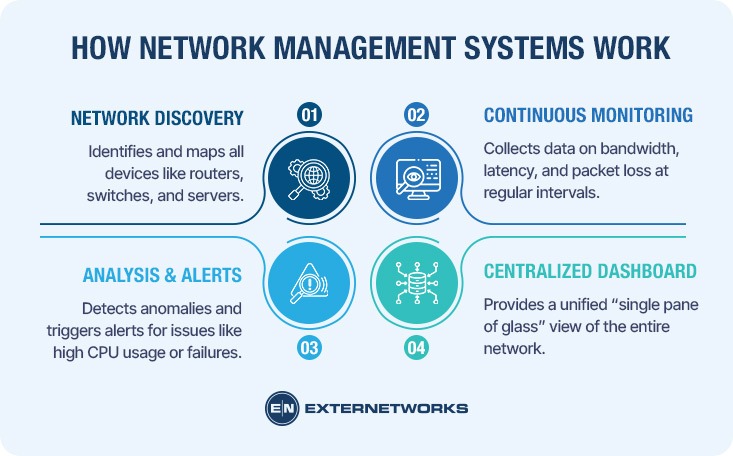
Network management systems operate through a continuous cycle: discover, monitor, analyze, and respond.
First, the system identifies and maps all devices on the network—routers, switches, servers, and endpoints. These devices are then polled at regular intervals to collect performance data such as bandwidth usage, latency, and packet loss.
This data feeds into centralized dashboards where automated rules detect anomalies. For example, if CPU usage on a core router exceeds a defined threshold, an alert is triggered before a full outage occurs. Security monitoring runs in parallel, scanning for unusual traffic patterns that may indicate potential threats.
This centralized approach provides teams with a unified view—often described as a “single pane of glass”—across the entire environment.
Understanding how network management works also requires familiarity with the tools and protocols involved.
SNMP (Simple Network Management Protocol) is widely used to collect device data, allowing systems to poll routers, switches, and servers for performance metrics such as bandwidth usage, CPU load, and error rates.
Other common tools include:
Organizations often combine these tools to gain a more complete view. For example, syslog servers capture anomalies that SNMP polling may miss, while flow data provides broader traffic insights.
While network management is essential, implementing it effectively presents several challenges.
Scale and complexity are major hurdles. As networks grow—with more devices, users, and cloud integrations—maintaining visibility becomes increasingly difficult.
Fault management is another challenge. Detecting issues is only the first step; identifying root causes quickly requires well-tuned alerts and clear escalation processes.
Security adds further complexity. Monitoring for threats without impacting performance requires careful balance.
Finally, the human factor plays a critical role. Even the best tools depend on skilled professionals who can interpret data and act decisively. Clear documentation and defined ownership are just as important as the technology itself.
Practical examples help illustrate how network management works in real-world situations.
Scenario 1: A retail company opens a new branch office. The IT team must configure routers, switches, and firewalls before employees can connect. Standardized configuration templates ensure consistency, reduce setup time, and minimize errors.
Scenario 2: An e-commerce company experiences a surge in traffic during a major sale. A centralized monitoring system detects unusual bandwidth usage, triggers alerts, and enables the team to reroute traffic before customers experience slowdowns.
Both scenarios highlight a key principle: proactive management prevents small issues from becoming major outages.
Network management is the foundation of a reliable, secure, and scalable IT environment. Whether managing a small office or a large enterprise network, the core principles remain consistent: monitor continuously, respond quickly, plan proactively, and document thoroughly.
A well-managed network is the result of deliberate processes, the right tools, and clear ownership.
As networks become more complex, structured management becomes increasingly critical. For organizations just getting started, exploring managed services or partnering with a NOC provider can be a practical next step.
See how ExterNetworks can help you with Managed NOC Services
Contact Us