Missed alerts turn into outages, outages turn into lost revenue. ExterNetworks Inc. delivers 24/7 NOC & Help Desk support to keep everything running smoothly.
Get 24/7 IT Support NowData is one of the most valuable assets an organization holds — and one of the most difficult to manage responsibly. Information governance is the framework of policies, processes, and accountability structures that determines how organizations create, store, use, and dispose of information assets. Done well, it protects the business, ensures compliance, and turns raw data into a strategic advantage.
The stakes are high. According to Best Practices for Information Governance, organizations without a coherent governance strategy routinely face regulatory penalties, data breaches, and costly inefficiencies driven by poor data quality.
At its core, information governance answers a deceptively simple question: Who is responsible for what data, and how should it be handled? The answer spans legal, IT, compliance, records management, and executive leadership — which is precisely what makes governance challenging to execute.
Effective information governance isn’t a one-time project; it’s an ongoing discipline that evolves alongside regulatory requirements, business growth, and emerging technologies.
The path from intention to execution, however, is rarely straightforward. Organizations consistently run into the same structural and cultural obstacles — and understanding those hurdles is the essential first step.
Even organizations committed to an information governance program often struggle to get programs off the ground — or keep them running. Understanding where these efforts typically break down is the first step toward building something more resilient.
Siloed data ownership is one of the most persistent obstacles. When departments manage their own data independently, inconsistencies multiply. Legal may define “customer record” differently than marketing or operations, creating downstream compliance headaches.
A few other challenges surface repeatedly across industries:
According to Access, many organizations also underestimate the cultural dimension — governance is as much a people problem as a technology problem.
The most durable governance programs treat these challenges as design inputs, not afterthoughts. Acknowledging them early shapes better policies, clearer ownership structures, and more realistic implementation timelines — exactly what the following real-world example demonstrates.
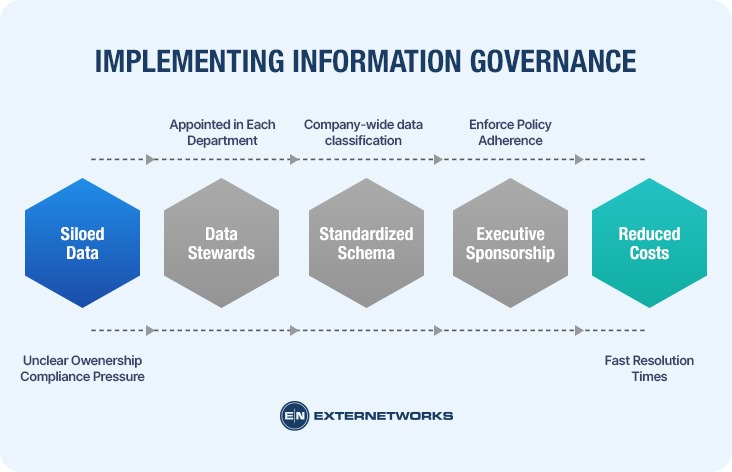
Seeing an information governance program in action clarifies what’s possible when an organization moves beyond theory. Consider a mid-sized financial services firm struggling with the exact challenges covered in the previous section — siloed data, unclear ownership, and mounting compliance pressure.
The core problem: Different departments were managing customer records independently, with no unified policy dictating retention, Access, or disposal. Regulatory audits were expensive and stressful, and sensitive data was often duplicated across systems.
What changed the outcome was a cross-functional governance committee. By bringing together representatives from legal, IT, compliance, and operations, the organization established shared accountability. Research on governance structures and diverse stakeholder involvement is among the strongest predictors of program success.
Key actions that drove results:
The firm reduced compliance-related costs by nearly 30% within the first year. Critically, IT help desk teams — often the first responders to data access issues — reported faster resolution times once clearer escalation processes were established alongside governance policies.
This example illustrates that governance success isn’t accidental. It’s engineered. Understanding how it’s engineered leads directly to the actionable strategies worth adopting.
The case study in the previous section demonstrated what’s achievable with the right foundation. But translating those outcomes into actionable steps requires a structured approach—one that balances organizational strategy with technical discipline.
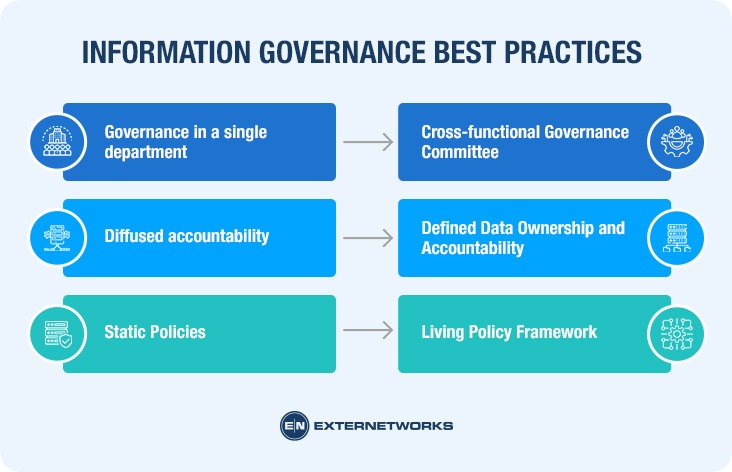
A governance program that lives in a single department rarely survives competing priorities. Forming a committee with representatives from legal, IT, compliance, operations, and business units ensures that diverse perspectives shape information governance decisions. This structure also secures executive sponsorship, which research consistently identifies as one of the strongest predictors of long-term program success.
Every critical data asset should have a named owner responsible for quality, Access, and lifecycle decisions. Without clear ownership, accountability diffuses—and data integrity suffers as a result. Assign stewardship roles at both the business and technical levels.
Policies that never get updated become liabilities. Conduct scheduled reviews — at a minimum annually — to reflect regulatory changes, new data types, or shifts in business strategy. Document everything in a centralized policy repository accessible to stakeholders across the organization.
A strong governance program ultimately rests on two technical pillars: how long data is kept, and who can access it. Those specifics deserve closer examination.
With best practices established, it’s worth examining two of the most operationally critical components of any information governance program: data retention schedules and access controls. Getting these right separates organizations that manage information from those that are managed by it.
Data retention isn’t just about deleting old files. It’s about defining how long specific data types must be kept to satisfy legal, regulatory, and business requirements—and then systematically enforcing those timelines. According to Best Practices in Information Governance, organizations that formalize retention schedules significantly reduce legal exposure and storage costs alike.
Access controls are equally essential. The principle is straightforward: employees should access only information relevant to their roles. In practice, understanding the different levels of permission structures helps organizations enforce least-privilege Access consistently across departments.
A well-designed retention and access framework delivers three outcomes:
Strong access governance transforms information security from a reactive function into a proactive discipline. Both components ultimately depend on the people who follow—and champion—these policies daily, which is why building a culture of governance awareness matters just as much as the technical framework itself.
Even the most technically sound information governance program fails without the human element. Policies, retention schedules, and access controls only work when the people responsible for handling data actually understand them.
Governance culture starts with awareness. Employees at every level need to know what data they’re responsible for, how to handle it properly, and why it matters. Role-based training is more effective than generic compliance sessions — a finance team member faces different data risks than someone in marketing or HR.
A cross-functional governance committee plays a central role here. When representatives from multiple departments help shape training content, programs stay grounded in real workflows rather than abstract policy language. This collaborative approach also builds internal advocates who reinforce good habits long after formal training ends.
In practice, organizations that treat governance education as a one-time event tend to see compliance drift over time. Structured refresher cycles — tied to policy updates or regulatory changes — keep teams aligned. Ongoing governance frameworks such as ITIL and COBIT provide ready-made models for embedding repeatable processes into daily operations.
According to OneTrust, accountability is strengthened when employees understand not only what the rules are but also the rationale behind them. That understanding transforms compliance from a checkbox into a shared organizational value — which, as the next section will explore, also means confronting the very real challenges that can undermine even well-designed programs.
No information governance program is without its challenges, and acknowledging those realities is part of building one that lasts. Even organizations that follow best practices encounter friction points that can slow progress or dilute outcomes.
A strong governance framework requires ongoing maintenance, not a one-time build. In practice, what typically separates successful programs from struggling ones is the ability to adapt without losing structural integrity.
For organizations relying on external infrastructure, aligning with IT service partners early helps reduce implementation gaps. These limitations don’t make governance impossible — they make thoughtful planning more critical. Understanding where programs commonly break down lays the groundwork for examining how real-world organizations have successfully navigated these challenges.
Abstract principles become far more meaningful when grounded in a real-world context. Examining how organizations actually apply information governance programs reveals patterns that any team can adapt, regardless of industry or size.
Healthcare organization managing patient records: A regional hospital system faced mounting compliance pressure around HIPAA retention requirements. By forming a cross-functional governance committee — pulling in legal, IT, clinical operations, and compliance — they established unified retention schedules and role-based access controls. The result was a measurable reduction in audit findings and faster response times during regulatory reviews.
Financial services firm handling client data: A mid-sized investment firm struggled with siloed data spread across legacy systems. Applying consistent data classification and ownership policies allowed them to locate, protect, and purge records on schedule — directly reducing their exposure during litigation holds.
Growing tech company scaling governance early: Rather than retrofitting policies after a data breach, one software company embedded governance requirements into its onboarding workflows from the start. Their managed IT support structure helped enforce policy consistency as headcount doubled.
A common pattern across all three scenarios: governance succeeds when accountability is distributed rather than siloed in a single department. These examples set the stage for the core principles worth carrying forward.
Effective information governance programs aren’t a one-time project — they’re an ongoing commitment that touches every corner of an organization. The real-world scenarios and practical frameworks covered throughout this article reinforce a consistent truth: organizations that treat governance as a living program outperform those that treat it as a compliance checkbox.
Here’s a quick synthesis of what matters most:
As Best Practices for Information Governance notes, sustainable governance requires iterative improvement, not perfection from day one.
Strong governance is what transforms raw data into a trusted organizational asset. Start small, stay consistent, and scale deliberately — the investment pays dividends in compliance, security, and operational clarity.
See how ExterNetworks can help you with Managed NOC Services
Contact Us