Missed alerts turn into outages, outages turn into lost revenue. ExterNetworks Inc. delivers 24/7 NOC & Help Desk support to keep everything running smoothly.
Get 24/7 IT Support NowReliability doesn’t happen by accident. It happens because someone decided in advance how reliable a service needs to be and then measured it.
That decision is a service level objective. An SLO is an internal target for how a service should perform over a defined time window, expressed as a measurable number. The service level objective is deliberately narrow: it’s a goal, not a guarantee, set by the team running the service rather than negotiated with a customer.
So what is an SLO in practical terms? It’s a line drawn through your monitoring data. Above the line, the service is healthy enough, and your engineers can keep shipping. Below it, something changes: you slow down, investigate, and fix.
Perfection isn’t the goal. Perfect uptime is costly and can lead to burnout. An SLO defines “good enough for our users,” then protects the engineering capacity you’d otherwise spend over-engineering a system nobody complained about.
An SLO has three parts: a metric, a target, and a time window.
The metric is what you measure: request latency, successful responses, job completion. The target is the threshold that counts as acceptable. The window is the period you evaluate over, commonly a rolling 28- or 30-day window.
Put together, an SLO reads like this: “99.9% of API requests return successfully over a rolling 30-day window.”
The mechanism’s usefulness comes from the inverse. If your target is 99.9%, you’ve accepted 0.1% failure. That remainder is your error budget, a concrete allowance for things to go wrong. Spend it slowly, and you have room to deploy, migrate, and experiment. Burn through it in a week, and you’ve told yourself something important: stop changing things and start stabilizing them.
Error budgets convert an argument into arithmetic. Instead of a product manager and an engineer debating whether a release is “too risky,” both look at the same number. There’s budget left, or there isn’t.
This balance is crucial. User happiness on one side, engineering velocity on the other, with a measurable target holding the line between them.
Good SLO examples share a structure: a measurable signal, a threshold, and a window. Here’s how that looks across different service types.
Availability. “99.95% of HTTP requests to the checkout service return a non-5xx status code over a rolling 30-day window.” Checkout failures cost revenue directly, which justifies the tighter target.
Latency. “95% of search queries return in under 300 milliseconds, measured over 28 days.” This targets a percentile, not an average. Averages hide the slow tail where users actually feel pain.
Freshness. “99% of inventory records are updated within 5 minutes of the source change, measured weekly.” Data pipelines need freshness SLOs more than availability ones; a pipeline that’s technically running but three hours behind is still broken.
Durability. “99.999999% of stored objects remain retrievable over a 12-month window.”
Internal services. “99.5% of authentication token validations complete within 100 milliseconds over 30 days.”
Notice what’s absent: vague statements like “the system will be fast” or “we aim for high uptime.” Every example names a signal, a number, and a period. If you can’t evaluate it from a dashboard, it isn’t an SLO.
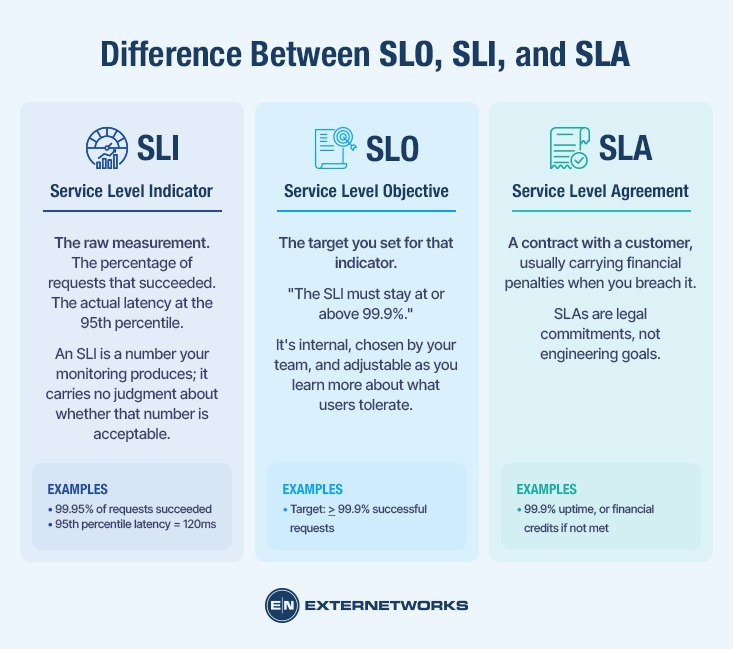
These three terms get used interchangeably, and that confusion costs teams real money. They operate at different layers.
SLI: Service Level Indicator. The raw measurement. The percentage of requests that succeeded. The actual latency at the 95th percentile. An SLI is a number your monitoring produces; it carries no judgment about whether that number is acceptable.
SLO: Service Level Objective. The target you set for that indicator. “The SLI must stay at or above 99.9%.” It’s internal, chosen by your team, and adjustable as you learn more about what users tolerate.
SLA: Service Level Agreement. A contract with a customer, usually carrying financial penalties when you breach it. SLAs are legal commitments, not engineering goals.
On SLO vs SLA specifically: the SLA is the promise you make externally, and the SLO is the stricter target you hold internally so you never get close to breaching it. If your SLA guarantees 99.5% availability, your SLO might be 99.9%. That gap is the warning track you find out you’re in trouble before your customer does, and before anyone issues a credit.
Without SLOs, every alert looks equally urgent. This leads to unnecessary alerts, like paging someone at 3 a.m. for a minor issue.
SLOs fix the prioritization problem. When an alert fires, the question shifts from “is this bad?” to “is this consuming our error budget?” Issues that threaten the objective get escalated. Issues without a ticket get ignored during business hours. Alert fatigue drops because the noise floor finally has a definition.
They also settle arguments. An SLO gives operations, engineering, and leadership one shared number for what “reliable” means. Nobody has to defend a gut feeling about whether the platform is stable.
For executives, SLOs translate infrastructure into business language. Availability targets map to revenue exposure. Latency targets map to conversion. A dashboard showing error budget consumption tells a CFO more about operational risk than a list of resolved tickets ever will.
And they protect your people. A team working against a clear target knows when it can stop firefighting and start building. That boundary is the difference between a sustainable operation and attrition.
Setting an SLO is a sequence. Work through it in order; skipping ahead produces targets nobody trusts.
Missing an SLO isn’t a team failure. It’s the system working: you set a threshold specifically so you’d know when you crossed it.
What matters is the policy you agreed to in advance. Most organizations trigger an error budget freeze: non-essential deployments stop, and engineering capacity shifts to reliability work until the budget recovers. This isn’t punishment. It’s the mechanism that stops a degrading service from degrading further while someone ships a new feature on top of it.
Run the incident review, but focus on the budget burn rather than the single outage. One bad day rarely exhausts a budget. A pattern of small, unexamined failures usually does, and that pattern is the thing worth fixing.
Then ask whether the SLO itself was right. Consistently missing a target by a wide margin can mean the target was aspirational rather than grounded in what the architecture can deliver. Consistently beating it by a wide margin means you’re over-investing in reliability users never asked for.
Adjusting a target based on evidence is good practice. Lowering it to avoid an uncomfortable conversation isn’t.
Keep the number of SLOs small. Three well-chosen objectives per critical service beat twenty that nobody reviews. Every SLO you add dilutes attention across the board.
Measure from the user’s position. Instrument the client, the load balancer, or a synthetic probe somewhere that reflects what the user actually gets. Internal health checks lie by omission.
Use percentiles, not averages, for latency. The 95th or 99th percentile exposes the slow requests your average smooths away. Those slow requests generate support tickets.
Review targets quarterly. Traffic patterns change, architectures change, and user expectations change. A target set two years ago against different infrastructure is a historical artifact.
Make the error budget visible to everyone. Put it where product and leadership can see it, not buried in an engineering dashboard. Shared visibility is what turns a target into a decision-making tool.
Write down the burn policy before you need it. Define what a 50% burn triggers and what a full burn triggers, then stick to it.
Don’t set an SLO on something you can’t act on. If no team owns the fix, the target is decoration.
An SLO is only as good as the data feeding it. Monitoring is what turns a target into something you can act on before it’s breached.
Effective SLO monitoring does three things. It collects the indicator continuously, so you’re measuring actual performance rather than sampling it occasionally. It calculates error budget consumption in real time, so you see the trajectory, not just the current state. And it alerts on burn rate the speed at which you’re consuming budget- rather than on every individual error.
Burn rate alerting is the critical piece. A fast burn means a serious incident is underway and someone needs to respond now. A slow burn over several days means something is quietly degrading and deserves investigation during business hours. One alerting rule, two very different responses, and no 3 a.m. page for the slow case.
Ultimately, an SLO is only a useful management tool when an organization can continuously measure performance against it, identify deviations in real-time, and respond to problems before the error budget is exhausted.
For many teams, maintaining this 24/7 visibility and response readiness is a significant operational burden. Strategic infrastructure monitoring and managed NOC (Network Operations Center) services offer one way to provide that continuous visibility and operational support.
As an extension of your team, a managed NOC can monitor burn rates and follow your escalation playbooks, handling the routine watch so your internal engineers can stay focused on growth. While many organizations manage this in-house, others find that an external partner provides the stability needed to make SLOs actionable without increasing internal alert fatigue.
Adopt SLOs when reliability has consequences you can name. A few signals that the time has arrived:
You have customer-facing SLAs. You need an internal target stricter than your contractual one, or you’ll discover breaches when the credit request lands.
Your team argues about whether to ship. Recurring debates between velocity and stability mean you’re missing a shared number to settle them.
On-call is burning people out. If engineers are paged for everything, SLOs give you the basis to decide what actually warrants a page.
You’re scaling services faster than headcount. More systems with the same team require triage by priority, and priority requires defined targets.
Leadership asks, “Are we reliable?” and nobody can answer. That question needs a number, not a narrative.
Start small. Pick the single service whose failure costs the most, define one SLO against it, and run it for a quarter. Learn what the measurement actually tells you before expanding.
You don’t need a mature SRE practice first. The SLO service level objective framework works at any scale; one objective on one critical path is a legitimate starting point.
Reliability stops being a feeling and starts being a number the moment you define a service level objective. That’s the whole value of the practice.
What to carry forward:
The balance never resolves permanently. User happiness pulls one way, engineering velocity pulls the other, and the SLO is where you hold that tension on purpose.
Maintaining the continuous visibility required to protect your SLOs shouldn’t come at the cost of your team’s sleep or strategic focus. If you’re ready to shift from reactive firefighting to proactive operational confidence, see how our managed NOC and infrastructure monitoring services provide the 24/7 support you need to keep your systems stable and your people focused on growth.
See how ExterNetworks can help you with Managed NOC Services
Contact Us