Missed alerts turn into outages, outages turn into lost revenue. ExterNetworks Inc. delivers 24/7 NOC & Help Desk support to keep everything running smoothly.
Get 24/7 IT Support NowOptical networks transmit digital data using light signals over optical fiber. Network equipment converts electrical data into optical signals, transmits them through fiber, and converts them back into electrical data at the receiving end.
The process generally follows five steps:
Enterprise optical networks can use different architectures depending on distance, capacity, reliability, and cost requirements. A campus connection may use optical Ethernet, while a data-center interconnect or carrier backbone may use wavelength-division multiplexing (WDM) and other optical transport technologies.
For businesses, the main advantage is moving large amounts of data across high-capacity links. Actual performance depends on the optics, fiber type, transmission distance, network design, and equipment capabilities.
Optical networking is used for long-distance connections. Basic terminology includes Cables, Fiber Optics, Cores, and Claddings.
Fiber optics are used to transmit information over long distances by sending light through a thin strand of glass. The glass acts as a barrier to prevent the light from leaking out. The light travels down the fiber optic cable at a specific angle. Once the light reaches the end of the fiber, it reflects back up the fiber.
A binary number system is used to represent numbers. Each digit represents a power of two (2^n). For example, the decimal equivalent of 01101001 is 4. This means that the first bit is 1, the second bit is 0, the third bit is 1, the fourth bit is 0, etc.
An optical network can be defined as a collection of interconnected nodes that are used for transmitting and receiving messages using light beams instead of electricity. The nodes may consist of computers, routers, switches, hubs, repeaters, amplifiers, etc. These devices convert the digital data into analog signals and vice versa.
The basic principle behind optical networking is the use of light beams rather than electrical currents to transfer data. Light waves travel at a much higher speed compared to electrons. In fact, it takes only about one-millionth of a second for a light beam to reach its destination.
Light travels faster than electrons because they move in opposite directions. Electrons move from negative to positive, whereas photons move from positive to negative.
In addition, light is not affected by electromagnetic interference (EMI), which makes it ideal for high-speed communications.
There are two types of optical networking:
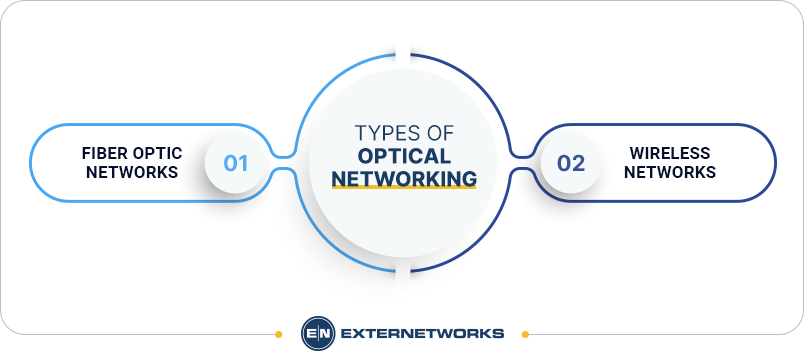
In this type of network, the data is transmitted through glass fibers. Each node consists of a transmitter and receiver. Data is converted into a modulated signal and then sent along with the fiber. At each end of the fiber, the signal is demodulated and converted back into the original format.
This type of network is very reliable and offers high bandwidth. However, it requires expensive equipment and installation costs.
This type of network uses radio frequency (RF) technology to send data between nodes. It operates on frequencies above 1 GHz. There are three main components of a wireless network:
A transmitter sends out RF energy that is picked up by the antenna. The receiver converts the received signal back into usable data.
Wireless networks have many advantages, including low cost, ease of deployment, scalability, mobility, and flexibility. They also offer better security since there is no need to physically connect wires.
However, wireless networks suffer from several drawbacks, such as limited range, interference, and vulnerability to eavesdropping.
With the advent of the Internet, the demand for fast and affordable broadband services increased tremendously. To meet these demands, companies started deploying fiber optic cable networks across the globe.
As more people start accessing the Internet, the demand continues to increase. As a result, the number of users connected to the Internet increases exponentially.
To handle all these connections, companies must invest heavily in infrastructure. For example, if you want to provide broadband access to 100 million homes, you will require around $10 billion worth of fiber optic cables.
To reduce the overall investment required to build a network, companies began looking for ways to share existing infrastructure. This led to the development of various technologies, including microwave links, satellite links, and wireless LANs.
However, none of these technologies can compete with the performance offered by fiber optics.
An optical network uses a combination of transmission media, optical interfaces, and network equipment to deliver data reliably.
The exact components vary by deployment. A simple point-to-point fiber connection may need only compatible optical interfaces and fiber. In contrast, a carrier-grade optical transport network may require amplification, WDM equipment, protection mechanisms, and centralized management.
Optical network performance depends on more than transceiver speed. Fiber characteristics, optical power, transmission distance, and equipment compatibility all influence link quality.
Key factors include:
To maintain signal quality, network teams should establish baseline optical power levels, monitor interface errors and link alarms, inspect and test fiber connections, and verify compatibility when replacing transceivers. Evaluate optical power readings and error counters against the equipment manufacturer’s specifications.
For enterprise networks, correlating optical telemetry with interface utilization, device logs, and application performance helps distinguish a physical-layer fault from congestion or a higher-layer network issue.
Planning optical network infrastructure requires businesses to evaluate current connectivity requirements alongside future capacity, availability, security, and operational needs. The right design depends on the number of locations, distance between endpoints, application workloads, existing infrastructure, and expected network growth.
1. Bandwidth and traffic demand
Estimate current and projected traffic across offices, data centers, cloud connections, and business-critical applications. Consider peak utilization, backup windows, replication workloads, and future expansion before selecting link capacities.
2. Distance and fiber type
Evaluate the distance between endpoints, the existing cabling infrastructure, and the required transmission characteristics. Multimode fiber is commonly used for suitable shorter-reach applications, while single-mode fiber supports many longer-distance deployments. The actual choice depends on the optics, reach, data rate, and network design.
3. Network architecture and equipment compatibility
Determine whether the environment requires Ethernet optical links, routed optical networking, or a dedicated optical transport system using technologies such as WDM. Verify compatibility among transceivers, fiber types, wavelengths, data rates, and connected equipment.
4. Availability and redundancy
Identify the business impact of a link failure. Where justified, design diverse paths, redundant equipment, and appropriate failover mechanisms. Confirm that redundant paths do not share an unrecognized physical point of failure.
5. Security and physical protection
Control access to network rooms and fiber infrastructure, document cable routes, and protect exposed equipment and connections. Optical fiber resists electromagnetic interference, but the overall network still requires appropriate logical access controls and operational security.
6. Monitoring and maintenance
Ensure the design provides sufficient telemetry for optical signal health, interface performance, link availability, and capacity monitoring. Define alert thresholds, escalation responsibilities, testing procedures, and maintenance expectations.
7. Total cost of ownership
Assess the complete cost of deployment and operation, including fiber installation, civil works where needed, optical equipment, transceivers, licensing, monitoring, maintenance, redundancy, and future upgrades. The lowest initial-cost option may not be the most economical over the infrastructure’s lifetime.
Before deployment, businesses should:
A well-planned optical network should meet current business requirements while allowing capacity and connectivity to scale as the organization grows. Combining sound infrastructure design with ongoing network monitoring helps IT teams maintain performance visibility and respond to operational issues.
Optical networking involves sending digital data using laser beams instead of electrical signals.
The basic building blocks of an optical network include:
An optical network consists of multiple nodes interconnected via optical fibers. A laser beam is used to carry digital data between adjacent nodes.
A laser is a device that emits coherent monochromatic light at a single wavelength. Lasers emit electromagnetic radiation at a specific wavelength within the visible spectrum.
A modulator is a device that changes the amplitude, phase, or polarization of a continuous waveform. In other words, it alters the intensity of the output light.
A photodetector is a device that detects the presence of photons. It measures how much power is reflected from the surface of the detector.
An amplifier amplifies the input signal before passing it onto the next stage.
A demultiplexed separates incoming signals based on their wavelengths.
A multiplexer combines multiple incoming signals into one outgoing signal.
A switch routes the incoming signals based on the destination address.
A transceiver converts electrical signals into optical signals and vice versa.
Traditional wired networks use copper wire and coaxial cables to connect computers. These wires have very high bandwidth, but they also have some limitations.
For example, there are only two types of cabling available: twisted pair and unshielded twisted pair (UTP). Twisted pairs are designed to carry both voice and data traffic. However, they cannot be used to carry high-speed data because they do not support higher frequencies.
In addition, UTP requires additional hardware such as transformers which make them expensive to install.
On the other hand, fiber optic cables offer several advantages over conventional wiring methods.
First, fiber optic cables allow for a more efficient transfer of data. They can carry up to 40 times more data than twisted pairs.
Second, fiber optic cables are immune to interference. No matter what kind of noise is present, fiber optic cables will pass the data without any problems.
Third, fiber optic cables are capable of carrying a wide range of data rates. For instance, you can send 10 gigabits per second of data over a single strand of fiber.
Finally, fiber optic cables are extremely flexible. You can bend them around corners and even stretch them across large distances.
An optical fiber amplifier is a device that increases the amount of light being transmitted by using a semiconductor diode. The most common application of optical fiber amplifiers is to boost weak signals.
There are three main types of optical fiber amplifiers: erbium-doped fiber amplifiers (EDFA), Raman amplifiers, and distributed feedback lasers.
EDFAs consist of small pieces of glass containing tiny amounts of rare earth metals like Erbium. When these materials are exposed to laser light, they emit amplified light at the same wavelength.
Raman amplifiers amplify light using nonlinear effects within the material itself.
Distributed Feedback Lasers (DFB) amplify light by reflecting it back and forth between two mirrors.
The output of an EDFA is called gain. Gain refers to the amount of amplification provided by the amplifier.
Gain is measured in decibels (dB). A typical EDFA provides about 20 dB of gain.
A DFB laser produces about 30 dB of gain.
When we talk about the power level of an optical signal, we refer to its amplitude. Amplitude refers to how much energy is contained in the signal.
Amplitude is measured in milliwatts (mW). A typical LED emits about 1 mW of light.
If an optical signal contains 100 mW of energy, then it is said to have 100 mW of amplitude.
If you look at the diagram below, you can see that when you send a low power signal down a fiber optic cable, the signal gets weaker as it travels along the cable.
This happens because the light waves get scattered by air molecules and dust particles.
This scattering reduces the strength of the signal.
To overcome this problem, you need to increase the amount of light being sent down the line.
That’s why an optical fiber amplifier boosts the signal before it reaches its destination.
An optical fiber amplifier consists of a number of components, including a laser source, a beam splitter, a photodetector, and a circulator.
Let’s take a closer look at each component.
A laser source generates a continuous stream of coherent light. Laser sources come in many different shapes and sizes.
For example, there are gas lasers, solid-state lasers, and semiconductor lasers.
In general, laser diodes are used for short-distance applications, while gas lasers are used for longer distances.
A beam splitter splits incoming light into two separate paths. It works just like a mirror.
When light hits a beam splitter, half of the light is reflected towards one path and half is reflected towards another path.
A photodetector detects the intensity of light. It converts light into electricity.
It also measures the amount of light hitting the detector.
A circulator sends light from one port to another without allowing any light to return to the original port.
It helps prevent unwanted reflections from returning to the source. When a signal enters an optical fiber amplifier, it passes through a circulator first.
Then, the circulator directs the light to the input of the amplifier.
After that, the circulator sends the light to the output of the amplifier.
At the output of the amplifier, the circulator sends all of the light back to the input of the circulator.
As mentioned earlier, the output of an EDFA provides about 20 dB of gain.
However, the gain is not constant. The more light you add to the system, the greater the gain will be.
The gain increases up to 40 dB.
Once the gain reaches 40 dB, the signal starts getting distorted.
So, if you want to amplify your signal, make sure that the gain never exceeds 40 dB.
Automation in networking refers to the ability to perform tasks automatically without human intervention. The term was coined in the early 1980s and has since become widely adopted. Automation is now a key part of modern networks, enabling network administrators to automate complex tasks such as configuration management, monitoring, troubleshooting, and performance analysis.
Today, automation is becoming more important in networking because of its ability to improve efficiency and reduce costs. In addition, automation helps organizations meet compliance requirements and regulatory standards.
Optical networks are becoming more and more important in our daily lives. The Internet has become a part of our everyday life, and we rely heavily on it for communication, entertainment, and even shopping.
Optical networks are the backbone of the modern information society. They connect together computers, servers, routers, switches, and other devices over long distances using light waves instead of electrical signals.
Fibers – Fiber optics carry data at high speeds.
Amplifiers – Amplifiers increase the strength of the signal so that it can travel longer distances.
Lasers – Lasers use light to transfer data.
Modulators – Modulators convert digital data into analog signals.
Detectors – Detectors measure the intensity of the incoming light.
After all this work is completed, the team connects the various pieces of equipment together.
This completes the construction of an optical network.
In this section, we’ll learn about the basic concepts behind optical networking. >We will also look at some of the major components used in optical networks.
We will then discuss how these components work together to create a working network. Finally, we will explain why optical networking is becoming increasingly popular.
The number of devices connected to the Internet is growing by the day. As the demand for bandwidth increases, so does the need for new ways to transport data.
For example, mobile phones are becoming more powerful every year. Their processors now handle tasks like video streaming, voice calls, and playing games. All of these activities require large amounts of data to be transferred between your phone and the server you are communicating with.
As the number of devices grows, so does the amount of traffic travelling across the Internet. That means there is less bandwidth available for everyone else.
To solve this problem, engineers developed a way to send data faster. Instead of sending bits one at a time, they sent them all at once. This method is called “optical networking.”
In conclusion, optical networking is a vital part of modern communications infrastructure, and understanding how it works will help you understand how the internet functions.
See how ExterNetworks can help you with Managed NOC Services
Contact Us