Editor’s Note: Network observability extends beyond traditional monitoring by capturing comprehensive telemetry data and enabling deep analytics for troubleshooting complex issues. It allows IT teams to understand n... Read More
Missed alerts turn into outages, outages turn into lost revenue. ExterNetworks Inc. delivers 24/7 NOC & Help Desk support to keep everything running smoothly.
Get 24/7 IT Support NowObservability is the ability to monitor and analyze data from a network or system. This helps us gain insights into our systems and networks, allowing us to identify problems before they occur.
Modern businesses rely on their network infrastructure to function efficiently, and the problem is that these networks often contain sensitive information that should remain private. You can access all the data traveling across your network without compromising privacy by using network monitoring tools.
Network observability is gathering information from a network device by using various methods that help understand what is going on within the network. It includes capturing packets, analyzing packet content, and examining protocol headers. The term “observability” comes from the fact that you have to be able to observe something to make sense of it. For example, if you want to understand why a particular host is not responding to ping, you must first be able to observe the connection attempt. Similarly, when you want to understand the behavior of an application, you must be able to capture its communications.
Network observability works by capturing packets and analyzing them. Packets contain information about the sender, receiver, protocol used, size, time, etc. These records are stored in a database for later analysis.
The most common way to collect network observability data is via packet sniffers. Packet sniffers are software programs that intercept packets and record all data passing over a network interface. They gather information about network protocols and identify individual hosts. To use a packet sniffer effectively, you should configure it to log only the relevant packets. You can then examine the captured packets later to determine what information they contain.
There are many types of packet sniffers available today. Some are designed to run on top of operating systems like Windows, Linux, macOS, etc., while others are standalone utilities that do not require additional software. Examples include Wireshark, tcpdump, Ettercap, Snort, Bro, Netflow, etc.
Network monitoring primarily tracks the health, availability, and performance of network devices and connections. It typically uses metrics such as bandwidth utilization, latency, packet loss, device status, CPU usage, and uptime to identify performance issues. Network observability goes further by collecting and correlating data from multiple telemetry sources, including packets, flows, logs, metrics, traces, DNS data, and application activity, to provide deeper context about why an issue is occurring.
The main difference is visibility and analysis. Network monitoring can alert an IT team to high latency or packet loss, while network observability helps investigate the underlying cause by correlating network, application, and infrastructure data. This makes observability particularly useful for complex environments such as hybrid cloud, multi-cloud, distributed applications, and remote or highly connected enterprise networks.
| Aspect | Network Monitoring | Network Observability |
|---|---|---|
| Primary focus | Network health and performance | End-to-end visibility and context |
| Telemetry sources | Metrics, device logs, SNMP, flows | Packets, flows, logs, metrics, traces, DNS, application data |
| Analysis | Tracks predefined metrics and alerts | Correlates multiple data sources to identify root causes |
| Troubleshooting | Identifies that a problem exists | Helps determine why the problem occurred |
| Typical use cases | Uptime, bandwidth, latency, device health | Root-cause analysis, application performance, security investigation, complex troubleshooting |
In practice, network monitoring and observability complement each other rather than compete. Monitoring provides continuous visibility into network health, while observability adds deeper context that helps IT teams understand dependencies, investigate incidents, identify root causes, and resolve problems more efficiently.
Network observability helps security teams detect cybersecurity threats by continuously analyzing network traffic, flows, packets, logs, DNS activity, and other telemetry to identify abnormal behavior. It can reveal unusual traffic volumes, unexpected connections, suspicious destinations, abnormal login patterns, and communication that differs from established network baselines. By correlating data across users, devices, applications, and network segments, security teams can investigate potential threats with greater context.
Network observability also helps detect lateral movement and command-and-control (C2) communication. For example, repeated connections to suspicious external servers, unusual east-west traffic between internal systems, unexpected remote access, or periodic beaconing can indicate that an attacker or compromised endpoint is communicating with malicious infrastructure. Monitoring encrypted traffic metadata, such as connection timing, destination, volume, and session behavior, can provide additional visibility without necessarily requiring inspection of the encrypted payload.
It can also help identify data exfiltration by detecting unusual outbound transfers, unexpected destinations, and abnormal data volumes. When observability platforms correlate network telemetry with threat-intelligence feeds, endpoint data, and security logs, they help security teams detect suspicious activity earlier, investigate potential compromises, and prioritize threats for response.
Network observability collects telemetry from multiple sources to provide a complete view of network and application behavior. Packet data provides detailed information about network communications, while flow data shows traffic patterns between devices, including source, destination, protocol, volume, and timing. Logs and metrics provide information about network events, device health, bandwidth utilization, latency, errors, and availability.
Other important data sources include distributed traces, DNS queries, device telemetry, and application data. Traces help identify how requests move across applications and services, while DNS data can reveal domain lookups and suspicious destinations. Device telemetry from routers, switches, firewalls, servers, and other infrastructure provides operational context, while application data helps correlate network behavior with application performance and user activity.
By combining packets, flows, logs, metrics, traces, DNS data, device telemetry, and application data, network observability platforms can correlate events across different layers of the environment. This broader telemetry helps IT and security teams troubleshoot performance issues, identify root causes, detect anomalous behavior, investigate security threats, and understand dependencies across complex network infrastructures.
Key Components of Network Observability
A complete network observability strategy consists of several connected components that turn raw network telemetry into actionable insights:
Together, these components provide end-to-end network visibility, helping IT teams move beyond detection to understand the cause, impact, and appropriate response.
Enterprise IT teams use a combination of network performance monitoring and diagnostics (NPMD), network traffic analysis (NTA), packet analysis, flow monitoring, SIEM, application performance monitoring (APM), cloud monitoring, and observability platforms to gain visibility across network and application environments. Each category provides different levels of telemetry and analysis, allowing teams to investigate performance issues, security events, and application dependencies.
For enterprise environments, the most effective approach is usually to combine multiple tool categories rather than depend on a single platform. Integrating network, application, cloud, and security telemetry gives IT teams broader visibility, improves troubleshooting, supports threat detection, and helps identify the root cause of complex issues across distributed infrastructure.
There are several ways of collecting information about the network, and some are better suited for specific tasks, while others are good. Let’s take a look at some of them:
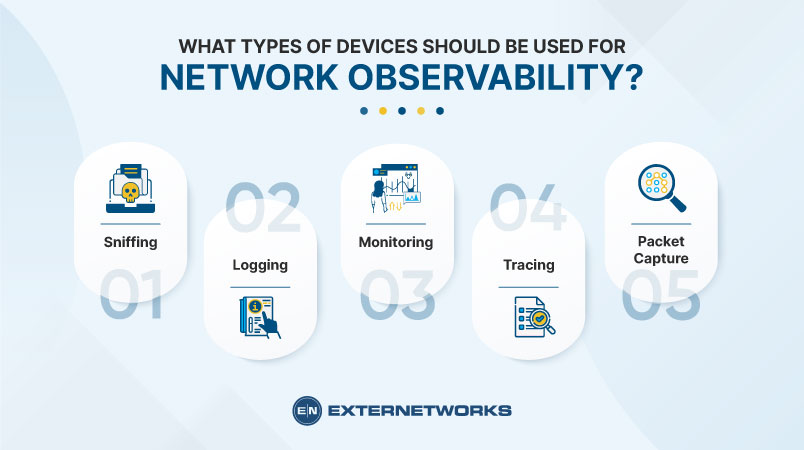
There are many benefits associated with network observability. Here are some of the top ones:
There are many situations where you would like to use network observability. One of the reasons is to troubleshoot connectivity issues. If you have a web server that doesn’t respond to incoming requests, you can try to figure out why. To do this, you can use a packet sniffer to capture the traffic going across the network.
Once you know where the issue lies, you can fix it. Another reason to use network observability is to improve the reliability of your network. If you detect that some component isn’t working properly, you can check its logs and run tests to make sure everything is functioning correctly.
In Conclusion, Using network observability will give you more insight into the behavior of the network. As a result, you can identify potential problems before they become serious. In addition, you can also learn about the different protocols used in the network.
Ensure that your systems remain safe and secure with our Network Monitoring Services to save time and cost.
See how ExterNetworks can help you with Managed NOC Services
Contact Us