Missed alerts turn into outages, outages turn into lost revenue. ExterNetworks Inc. delivers 24/7 NOC & Help Desk support to keep everything running smoothly.
Get 24/7 IT Support NowTelco termination points are the points where the phone company connects your telephone line to the public switchboard. These points are usually located at the customer’s home or business. The telco termination point is also known as the local loop.
The local loop is the physical connection between the telephone company’s central office and the subscriber’s house. At the end of the day, the local loop is the last link in the chain that takes calls from the outside world and delivers them to their destination inside your home.
The local loop consists of two parts: the tip and ring wires. Tip refers to the wire coming out of the wall jack at the side of your home. Ring refers to the wire running back towards the main telephone pole.
Tip and ring wires connect to the central office through a junction box called a splice block. Splice blocks contain fuses and circuit breakers that protect against short circuits and overloads.
In addition to the tip and ring wires, there are several other wires that run throughout your home. They include ground wires, which provide power to the electrical outlets in your home; neutral wires, which carry electricity away from appliances like refrigerators and air conditioners; and protective earth wires, which help prevent electric shock by providing a path for electricity to flow back into the utility grid if something goes wrong with the wiring.
Most homes have three types of local loops:
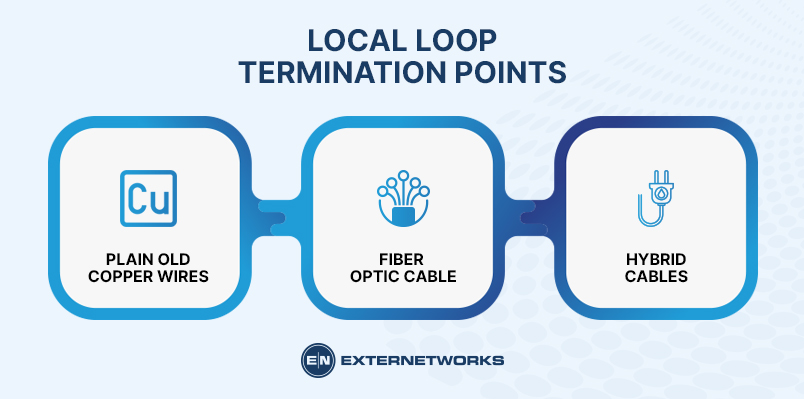
Most homes have plain old copper wires. Plain old copper wires are made of thin metal strands twisted together to form a long rope-like cord. When you plug a device into a wall outlet, it attaches to one of the wires in this cord.
Copper wires can be found in every room of your home. In fact, they are probably already connected to some of your devices. For example, your television may use a single pair of copper wires to send signals to your TV. Other common uses for copper wires include:
Fiber optic cable is much thinner than copper wire. It looks like a string of tiny glass tubes. Each tube contains light waves traveling down the length of the cable. Fiber optic cable transmits information faster than copper wire because it doesn’t lose any signal along its length.
Fiber optic cable comes in different varieties. Some are designed to transmit voice and video signals while others are only capable of carrying data.
Some homes have hybrid cables instead of plain old copper wires. Hybrid cables combine both copper and fiber optics. Like fiber optic cable, hybrid cables are very thin and look like strings of glass tubes. But unlike fiber optic cable, hybrid cable also includes copper wires. These wires allow hybrid cables to work with older devices that don’t support fiber optic connections.
Businesses can identify the telecommunications termination point by tracing where the service provider’s telephone, internet, or fiber-optic cable enters the premises. This point is often in a network demarcation box on an exterior wall, near a utility area, or close to the building’s main cable entry. It marks the connection between the telecommunications provider’s network and the building’s internal cabling.
In larger offices and commercial buildings, the termination point may be located in a telecommunications room or building entrance facility. These areas typically contain incoming service cables, termination panels, fiber-optic equipment, and other network connections. The exact location depends on the building’s design, the type of telecommunications service, and how the original installation was completed.
If the termination point is difficult to locate, businesses should check building network diagrams, equipment labels, and installation records. They can also ask the building facilities team, network administrator, or telecommunications provider for assistance. Identifying this point helps IT teams troubleshoot connectivity issues, determine responsibility for cable faults, and coordinate maintenance or upgrades more efficiently.
A telecommunications termination point connects a service provider’s incoming network to the customer’s internal communication infrastructure. The provider’s cable, such as a copper telephone line or fiber-optic cable, enters the premises and terminates at a designated connection point. This equipment provides a physical interface between the external telecommunications network and the wiring that distributes services throughout the building.
From the termination point, the incoming connection links to customer-side wiring and network equipment, such as routers, switches, telephone systems, or internal cabling. For example, an incoming fiber-optic connection may terminate at an optical network terminal (ONT), which converts optical signals into a form suitable for the customer’s network equipment. The specific connection method depends on the service type and the equipment the provider installs.
The termination point also establishes the demarcation boundary between the service provider’s network and the customer’s equipment. The provider is generally responsible for its network up to the agreed demarcation point. At the same time, the customer is responsible for internal wiring and connected equipment beyond that boundary, as defined in the service agreement. Clearly identifying this boundary helps businesses troubleshoot connectivity problems, determine who is responsible for repairs, and coordinate maintenance with their telecommunications provider.
Whether the business or its telecommunications provider maintains the termination point and internal cabling depends on the service agreement. Typically, the provider manages its network infrastructure and incoming service cables up to the agreed demarcation point. The customer usually maintains internal wiring, routers, switches, and other network equipment installed beyond this boundary. However, ownership and maintenance responsibilities may differ depending on the installation and contractual terms.
To avoid confusion, businesses should review their service contracts and confirm which components the provider’s maintenance services cover. They should confirm whether the agreement includes repairs to the termination box, fiber-optic connections, copper cables, or internal wiring. Understanding these responsibilities helps IT teams plan maintenance activities, estimate repair costs, and prevent disputes when network problems occur.
When a telecommunications fault is detected, the business should report the issue to its service provider and follow the prescribed troubleshooting process. The provider can investigate problems within its network, while the customer’s IT team or an authorized technician can inspect internal cabling and connected devices. Clear fault-reporting procedures and defined maintenance responsibilities help businesses resolve connectivity issues faster and minimize service disruptions.
When a telephone line has no dial tone or connectivity, technicians should follow a systematic troubleshooting process to determine whether the problem lies with the telephone handset, internal cabling, the termination point, or the telecommunications provider’s network. Starting with basic checks helps isolate the fault, avoid unnecessary repairs, and restore service more efficiently.
Key troubleshooting steps include:
These steps help technicians narrow down the source of a telephone connectivity failure and determine the right repair procedure. Documenting the symptoms, tests performed, and results also helps the telecommunications provider diagnose the issue more quickly and minimize service downtime.
A telecommunications termination point supports Voice over Internet Protocol (VoIP) phones and business voice services by providing the connection through which internet and network traffic reaches the company’s communication infrastructure. In a VoIP setup, the incoming internet service connects to a router or firewall, which directs traffic to the business network. Unlike traditional telephone services, VoIP converts voice into digital data packets that travel over an IP network rather than relying on a dedicated conventional telephone line.
Within the business network, routers and switches help deliver voice traffic to VoIP phones, computers with calling applications, and IP-based phone systems. Routers connect the internal network to the internet, while switches connect devices within the office and may provide Power over Ethernet (PoE) to compatible VoIP phones. Depending on their deployment, businesses may also use a Session Border Controller (SBC) to secure and manage voice communications between their network and an external VoIP provider.
Traditional telephone termination and IP-based voice termination work differently. Traditional voice services typically terminate at a telephone network interface or demarcation point, from which telephone wiring connects to handsets or a private branch exchange (PBX). VoIP services, however, rely on an IP connection and network equipment to carry voice traffic. A clearly identified termination point helps businesses troubleshoot voice connectivity, isolate network faults, and maintain reliable business calling services.
The equipment required to connect a business telephone system or router to a telecommunications service depends on the access technology, such as copper telephone lines, fiber-optic connections, or broadband internet. Businesses need the appropriate connection equipment to receive the service provider’s signal, distribute connectivity across the premises, and support voice and data communications.
Common equipment includes:
The exact setup varies by service type. A fiber-based business connection may require an ONT and router, while a traditional telephone service may use a telephone termination point and internal wiring. Businesses should confirm equipment compatibility and installation requirements with their telecommunications provider to ensure reliable connectivity and proper integration with their existing telephone system.
In conclusion, the local loop is a bundle of wires that connects the central office to your house. The local loop is the final piece of the puzzle that makes up the phone system.
See how ExterNetworks can help you with Managed NOC Services
Contact Us