Editor’s Note: This article explains how managed switches offer greater control, security, and flexibility over unmanaged switches, allowing administrators to configure network settings, monitor traffic, and protect... Read More
Missed alerts turn into outages, outages turn into lost revenue. ExterNetworks Inc. delivers 24/7 NOC & Help Desk support to keep everything running smoothly.
Get 24/7 IT Support NowSwitching technology has changed dramatically since the first Ethernet LANs were introduced. Today’s switches are smaller, faster, and easier to install.
The best way to choose switching solutions depends on your requirements. There are three types of switches: managed, unmanaged, and wireless. Each type offers advantages and disadvantages, so it’s important to understand what you need before buying. In this article, you will see more about what is managed switch and their benefits.
A managed switch is a device that connects computers to networks, and it allows network administrators to manage the configurations of these network devices remotely. The managed network service provides security features such as intrusion prevention systems (IPS) and firewalls, which protect against unauthorized network access.
The main differences between managed and unmanaged switches are their level of control and cost. A managed switch offers more control than an unmanaged switch, allowing you to configure settings like port speed, duplex mode, VLAN tagging, etc.
In addition, it provides advanced network security features such as IDS/IPS, firewall, and VPN capabilities. This makes them ideal for small businesses. On the other hand, unmanaged switches are cheaper and easier to set up. They don’t offer any additional security features but come at a lower price.
The best way to decide which type of switch to buying is by looking at what you want to achieve from it. If you’re looking to secure your network, you should consider buying a managed switch, which will give you access to all the above features.
If you don’t require any of those features, then you might find that an unmanaged network switch is enough for your needs. In this case, you can save money by choosing one without any additional features.
A managed network switch enables complete control of data, bandwidth, and traffic control over an ethernet network.
Managed switches are distinguished by a range of powerful features that enable efficient network management:
Managed switches can be categorized based on their level of control, functionality, and the layer at which they operate in a network. The main types include:
Fully managed switches offer complete control over all network settings and features. Administrators can configure, monitor, and optimize every aspect of the switch, including security, traffic management, and routing. These switches are commonly used in large enterprises and data centers where high performance and customization are essential.
Smart switches, also known as lightly managed switches, provide a balance between unmanaged and fully managed switches. They offer essential features such as VLAN support and Quality of Service (QoS), but lack advanced configuration options. These are ideal for small to medium-sized businesses that need some control without complexity.
Layer 2 switches operate at the data link layer of the OSI model. They use MAC addresses to forward data between devices. These switches are suitable for basic networking tasks like traffic segmentation and efficient data forwarding within a local network.
Layer 3 switches operate at the network layer and combine switching with routing capabilities. They can make decisions based on IP addresses and support functions like inter-VLAN routing. These switches are used in complex networks that require efficient communication between different network segments.
PoE-managed switches can deliver electrical power and data over Ethernet cables. This eliminates the need for separate power sources for devices like IP cameras, wireless access points, and VoIP phones.
Stackable switches can be connected and managed as a single unit. This simplifies network management and allows easy scalability, making them ideal for growing organizations.
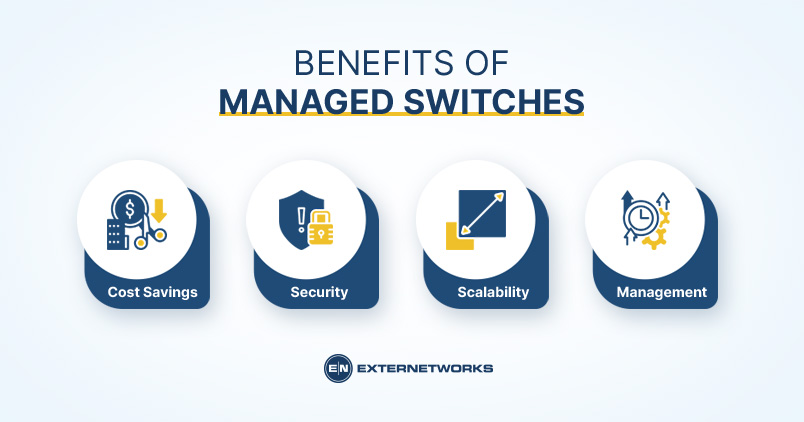
Managed switches have many advantages over unmanaged switches, including:
Managed switches are widely used in various scenarios where performance, control, and security are critical:
Enterprise Networks: Large organizations use managed switches to segment departments, manage traffic efficiently, and ensure secure communication across the network.
Data Centers: In data centers, managed switches handle high traffic volumes, provide redundancy, and ensure minimal downtime through advanced configurations.
VoIP and Video Conferencing: QoS features make managed switches ideal for supporting voice and video applications without lag or interruptions.
Campus Networks: Educational institutions use managed switches to connect multiple buildings, manage bandwidth, and maintain secure access for students and staff.
Industrial and IoT Environments: Managed switches enable reliable communication between devices in industrial automation systems and IoT networks, often with enhanced durability and monitoring.
Network Security Implementation: Organizations deploy managed switches to enforce policies, monitor traffic, and prevent unauthorized access through detailed control mechanisms.
A managed switch will give you network access to all the settings on your router. You can configure it to automatically update firmware, set up port forwarding rules, and monitor traffic. It may also detect potential threats and block them before they reach your computer. If you don’t want to pay for this extra layer of protection, then you should consider buying a separate router instead.
There are two types of switches: Managed and Unmanaged. Both types come in different sizes, but they both perform similar functions. However, there are some differences between them.
We recommend getting a managed switch if you’re new to networking because it’s easier to set up. And if you already own a router, you might want to save money by using your existing equipment. The best choice depends on your need and where to place your switch. If you’re looking for something basic, you should probably get an unmanaged switch. But if you want to ensure everything works properly, you’ll have to invest in a managed switch.
A managed switch service provides many different functions. It connects computers to local area networks (LAN), wide area networks (WAN), and storage area networks (SAN). It allows users to configure settings remotely. It provides firewall protection. And it offers a variety of security features, including IDS and anti-virus software.
See how ExterNetworks can help you with Managed NOC Services
Contact Us