In an era defined by digital transformation, the network is the central nervous system of every modern enterprise. From global telecommunications to critical IT infrastructure, the demand for uninterrupted connectivity and flawless network performance has never been greater.
Yet, the very tools and teams responsible for ensuring this reliability are struggling. Organizations are grappling with sprawling, complex networks, a deluge of alerts, and the constant pressure to resolve issues before they affect customers. This operational strain is exposing the limitations of traditional Network Operations Centers (NOCs), forcing a fundamental evolution.

In response, organizations are rapidly adopting a more advanced paradigm: the Intelligent NOC. An Intelligent NOC represents a strategic shift from reactive problem-solving to proactive, predictive, and automated network management. It uses artificial intelligence, machine learning, and advanced automation. These tools monitor, analyze, and maintain network health with great efficiency and foresight.
This article explores the defining characteristics of an Intelligent NOC, how it transforms network operations, and why it is becoming the new standard for managing the IT infrastructure of the future.
Introduction: The Evolution of Network Operations
The journey of network management has been one of constant adaptation. As networks have grown from simple, localized systems to complex, distributed ecosystems, the centers that manage them have had to evolve.
How does an Intelligent NOC enhance network monitoring and management?
An Intelligent NOC enhances network monitoring by moving beyond simple threshold-based alerts. Instead, it uses AI to analyze vast streams of telemetry data, identifying subtle anomalies and patterns that signal potential future problems. This allows for predictive maintenance and proactive optimization, preventing outages before they affect any user. For management, it automates routine tasks —from ticket creation to root cause analysis —freeing human experts to focus on strategic initiatives.
How does an Intelligent NOC improve incident detection and response times?
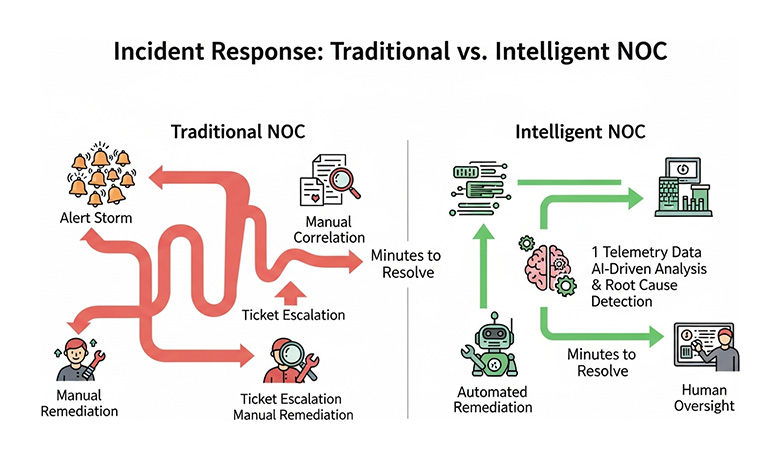
By leveraging machine learning, an Intelligent NOC can correlate millions of data points in real-time to pinpoint the source of an issue with incredible speed. It significantly improves incident detection by filtering out noise and false positives, presenting engineers with only actionable alerts. Automation then kicks in, triggering pre-defined workflows for remediation. This combination drastically reduces Mean Time to Resolution (MTTR), often from hours to mere minutes, directly enhancing service reliability and the customer experience.
What are the key features and functionalities of an Intelligent NOC?
Key features include predictive analytics to forecast failures. It uses AI to find root causes. It automates incident response and fixes. It provides full network observability. It provides a unified view of the entire IT infrastructure, including servers, applications, firewalls, and cloud services. The system manages dynamic patches. It also recommends ways to improve performance. It supports security operations in an integrated way.
The Foundation: What is a Traditional NOC?
A traditional Network Operations Center is a centralized location where IT teams monitor and maintain a network. Its primary function is to ensure uptime and optimal network performance. Staffed by engineers and technicians, these centers rely on a suite of monitoring tools that generate alerts when performance metrics breach pre-set thresholds. The operational model is fundamentally reactive, focusing on identifying and resolving faults after they occur.
The Growing Complexity: Challenges in the Always-On World
Modern IT infrastructure is a complex web of on-premises hardware, multi-cloud environments, IoT devices, and sophisticated software. This complexity, coupled with the relentless demand for 24/7 availability across every industry, has overwhelmed the traditional NOC model. Teams face “alert fatigue” from an endless stream of notifications, struggle to correlate events across siloed tools, and spend too much time on manual, repetitive tasks, leaving little room for strategic improvement.
Introducing the Intelligent NOC: A Paradigm Shift
The Intelligent NOC is the answer to these challenges. It represents a paradigm shift from a human-centric, reactive model to a software-driven, proactive one. This new model is not about replacing human expertise but augmenting it with powerful AI and automation capabilities.
How do AI and automation contribute to the functioning of an Intelligent NOC?
AI and automation are the core engines of an Intelligent NOC. AI algorithms continuously learn the network’s normal behavior, enabling them to detect and predict deviations with high accuracy. Automation platforms then execute workflows based on these AI-driven insights. This can range from automatically creating a detailed support ticket to executing a script that reroutes traffic or reboots a server, minimizing human intervention for known issues.
Defining the Intelligent NOC: Beyond Automation and AI
While AI and automation are foundational technologies, a truly Intelligent NOC is defined by its holistic approach and strategic outcomes. It’s a fusion of advanced technology, streamlined processes, and evolved human roles.
A Holistic Approach to Network Management
An Intelligent NOC breaks down the silos that plague traditional operations. It integrates data from across the entire technology stack—from physical hardware and telecommunications links to applications and cloud services. This provides a single, unified source of truth, enabling comprehensive visibility and a contextual understanding of how different components impact overall network performance.
Key Characteristics of an Intelligent NOC
Beyond its technological underpinnings, an Intelligent NOC is characterized by its operational philosophy:
- Predictive: It anticipates problems before they escalate.
- Proactive: It takes action to prevent predicted issues.
- Automated: It handles routine tasks and initial incident response autonomously.
- Data-Driven: All decisions are based on comprehensive data analysis, not guesswork.
- Self-Improving: It uses machine learning to learn from past events and continuously refine its responses.
Differentiating “Smart” from “Truly Intelligent”
Many NOCs use “smart” tools—scripts that automate simple, repetitive tasks. A “truly intelligent” NOC goes much further. Its intelligence is cognitive and adaptive. It can understand context, correlate disparate events to uncover hidden root causes, and make autonomous decisions in complex scenarios. It’s the difference between a scripted response and a system that can reason and learn.
The Core Pillars of an Intelligent NOC
The capabilities of an Intelligent NOC are built upon four interconnected pillars that work in concert to deliver proactive, automated network management.
Advanced Network Observability and Real-time Visibility
This is the foundation. An Intelligent NOC ingests massive volumes of data—logs, metrics, and traces—from every corner of the IT infrastructure. This goes beyond basic monitoring to provide deep observability. It allows engineers to not only see that a problem occurred but also to ask complex questions and understand why it happened, providing the rich context needed for rapid resolution and prevention.
Artificial Intelligence (AI) and Machine Learning (ML)
AI and ML are the brains of the operation. These technologies analyze observability data. They set dynamic performance baselines. They detect anomalies that old tools miss. They predict failures by spotting early warning signs. ML models continuously refine their understanding, becoming more accurate over time and providing the predictive foresight that defines an Intelligent NOC.
Intelligent Automation and Orchestration
This pillar provides the muscle. When AI detects or predicts an issue, intelligent automation takes over. This isn’t just simple scripting; it’s sophisticated orchestration that can execute multi-step remediation workflows across different systems. This includes everything from automated diagnostics and ticket enrichment to self-healing actions that resolve common incidents without any human touch.
Data-Driven Decision Making and Optimization
Finally, an Intelligent NOC transforms raw data into strategic business intelligence. By analyzing long-term performance trends, it can identify chronic issues, recommend capacity upgrades, and provide insights for network optimization. This enables the NOC to move from a purely operational function to a strategic partner that helps drive business efficiency and growth.
The Shift to Proactive Network Management
The most significant impact of adopting an Intelligent NOC is the fundamental shift from a reactive to a proactive operational posture.
From Reactive Firefighting to Predictive Foresight
In a traditional NOC, teams are in a constant state of “firefighting”—reacting to alarms and scrambling to fix what’s broken. An Intelligent NOC changes the game by providing predictive foresight. By identifying and addressing potential issues before they affect services, teams can get ahead of problems, drastically reducing unplanned downtime and emergency maintenance.
Enhancing Network Resilience and Agility
Proactive management inherently builds a more resilient network. Systems that can predict failures, automatically reroute traffic, and heal themselves are far less fragile. Furthermore, the automation and visibility provided by an Intelligent NOC increase business agility. New services and applications can be deployed with confidence, knowing the network has the intelligence to monitor and support them effectively.
Mitigating Alert Fatigue and Improving Focus
By using AI to correlate alerts and suppress noise, an Intelligent NOC ensures that human operators only see high-priority, context-rich incidents. This eliminates alert fatigue, which leads to burnout and missed events. It allows skilled engineers to stop chasing ghosts in the machine and focus their expertise on solving complex, novel problems and driving strategic improvements.
Strategic Benefits of Adopting an Intelligent NOC
The transition to an Intelligent NOC is not merely a technical upgrade; it is a strategic business decision that delivers tangible, far-reaching benefits.
Operational Efficiency and Cost Savings
Automation handles the high-volume, low-complexity tasks that consume the majority of a traditional NOC’s time. This drastically reduces manual labor costs and improves operational efficiency. Predictive maintenance also cuts costs by preventing catastrophic failures that require expensive emergency repairs and cause revenue loss from downtime.
Enhanced Network Performance and Uptime
By preventing outages before they occur and resolving incidents faster when they do, an Intelligent NOC directly contributes to higher network performance and availability. An intelligent NOC ensures that business-critical applications run smoothly and that service level agreements (SLAs) are consistently met, protecting brand reputation and revenue streams.
Superior Customer Experience and Satisfaction
For any modern business, network performance is synonymous with customer experience. Whether it’s an e-commerce site, a streaming service, or a corporate VPN, a slow or unavailable network creates user frustration. An Intelligent NOC ensures a seamless, reliable experience for every customer, a critical differentiator in today’s competitive market.
Strategic Business Advantage
Ultimately, an Intelligent NOC transforms the network operations team from a cost center into a value driver. A highly reliable, agile, and efficient network becomes a strategic asset that enables faster innovation, supports business growth, and provides a distinct competitive advantage in the digital marketplace.
Intelligent NOC vs. Traditional NOC: A Clear Distinction
The differences between a traditional NOC and an Intelligent NOC are stark, reflecting a fundamental evolution in philosophy, technology, and business impact.
Operational Models: Reactive vs. Predictive
The traditional NOC operates on a reactive “break-fix” model, responding to alerts only after an issue occurs. The Intelligent NOC uses a predictive model. It analyzes data to foresee and stop issues before they affect service. This shifts focus from fixing problems to preventing them.
Toolsets: Fragmented vs. Integrated AI-based Platforms
A traditional NOC often relies on a disparate collection of monitoring tools, each covering a specific domain. This creates information silos and makes correlation difficult. An Intelligent NOC is built on a unified, AI-powered platform that provides end-to-end visibility and centralizes intelligence, offering a single pane of glass for all network operations.
Role of Personnel: Manual Labor vs. Strategic Oversight
In a traditional setting, engineers spend much of their time on manual, repetitive tasks and first-level troubleshooting. In an Intelligent NOC, these tasks are automated. The role of personnel shifts to strategic oversight: managing the automation platform, handling complex escalations, and leveraging data-driven insights for long-term network optimization and planning.
Impact on Business: Cost Center vs. Value Driver
Historically, the NOC has been viewed as a necessary cost center—an insurance policy against downtime. The Intelligent NOC changes this perception. By improving efficiency, enhancing the customer experience, and enabling business agility, it becomes a strategic enabler of business goals and a clear driver of value.
Why Intelligent NOCs Are Essential Today
The evolution from traditional to Intelligent Network Operations Centers is no longer a futuristic concept; it is a present-day necessity. The escalating complexity of our digital world demands a new approach—one that is proactive, data-driven, and highly automated.
An Intelligent NOC delivers on this demand by harnessing the power of AI and machine learning to transform network management from a reactive chore into a strategic advantage.
The Intelligent NOC model gives predictive foresight. It improves resilience. It lets human experts focus on essential tasks. This helps improve network performance, operational efficiency, and the customer experience.
For organizations looking to thrive in the always-on economy, embracing the future of proactive network management is not just an option but an imperative for success. The journey begins with understanding that the goal is no longer to monitor networks, but to endow them with the intelligence to manage themselves.