The Growing Complexity of Network Operations
Understanding the Network Operations Center (NOC)
In the simplest terms, a Network Operations Center, or NOC, acts as the central nervous system for any organization’s IT infrastructure. It’s the hub where skilled IT technicians monitor, manage, and troubleshoot network systems around the clock to ensure they run smoothly. This involves overseeing network traffic, ensuring server reliability, maintaining firewalls, and responding to outages and security threats. Essentially, the NOC ensures that end-users have efficient and uninterrupted access to the services they depend upon.
Increasing Complexity with Emerging Technologies
As technology evolves, so too does the complexity of managing network operations. The advent of cloud computing, the Internet of Things (IoT), and 5G networks has exponentially increased the volume and velocity of data flowing through these systems. These technologies have broadened the network ecosystems that NOCs must monitor, introducing new layers of complexity. For example, the proliferation of IoT devices generates vast amounts of data that require constant monitoring and quick resolution strategies when issues arise. Furthermore, the shift towards remote work and the interconnection of global systems have expanded the scope of network operations beyond traditional boundaries.

AI and Automation Transforming the NOC Landscape
To cope with this burgeoning complexity, AI and Automation NOC are stepping in as transformative forces within the NOC landscape. Artificial intelligence offers the potential to analyze and process vast datasets quickly and efficiently, identifying patterns and alerting human operators to any anomalies. This capability allows NOCs to move from reactive to proactive operations, predicting and preventing outages before they occur. Automation, on the other hand, reduces the burden of routine tasks, such as software updates and system patching, allowing NOC personnel to focus on more complex issues that require human intervention.
Together, AI and automation are not just making network operations more efficient — they’re revolutionizing them. Enhanced with machine learning algorithms and automated processes, NOCs are evolving into intelligent systems capable of not only monitoring but also optimizing network performance in real-time. This transformation ultimately leads to improved service delivery, reduced operational costs, and enhanced security, enabling organizations to keep pace with the rapid innovations of the digital age.
What challenges can AI and automation solve in a NOC?
AI and automation help NOCs manage alert overload by analyzing large volumes of network events, correlating related alerts, and filtering out duplicate or low-priority notifications. Instead of requiring engineers to review every alert manually, AI can identify unusual patterns and prioritize incidents based on severity and potential business impact. This reduces alert fatigue and lets NOC teams focus on incidents that need immediate attention.
Automation can also address staffing constraints and repetitive workloads. Automated workflows can handle routine tasks such as ticket creation, device health checks, configuration updates, patching, service restarts, and basic remediation. This allows NOC engineers to manage larger environments without increasing their manual workload, giving them more time to focus on complex incidents and strategic network improvements.
AI and automation are especially valuable in complex, distributed network environments spanning cloud platforms, data centers, remote locations, IoT devices, and edge infrastructure.
AI can correlate data from multiple sources to identify relationships that are difficult to detect manually, while automation can consistently execute predefined responses across systems. Together, these capabilities accelerate troubleshooting, improve root-cause identification, reduce response times, and help NOCs maintain reliable network performance.
What Is the Difference Between AI, Automation, and AIOps in a NOC?
| Technology | Role in a NOC | Key Capabilities |
| Network Automation | Automation performs predefined network tasks without requiring engineers to handle every routine action manually. | It handles configuration changes, service restarts, ticket creation, patching, and automated remediation. |
| AIOps | AIOps combines AI, machine learning, monitoring data, and automation to improve IT and network operations. | It enables event correlation, alert reduction, incident analysis, predictive insights, and automated responses. |
| AI + Automation | AI identifies what may be wrong, while automation can execute an appropriate predefined response. | Faster detection, automated troubleshooting, reduced manual intervention, and quicker remediation. |
| AIOps + NOC | AIOps brings information from multiple monitoring sources together to give NOC teams a broader operational view. | It provides cross-system visibility, intelligent prioritization, root-cause identification, and workflow automation. |
| Combined Approach | AI provides intelligence, automation performs actions, and AIOps coordinates insights across the NOC environment. | Proactive monitoring, reduced alert fatigue, faster troubleshooting, improved uptime, and scalable operations. |
What AI Tools and Platforms Are Used in NOC Operations?
NOCs use different AI-enabled tools to monitor infrastructure, analyze events, detect threats, and automate responses. AIOps platforms use machine learning and event correlation to identify patterns across network, application, and infrastructure data, helping teams reduce alert noise and identify potential root causes. Observability tools provide visibility across networks, applications, cloud environments, logs, metrics, and traces to support faster troubleshooting.
Network monitoring platforms continuously track device health, bandwidth, availability, latency, and performance, while AI capabilities can help identify abnormal behavior and predict potential failures. EDR and XDR platforms extend monitoring to endpoints and broader IT environments, using behavioral analytics to detect suspicious activity and speed up security incident investigations.
NOCs can also use orchestration and automation tools to execute predefined remediation workflows, such as restarting services, changing configurations, or escalating incidents. AI-assisted ITSM platforms can improve ticket classification, prioritization, routing, summarization, and resolution recommendations. Together, these technologies help NOCs shift from manual, reactive monitoring to more intelligent, proactive, automated operations.
How Does AI Support Network Security in a NOC?
AI strengthens NOC security by enabling faster threat detection and behavioral analysis across network traffic, endpoints, and infrastructure. Machine learning models can identify unusual login patterns, abnormal data transfers, unexpected device behavior, and other indicators that may signal a cyberattack. This lets NOC teams investigate suspicious activity before it becomes a larger security incident.
AI can also analyze suspicious network traffic and correlate security events from multiple sources, including firewalls, endpoints, servers, and network monitoring systems. By connecting related events, AI can help distinguish isolated alerts from coordinated attack patterns and prioritize incidents based on their potential severity and business impact.
When integrated with security automation, AI can support automated containment and response for predefined threats. For example, based on established response policies, it can isolate a compromised endpoint, block suspicious traffic, or restrict an affected account. This combination of AI-driven analysis and automated action helps NOCs reduce response times while keeping security teams involved in higher-risk decisions.
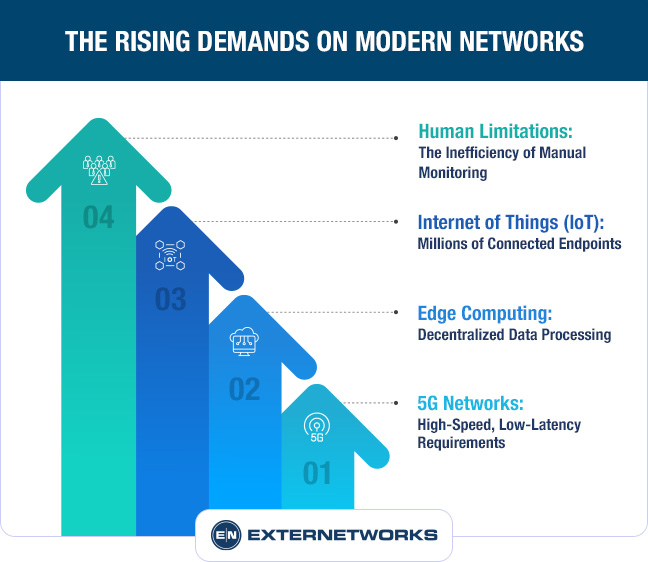
The Rising Demands on Modern Networks
As technology continues to advance, modern networks face increasing pressure to perform. In this context, several emerging trends and technological advancements are placing unparalleled demands on network operations, necessitating a transformation in how these networks are managed.
Increased demands from:
5G Networks: High-Speed, Low-Latency Requirements
5G technology represents a significant leap forward in mobile network performance. With its promise of ultra-fast speeds and near-instantaneous data transfer, 5G is set to enable a range of applications that were previously unattainable. From augmented reality experiences to autonomous vehicles, the high-speed, low-latency nature of 5G is crucial. However, it also introduces substantial complexity to network operations as providers need to ensure seamless connectivity and maintain rigorous performance standards across expansive geographical areas.
Edge Computing: Decentralized Data Processing
Edge computing shifts data processing closer to the source of data generation, rather than relying entirely on centralized data centers. This decentralization enhances processing efficiency and reduces latency, which is particularly beneficial in applications requiring real-time analytics. For network operations, this means dealing with a multitude of edge devices that must communicate efficiently with both each other and central systems. The demands on the network increase as operators work to maintain synchronization and reliability across this distributed architecture.
Internet of Things (IoT): Millions of Connected Endpoints
The Internet of Things has expanded rapidly, with a multitude of devices connected to global networks, ranging from smart home appliances to industrial sensors. This proliferation presents a dual challenge: managing the sheer volume of connected endpoints and ensuring their security and reliability. Networks must handle vast amounts of data flowing continuously from IoT devices, requiring robust infrastructure to avoid bottlenecks and potential points of failure.
Human Limitations: The Inefficiency of Manual Monitoring
As networks expand in complexity and scale, relying on humans to manually monitor and manage their performance is increasingly impractical. The human capability to effectively track millions of concurrently connected devices and instantly detect issues is inherently limited. This human limitation highlights the growing need for AI and automation, which can provide more scalable and efficient solutions for monitoring, diagnosing, and managing network operations in real-time.
As the demands on modern networks rise, driven by advancements in 5G, edge computing, and IoT, alongside inherent human limitations, there is an undeniable need for innovative solutions. These solutions must be capable of handling such complexity effectively — a challenge that AI and automation are remarkably well-suited to address.
Why Traditional NOCs Are No Longer Enough
As the digital landscape evolves, traditional Network Operations Centers (NOCs) struggle to keep pace with the increasingly complex demands of modern network environments. Here’s why relying solely on conventional NOCs is no longer sufficient:
Challenges with Scale, Data Volume, and Complexity
The sheer scale of today’s networks is exponentially greater than in the past. Organizations are expanding rapidly, resulting in broader networks with more devices, larger data centers, and interconnected systems worldwide. This growth results in massive volumes of data that must be continuously monitored. Traditional NOCs, often reliant on manual monitoring and outdated tools, are ill-equipped to handle the vast influx of data. Furthermore, the data complexity arising from varying protocols, formats, and system interactions exacerbates the challenge, making it harder for NOCs to provide accurate and timely analysis.
Human Engineers Face Fatigue from Alert Noise and Repetitive Tasks
The architecture of a traditional NOC typically generates a barrage of alerts, many of which are redundant or false positives. Human engineers become overwhelmed by this “alert noise,” leading to fatigue and decreased productivity. This constant influx of notifications demands immediate attention, often for issues that are minor or non-existent. Such repetitive tasks not only contribute to burnout but also detract from engineers’ ability to focus on more critical, complex problem-solving efforts. As network environments evolve and change, the volume of alerts increases, but the manual processes in place to address them do not scale accordingly.
Delays in Identifying and Resolving Incidents Impact Performance and Uptime
Time is of the essence in network management. Delays in identifying and resolving incidents can have significant repercussions on performance and uptime. Traditional NOCs, constrained by manual processes and limited automation, often fail to detect and address network issues promptly. This latency can lead to prolonged outages and performance bottlenecks, ultimately compromising customer satisfaction and business continuity. In today’s landscape, where network reliability is paramount, the ability to respond swiftly and effectively to incidents is critical, a capability that traditional NOCs often struggle to provide.
While traditional NOCs have served as the backbone of network operations for decades, the rapid advancement of technology necessitates a transformation. As we move further into a digital-first world, embracing AI and automation in NOCs becomes not only advantageous but also essential for managing the complexities and demands of modern networks.
Enter AI and Automation: Redefining NOC Capabilities
As network operations continue to grow in complexity, the infusion of AI and automation is marking a transformative shift in how Network Operations Centers (NOCs) function. This innovative approach not only augments the capabilities of NOCs but also redefines their core operations to make them more efficient, responsive, and resilient.
AI for Real-Time Data Analysis: Identifying Patterns and Anomalies Quickly
AI’s ability to process vast quantities of data in real time is one of its most significant advantages in network management. By leveraging advanced algorithms and machine learning models, AI systems can quickly identify patterns within network traffic. This capability allows NOCs to anticipate potential issues before they escalate into critical problems. For instance, AI can detect subtle deviations in data flow that could indicate a security breach or a performance bottleneck, enabling proactive measures to mitigate risks.
Automation: Fixing Common Issues Without Human Intervention
Automation is revolutionizing how routine network issues are addressed within NOCs. Traditional network management often involves manual troubleshooting, which can be time-consuming and prone to human error. Through automation, many common network issues can now be resolved without human intervention. From rerouting traffic during peak loads to restarting a malfunctioning server, automated systems streamline operations, freeing up human resources for more strategic tasks. This shift not only enhances efficiency but also improves response times, ensuring that the network remains robust and reliable.
Reduces Mean Time to Detect (MTTD) and Mean Time to Resolve (MTTR)
One of the critical metrics that defines the effectiveness of an NOC is its ability to detect and resolve network issues swiftly. AI and automation significantly reduce both Mean Time to Detect (MTTD) and Mean Time to Resolve (MTTR), which are essential for maintaining high network availability and performance. By quickly identifying issues through AI-driven analytics and resolving them automatically, these advanced technologies minimize downtime and service disruptions, thereby ensuring a seamless user experience.
Supports 24/7 Operations Without Human Fatigue
Unlike human operators, AI and automated systems do not suffer from fatigue, making them ideal for supporting 24/7 network operations. They can continuously monitor and manage network activities around the clock, ensuring consistent performance and reliability. This capability is especially critical in today’s globalized economy, where networks must support business operations across multiple time zones. By maintaining vigilant oversight without the risk of human error due to tiredness, AI and automation ensure that networks are always up and running.
AI and automation are not just enhancing the efficiency of Network Operations Centers; they are redefining how these centers manage the complexities of modern networks. With real-time data analysis, automated issue resolution, and the elimination of downtime factors such as fatigue, these technologies are propelling NOCs into a new era of operational excellence. As they continue to evolve, AI and NOC Automation will undoubtedly play an increasingly central role in shaping the future of network management.
The Shift from Reactive to Proactive Operations
Network Operations Centers (NOCs) have traditionally been reactive environments, where teams wait for issues to arise before taking action. Typically, this involves receiving alerts or notifications about network disruptions or failures, and then scrambling to mitigate these problems as quickly as possible. However, this approach has several drawbacks, including potential downtime, degraded customer experience, and increased operational stress for IT personnel.
From Reactive to Proactive Operations with AI
The introduction of Artificial Intelligence (AI) into NOCs has initiated a significant paradigm shift from this traditional reactive approach to a more proactive one. AI and NOCs, with their ability to analyze vast amounts of data quickly and accurately, empower network teams to anticipate issues before they manifest into full-blown problems.
By leveraging AI, NOCs can continuously monitor network patterns and behaviors. Machine learning algorithms can be trained to recognize subtle deviations from normal operations that might indicate a pending failure or bottleneck. These predictive insights enable network teams to intervene before users are impacted, effectively shifting the NOC’s function from firefighting mode to one of anticipatory maintenance.
Benefits of Proactive Operations
This transformation from reactive to proactive operations offers several significant advantages:
Improved Uptime: Active monitoring and predictive maintenance help identify potential risks and vulnerabilities before they escalate, thereby minimizing unplanned downtime. This ensures that systems are more consistently available to meet the demands of businesses and their customers.
Enhanced Customer Experience: By addressing issues before they affect end-users, businesses can maintain higher service levels. Reliable and uninterrupted services lead to increased customer satisfaction and loyalty.
Operational Efficiency: A proactive approach reduces the need for constant crisis management, freeing up IT teams to focus on strategic initiatives rather than immediate fixes. This results in more efficient use of resources and a better allocation of human capital.
Cost Savings: Addressing potential issues before they compound into larger problems can significantly reduce the costs associated with emergency repairs, as well as the indirect costs of lost business due to downtimes.
The integration of AI into NOCs marks a fundamental shift in how network operations are managed, transitioning from a passive, reactive stance to an active, forward-looking approach. This change not only enhances the resilience and reliability of network systems but also aligns operational goals more closely with business objectives, creating a robust framework for handling the complexities of modern digital infrastructures.
Network Observability: From Data to Insight
In the ever-evolving landscape of network operations, the concept of network observability has emerged as a critical component for maintaining robust and efficient systems. At its core, network observability refers to achieving complete visibility across all network layers and endpoints. This comprehensive visibility enables Network Operations Centers (NOCs) to monitor, understand, and manage the network environment with detailed insights.
Unlike traditional network monitoring, which primarily focuses on collecting metrics and logs, network observability tools delve deeper, transforming raw data into actionable intelligence. They enable operations teams not just to see what is happening across the network but to understand why it is happening. This shift from mere data gathering to insightful analysis proves instrumental in enhancing decision-making processes within network operations.
One of the primary strengths of observability tools lies in their ability to support decision-making rather than merely execute data collection. Traditional monitoring systems often fall short by overwhelming operators with volumes of data that are devoid of context or meaningful insights. In contrast, observability tools filter and refine this data, presenting a holistic view of network traffic, application performance, and user behavior patterns. This informed perspective enables teams to make informed decisions rapidly, thereby optimizing network performance, reducing operational costs, and enhancing service reliability.
Furthermore, network observability acts as a foundational element for Artificial Intelligence for IT Operations (AIOps) platforms. By providing granular visibility into every network facet, these tools empower AIOps applications to correlate disparate data points, analyze patterns, and automate intelligent responses to anomalies. For instance, in the event of a network disruption, observability-driven AIOps can quickly identify the root cause, propose corrective measures, or even autonomously resolve issues, thereby minimizing downtime and ensuring service continuity.
Ultimately, integrating network observability tools transforms the way NOCs operate, shifting the paradigm from reactive troubleshooting to proactive management. By evolving from mere data collection to insightful analysis, these tools equip network professionals with the tools required to anticipate challenges, streamline operations, and significantly enhance user experiences. In doing so, network observability becomes not just a technology tool but a strategic advantage in the realm of network management.
Real-World Example: IBM Netcool + Watson for Nextel
In the ever-evolving landscape of telecommunications, staying ahead of network issues is crucial for maintaining service quality and customer satisfaction. To address these challenges, Nextel turned to IBM Netcool and Watson to enhance its Network Operations Center (NOC) capabilities. This integration of AI-driven insights revolutionized their incident management processes, offering a blueprint for innovation in network operations.
AI-Driven Insights for Incident Resolution
The complexity of modern network systems means that traditional manual methods of monitoring and responding to incidents are often inefficient. Nextel faced challenges with the speed and accuracy of incident resolution. By integrating IBM Netcool with Watson, Nextel leveraged AI to process vast amounts of network data, quickly identifying and categorizing incidents. This AI-enabled system can prioritize incidents based on their potential impact, allowing the NOC team to focus on the most critical issues first and thereby streamline the entire process. As a result, their incident response times were significantly reduced, leading to improved service availability for their customers.
Reduction in False Alerts
One of the major headaches for NOCs is the issue of false alerts — alerts that indicate a problem when one does not exist. These can divert valuable resources away from actual network issues. With the implementation of AI-driven analytics, Nextel was able to reduce the incidence of false alerts drastically. Watson’s advanced pattern recognition capabilities analyze historical data and accurately distinguish normal network behavior from anomalies. By filtering out these false positives, the NOC team could dedicate more attention and resources to genuine network issues, thereby enhancing operational efficiency.
Faster Identification of Root Causes
Identifying the root cause of a network incident can be like finding a needle in a haystack. By utilizing Watson’s machine learning algorithms, Nextel was able to correlate various network events and phenomena, pinpointing underlying causes more swiftly than ever before. Rather than spending hours sifting through logs or playing a prolonged guessing game, the AI system helped to quickly zero in on the source of a problem. This expedited the troubleshooting process, enabling technicians to implement fixes promptly and thereby reduce downtime for customers.
The successful integration of IBM Netcool with Watson at Nextel serves as a compelling case study of how AI and automation can transform network operations. This partnership not only improved their incident resolution times but also streamlined operations by reducing false alerts and accelerating the identification of root causes. As the demands on network infrastructures continue to increase, innovative solutions like these provide a clear path to maintaining robust and reliable network services.
Ready to Future-proof Your NOC Operations?
Schedule a free consultation with our network experts at ExterNetworks and discover how we can help modernize your operations with AIOps solutions. Surface