Introduction to Tier 1 NOC Support
In the intricate world of IT infrastructure, Tier 1 NOC (Network Operations Center) support plays an essential role as the initial level of network monitoring and management. Fundamentally, Tier 1 NOC support forms the bedrock of a layered approach to network issues, focusing on the early identification and resolution of routine technical glitches such as system alerts, password resets, and ticket triage. This preliminary support level is crucial in maintaining the seamless operation of IT ecosystems by swiftly addressing basic disruptions.

Understanding the IT Support Hierarchy
Tier 1 support is the entry point in the comprehensive IT support hierarchy, which traditionally includes Tier 2 and Tier 3 levels. Each tier represents increasingly complex and specialized levels of expertise. While Tier 1 staff manage straightforward and repetitive tasks, Tier 2 offers more advanced troubleshooting, and Tier 3 provides deep technical knowledge for complex problems.
Business Dependence on Structured NOC Tiers
Businesses rely heavily on a structured, tiered approach to ensure maximized uptime and optimal performance of their networks. This systematic layering allows each level to focus on its specialized tasks effectively and efficiently. By distributing network management efforts across different tiers, organizations can:
- Enhance Response Time: Quick identification and resolution of basic issues at Tier 1 prevent unnecessary escalation, preserving resources for more complex tasks.
- Ensure Resource Optimization: Businesses can allocate resources strategically, with specialized skills being reserved for levels where they are most critically needed.
- Facilitate Proactive Monitoring: Tiered NOC systems ensure continuous monitoring and adaptive management, crucial for preemptively identifying and addressing potential threats.
The reliance on structured tiers underscores their indispensable role in safeguarding network integrity, fostering a proactive IT environment that effectively supports business continuity. Through this hierarchical structure, organizations enhance their capacity to maintain consistent network performance, ultimately benefiting their operations and, by extension, their competitive position in the market.
65%+ of IT Support Can Be Handled at Tier 1
In the realm of IT support, the majority of issues that businesses encounter can be efficiently managed at the Tier 1 level. Defined as the first line of defense, Tier 1 support deals primarily with repetitive, predictable, and easily solvable incidents. This crucial layer not only streamlines operations but also lays the groundwork for a more effective and agile IT support structure.
Repetitive and Predictable Nature of IT Issues
The day-to-day operations of any tech-driven organization often give rise to common problems and queries. These scenarios typically include password resets, software installation guidance, and minor connectivity issues. The predictable nature of these requests means that Tier 1 support teams are well-equipped with scripts, resources, and protocols to resolve such issues swiftly. Their routine nature allows businesses to optimize operations without diverting advanced resources, ensuring that more complex issues can be addressed by higher tiers of support.
Statistics Speak Volumes
According to industry studies, a staggering 65% or more of IT support tickets fall squarely within Tier 1 responsibilities. This statistic highlights the importance of cultivating a robust Tier 1 team, as it is this frontline support that handles the bulk of incidents. By addressing these issues promptly, Tier 1 support plays a pivotal role in minimizing downtime and enhancing user satisfaction, thereby fostering a culture of reliability and trust within the organization.
Core Tasks at Tier 1 Support
The scope of Tier 1 tasks is well-defined yet expansive enough to have a significant impact on operational efficiency. Key responsibilities include:
- System Monitoring: Constant vigilance over network systems ensures that potential problems are detected early. Proactive system monitoring enables Tier 1 agents to identify irregularities or failures before they escalate into major concerns.
- Ticket Categorization: An organized process is vital for effectively managing support requests. Tier 1 teams categorize tickets based on severity and type, guiding them toward appropriate resolution paths or escalating them to higher tiers when necessary.
- Basic Troubleshooting: Equipped with a rich knowledge base, Tier 1 support personnel perform initial diagnostics and execute standard solutions for routine issues. By swiftly resolving these common problems, they help maintain a continuous and efficient workflow across the organization.
Tier 1 NOC support stands as the cornerstone of IT operations for many businesses, handling a significant portion of support requests with agility and effectiveness. By focusing on the repetitive and predictable aspects of IT problems, organizations can leverage their Tier 1 support to maintain fluid operations, allowing higher tiers to concentrate their expertise on more complex challenges.
Tier 1 Frees Higher Tiers for Complex Issues
In the world of IT support, efficiency and expertise are essential for maintaining seamless operations. One of the fundamental roles of a Tier 1 NOC is to act as the first line of defense, handling all routine inquiries and minor issues. This strategy not only ensures prompt attention to common problems but also significantly enhances the overall efficiency of the IT support structure by freeing up Tier 2 and Tier 3 engineers to focus on more complex issues.
Focus on Escalated, Mission-Critical, or Specialized Issues
Tier 2 and Tier 3 engineers possess specialized skills and in-depth knowledge, making them well-suited for handling escalated cases, mission-critical problems, and complex technical challenges. Tasks that fall under their expertise often require detailed analysis, advanced problem-solving techniques, and more substantial time investments to ensure effective resolution. By keeping these highly skilled engineers dedicated to significant and sensitive issues, organizations ensure that critical incidents receive the attention and expertise needed without delay.
Reduction of Efficiency and Resolution Time with Minor Tickets
When experienced engineers are bogged down with routine inquiries or minor technical issues, their ability to tackle more pressing problems is compromised. This diversion not only results in a waste of talent but also negatively impacts the overall efficiency of the support operation. Furthermore, if these engineers are frequently interrupted with basic tickets, the time taken to resolve complex issues increases, potentially affecting the organization’s service quality and customer satisfaction.
Tier 1 as a Filter for Routine Matters
The Tier 1 NOC serves as an essential filter, processing all incoming tickets and resolving issues that fall within its purview. This diligent approach ensures that only the issues warranting specialized attention are escalated to the higher tiers. The filtering process involves assessing the complexity and significance of each request, successfully segregating trivial matters from those that require advanced intervention. By addressing routine matters effectively, Tier 1 support prevents unnecessary escalations, resulting in a streamlined workflow that enhances productivity across all tiers.
By serving as the first point of contact and efficiently managing day-to-day issues, Tier 1 support plays a pivotal role in maintaining the operational efficiency of an organization’s IT infrastructure. It ensures that high-level engineers are not distracted by minor tasks, thus enabling them to concentrate on maximizing their expertise in solving complex and critical issues, ultimately benefiting the organization as a whole.
Not Cost-Effective to Use Expensive Engineers for Basic Tasks
In the world of IT support, allocating human resources strategically is crucial for maintaining operational efficiency and controlling costs. One of the key principles in this allocation is the division of labor across different tiers in the Network Operations Center (NOC). This is particularly relevant when considering the high salaries of Tier 2 and Tier 3 engineers compared to their Tier 1 counterparts.
Understanding the Salary Disparities
Tier 2 and Tier 3 engineers are highly skilled professionals with specialized knowledge and experience. They often earn two to three times the salary of Tier 1 technicians. These salaries reflect their expertise and ability to resolve complex issues that require deep technical understanding and problem-solving skills. However, when these high-earning engineers are tasked with basic, routine tasks such as password resets or simple diagnostics, it becomes an inefficient use of resources. This practice not only inflates operational costs but also detracts from the potential use of their advanced skills on projects or problems that truly require their level of expertise.
Scalability and Economic Viability
When expensive engineers focus on tasks that could be handled by less experienced staff, the scalability of operations is hindered. A Tier 1 technician, possessing the foundational skills necessary to resolve routine inquiries and basic technical issues, is well-positioned to handle these tasks efficiently. By staffing a robust Tier 1 team, businesses can ensure that routine issues are resolved promptly and without detracting from the company’s bottom line.
Smart Allocation of Skilled Resources
Effective resource management involves allocating support tasks according to the complexity and required expertise. Allowing Tier 1 technicians to manage routine tasks frees up Tier 2 and Tier 3 engineers to concentrate on more complex and critical incidents that demand their level of knowledge and problem-solving acumen. This not only maximizes the return on investment in skilled personnel but also boosts morale as each team member operates at their full potential within the organization.
The strategic deployment of Tier 1 NOC support is fundamental to ensuring that businesses leverage their human capital efficiently. By recognizing the role that each tier plays and capitalizing on the competencies of Tier 1 technicians for basic tasks, organizations can maintain cost-effectiveness while maximizing the capabilities of their engineering talent.
Benefits of 24/7 Tier 1 NOC Services
In today’s digitally driven environment, 24/7 Tier 1 Network Operations Center (NOC) services play a crucial role in maintaining seamless IT operations. Here are some key benefits they offer:
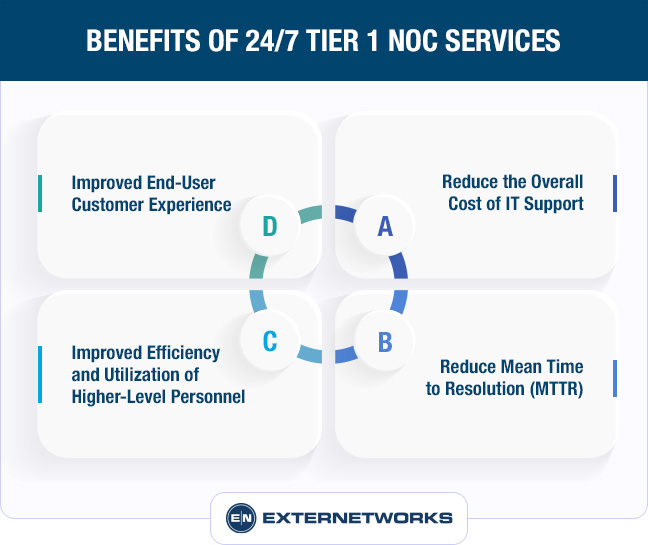
Reduce the Overall Cost of IT Support
One of the primary benefits of implementing 24/7 Tier 1 NOC services is the significant reduction in the costs associated with IT support. By leveraging this service, organizations can ensure that issues are addressed around the clock without incurring the high costs associated with higher-tier support. Lower-tier support personnel handle initial diagnostics and troubleshooting at a fraction of the cost of senior engineers. This also eliminates the need for overtime and on-call pay, as senior engineers are only summoned when necessary.
Additionally, the 24/7 Tier 1 service model enables scalable operations with predictable pricing. This ensures that businesses can budget accurately and allocate resources more effectively, minimizing wastage and maximizing return on investment.
Reduce Mean Time to Resolution (MTTR)
Reducing the mean time to resolution (MTTR) is crucial for maintaining service quality and customer satisfaction. With 24/7 Tier 1 NOC services, organizations benefit from immediate responses to any incidents or disruptions that may occur. This swift action leads to faster ticket resolutions and ensures that services are restored quickly, minimizing downtime.
The tier 1 team is equipped to perform triage and initial diagnostics without delay, which speeds up service level agreements (SLAs). This efficiency ensures that issues are not only identified faster but also resolved more effectively, leading to improved performance metrics and reliability.
Improved Efficiency and Utilization of Higher-Level Personnel
Another significant advantage of employing a 24/7 Tier 1 NOC service is the improved utilization of higher-level technical staff. With Tier 1 professionals managing routine tasks and initial triage, senior staff members are free to focus on more strategic activities, such as innovation, architectural planning, and handling complex escalations.
This separation of responsibilities means that employee burnout is reduced, as staff are not overwhelmed with issues that are not within their specialized expertise. This not only increases the retention of skilled engineers by allowing them to concentrate on more fulfilling tasks but also fosters a more productive and innovative working environment.
Improved End-User Customer Experience
Finally, the 24/7 availability of Tier 1 NOC services significantly enhances the end-user customer experience. Users have access to prompt and professional support at any time, including off-hours, ensuring that their needs are met and their issues are resolved quickly. This around-the-clock availability eliminates bottlenecks and minimizes response times, thereby boosting customer satisfaction.
By ensuring that users receive the attention and support they need precisely when they need it, businesses can strengthen their reputation for reliability and customer-centric service. This not only helps retain existing customers but also attracts new ones through positive word-of-mouth referrals.
In conclusion, 24/7 Tier 1 NOC services provide a strategic advantage by enhancing operational efficiency, reducing costs, and improving the overall user experience. Their ability to streamline processes and deliver timely support is invaluable in today’s fast-paced business world.
How to Structure Tier 1 NOC Support for Success
Creating a structured and efficient Tier 1 NOC support system is crucial to achieving seamless network operations and delivering prompt service to customers. Here’s a guide on how to establish a successful Tier 1 NOC support structure:
Utilize Dedicated or Outsourced Tier 1 NOC Services
Choosing between a dedicated in-house Tier 1 NOC team or outsourcing the function is a pivotal decision that can impact your organization’s operational efficiency and cost-effectiveness.
In-House vs. Outsourced Services
With a dedicated in-house team, you have complete control over operations, enabling tailored processes and policies that closely align with your company culture and goals. Alternatively, outsourcing Tier 1 NOC services to a reputable third-party provider can offer the advantage of specialized expertise, resource flexibility, and reduced operational overhead, which could be essential for companies looking to scale quickly or those lacking in-depth IT resources.
Evaluating Your Needs
Assess the needs of your organization in terms of response times, budget constraints, and the complexity of your IT infrastructure. Opt for a solution that delivers not only technical proficiency but also aligns with your strategic business objectives.
Ensure Tier 1 Agents Are Trained in Essential Areas
Training is the backbone of a competent Tier 1 NOC team. Specialized training ensures that your agents can effectively monitor network health, respond swiftly to incidents, and maintain the desired level of operational efficiency.
Monitoring Tools
Familiarity with leading monitoring tools, such as SolarWinds, Nagios, or PRTG Network Monitor, enables Tier 1 agents to monitor network performance and identify irregularities proactively. Training should encompass both system navigation and interpreting data to make informed decisions actively.
Ticketing Systems
Agents must be proficient in using ticketing systems such as Jira Service Desk or ServiceNow. Comprehensive training in these platforms enables smooth management of customer incidents, efficient escalation processes, and ensures accountability through the documentation of actions taken.
Standard Operating Procedures (SOPs)
SOPs are critical for maintaining consistency and quality of service. Agents should be thoroughly educated about the company’s SOPs, including incident response protocols, escalation guidelines, and communication standards. Understanding these procedures ensures that agents handle tasks and issues uniformly, reducing error margins and improving service consistency.
Implement Regular Training and Development Programs
Continuous learning is vital in keeping Tier 1 agents at the forefront of emerging technologies and process improvements. Regular workshops, refreshers on current systems, and training modules on the latest trends in network operations can significantly enhance agent performance, adaptability, and overall service excellence.
Effectively structuring Tier 1 NOC support involves strategic decisions around service sourcing and a commitment to rigorous agent training. By selecting the right structure and ensuring that agents are thoroughly trained in essential tools and procedures, organizations can establish a Tier 1 NOC that not only maintains network stability but also enhances customer satisfaction through prompt and reliable service.
Adaptability: When to Consider Outsourcing Tier 1 NOC Support
Outsourcing Tier 1 Network Operations Center (NOC) support is a strategic decision that many organizations opt for to streamline operations and optimize resources. Here are key circumstances when outsourcing may become a viable and effective option:
Your IT Staff is Overwhelmed with Basic Tasks
In any growing organization, as the network infrastructure expands, so does the volume of basic support tasks. May include monitoring network performance, responding to routine alerts, and performing system checks. When your highly skilled IT team is inundated with these fundamental tasks, it diverts their attention from more critical projects that could drive innovation and improve business processes. Outsourcing your Tier 1 NOC support alleviates this burden by handling these routine responsibilities, allowing your internal team to focus on strategic initiatives and complex technical challenges.
You Want 24/7 Coverage Without Hiring Night-Shift Staff
Providing round-the-clock network monitoring and support is essential for ensuring business continuity and minimizing downtime. However, maintaining a full-time, in-house night-shift staff can be both costly and logistically challenging. Outsourcing Tier 1 support to a dedicated NOC service provider ensures seamless 24/7 coverage without the necessity of hiring additional employees to work odd hours. Leveraging external experts who are accustomed to providing continuous support not only ensures that your network is monitored at all times but also contributes to faster response times and enhanced network reliability.
Your Budget Doesn’t Support Expanding Tier 2/3 Engineers
Investing in expanding higher-level IT support teams, such as Tier 2 and Tier 3 engineers, can be financially burdensome. These technical experts are crucial for resolving complex issues, but come with a substantial cost. By outsourcing Tier 1 NOC services, companies can reallocate their limited budgetary resources to bolster their Tier 2 and 3 capabilities. Freeing up financial constraints allows businesses to retain essential engineering talent for advanced problem-solving and system enhancements while keeping operational costs in check. Moreover, the cost efficiency of outsourced Tier 1 support enables the scalability necessary to meet the demands of a growing organization without incurring financial strain.
Outsourcing Tier 1 NOC support offers a strategic advantage, providing organizations with the flexibility and efficiency required to manage IT operations effectively. It enables businesses to strike the right balance between maintaining robust network support and controlling costs, ensuring smooth and uninterrupted business operations.
Conclusion
In today’s fast-paced digital environment, the significance of Tier 1 Network Operations Center (NOC) support cannot be understated. As businesses strive for uninterrupted service and strategic growth, having a robust and responsive Tier 1 NOC becomes crucial. The key takeaways from the discussion on the importance of Tier 1 NOC support are multifaceted, each contributing to a comprehensive understanding of its critical role.
24/7 Network Monitoring is Essential
Ensuring continuous network monitoring through a dedicated Tier 1 NOC is instrumental in minimizing downtime and maintaining business continuity. Organizations that rely on constant connectivity can ill-afford disruptions. By outsourcing this function, companies benefit from expert teams that provide seamless, round-the-clock support without the challenges and costs associated with maintaining an in-house night-shift team. This approach not only ensures network reliability but also improves response times, which are critical to addressing potential issues before they escalate.
Cost-Effective Allocation of Resources
Budget constraints can limit the growth and capabilities of in-house technical teams, particularly when it comes to expanding Tier 2 and Tier 3 engineer roles. Outsourcing Tier 1 NOC services offers a cost-effective solution, enabling companies to reallocate financial resources to enhance the capacity of higher-level IT support. This strategic allocation of funds ensures that complex technical challenges receive the attention they deserve without placing a financial burden on the organization. Companies can thus maintain and even improve their IT infrastructure without compromising on quality or performance.
Scalability and Flexibility in IT Operations
Outsourcing Tier 1 NOC functions provides the scalability necessary to adapt to the evolving demands of the business landscape. As organizations grow, the need for flexible and efficient IT operations becomes increasingly apparent. By partnering with a dedicated NOC service provider, businesses can adjust their support levels in alignment with organizational needs, all while controlling operational costs. This flexibility is essential for driving innovation and leveraging technical resources in a manner that supports strategic business objectives.
Tier 1 NOC support serves as a vital component of modern network management. By offering around-the-clock coverage, cost-effective resource allocation, and scalable operational benefits, it empowers organizations to focus on strategic initiatives without sacrificing operational integrity. As businesses continue to evolve, embracing outsourced Tier 1 support will remain a strategic enabler for ensuring continuous operability and competitive advantage in the digital age.