 NOC Services
The True Cost of Network Downtime: Understanding Its Business Impact



Editor’s Note: This infographic-driven article sheds light on the hidden and often underestimated costs of network downtime, emphasizing the critical need for robust incident management and continuous monitoring. It... Read More
Downtime Draining Your Business? Fix It Before It Costs More
Missed alerts turn into outages, outages turn into lost revenue. ExterNetworks Inc. delivers 24/7 NOC & Help Desk support to keep everything running smoothly.
Get 24/7 IT Support NowNetwork downtime is the loss of network availability that disrupts business operations, productivity, and access to critical applications. The cost of network downtime can include lost revenue, reduced employee productivity, recovery expenses, and damage to customer relationships. The actual financial impact depends on the outage duration, the systems affected, and how heavily an organization relies on its network.
Network downtime can result from several factors, including server failures, hardware malfunctions, power outages, software issues, cybersecurity incidents, and human error. Understanding the common causes of network downtime helps IT teams identify potential risks and take preventive measures.
How much could an unexpected network outage cost your organization? Even a short interruption can affect business operations, delay customer transactions, and reduce productivity. Organizations without adequate monitoring systems or internal technical resources may also take longer to identify and resolve network issues.
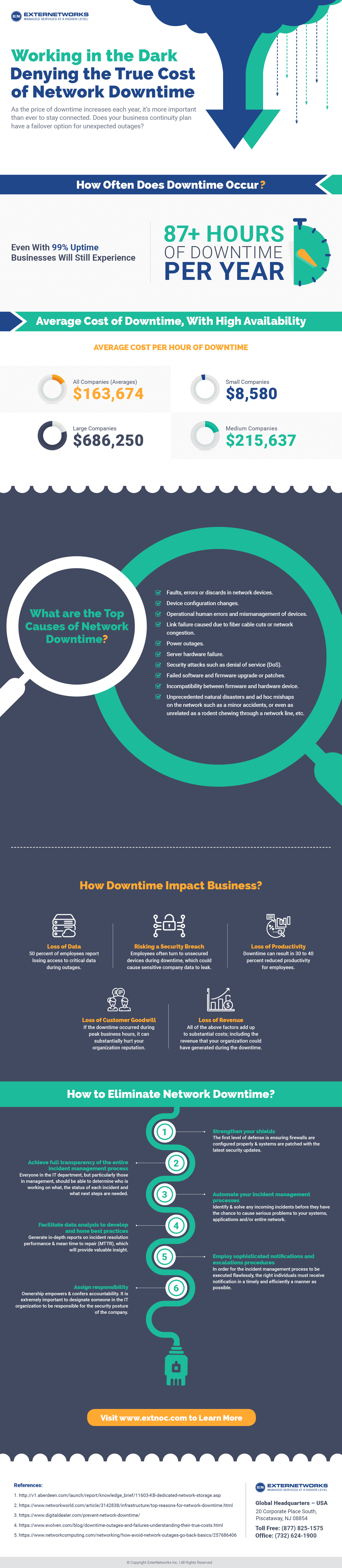
Proactive maintenance, effective incident management, and continuous network monitoring can help businesses identify potential disruptions early and minimize their impact. Explore the infographic below to understand the true cost of network downtime, its business consequences, and practical ways to reduce interruptions.
What Is the Actual Cost of Network Downtime for a Business?
The actual cost of network downtime extends beyond the immediate loss of network connectivity. When business-critical systems, applications, or network infrastructure become unavailable, organizations may experience financial losses, operational delays, reduced employee productivity, and customer dissatisfaction.
The impact varies by the organization’s size, industry, network dependency, and outage duration.
Some of the major business costs associated with network downtime include:
- Lost Revenue: Organizations may lose sales and business opportunities when customers cannot access websites, applications, or online services.
- Employee Productivity Loss: Employees may be unable to access business applications, databases, communication platforms, and other essential resources.
- Operational Disruptions: Manufacturing, logistics, healthcare, financial services, and other network-dependent operations may experience interruptions.
- Recovery Expenses: Organizations may incur additional costs for troubleshooting, technical support, equipment replacement, and system restoration.
- Customer and Reputation Impact: Repeated service interruptions can reduce customer confidence and affect long-term business relationships.
- Understanding these costs helps organizations evaluate the financial risks of network interruptions and prioritize investments in infrastructure reliability and availability.
How Do You Calculate the Cost of Network Downtime?
Calculating the cost of network downtime helps organizations understand the financial consequences of unexpected IT disruptions and evaluate the importance of business continuity planning.
A basic downtime cost calculation considers lost revenue, employee productivity losses, and additional recovery expenses.
Network Downtime Cost Formula:
Downtime Cost = Revenue Loss + Employee Productivity Loss + Recovery Expenses + Other Business Losses
For example, consider a hypothetical organization with the following operational figures:
| Cost factor | Example calculation | Estimated loss |
|---|---|---|
| Lost revenue | $5,000 per hour | $5,000 |
| Employee productivity | 50 employees × $40 per hour | $2,000 |
| Recovery expenses | Technical support and restoration | $1,000 |
| Total estimated cost | $8,000 |
In this example, one hour of network downtime could result in an estimated business impact of $8,000.
Actual costs may be higher when the outage affects customer transactions, contractual obligations, production operations, or regulatory requirements.
Organizations should use their own revenue figures, employee costs, recovery expenses, and operational data to calculate a more accurate downtime estimate.
What Are the Direct and Indirect Costs of Network Downtime?
Network downtime creates two major categories of business expenses: direct costs and indirect costs. Understanding the difference helps organizations evaluate both immediate financial losses and the longer-term consequences of service interruptions.
Direct Costs of Network Downtime
Direct costs are the immediate and measurable expenses associated with a network outage.
Common examples include:
- Lost sales and interrupted customer transactions.
- Employee wages paid during periods of reduced productivity.
- Emergency technical support and troubleshooting expenses.
- Hardware replacement and infrastructure repair costs.
- Additional expenses associated with restoring affected systems.
Indirect Costs of Network Downtime
Indirect costs are the broader business consequences that may continue even after network services are restored.
These include:
- Reduced customer satisfaction and customer retention.
- Damage to brand reputation and business credibility.
- Delayed projects and missed business opportunities.
- Supply chain and partner communication disruptions.
- Reduced employee efficiency due to operational interruptions.
- Potential contractual penalties or compliance-related consequences.
While direct costs can often be calculated from financial records, indirect costs may be harder to measure. However, they can significantly influence an organization’s long-term performance.
How to eliminate network downtime?
Organizations can minimize the financial impact of network downtime by reducing outage frequency, shortening recovery times, and prioritizing critical business systems. Proactive monitoring, preventive maintenance, incident response planning, and infrastructure redundancy help reduce operational disruptions and associated recovery expenses.
Strengthen your shields
The first level of defense is ensuring firewalls are configured properly & systems are patched with the latest security updates.
Automate your incident management processes
Identify & solve any incoming incidents before they have the chance to cause serious problems to your systems, applications and/or the entire network.
Employ sophisticated notifications and escalations procedures
In order for the incident management process to be executed flawlessly, the right individuals must receive notification in a timely and efficiently a manner as possible.
Achieve full transparency of the entire incident management process
Everyone in the IT department, but particularly those in management, should be able to determine who is working on what, the status of each incident & what next steps are needed.
Facilitate data analysis to develop and hone best practices
Generate in-depth reports on incident resolution performance & mean time to repair (MTTR), which will provide valuable insight.
Assign responsibility
Ownership empowers & confers accountability. It is extremely important to designate someone in the IT organization to be responsible for the security posture of the company.
How Much Does One Hour of IT Downtime Cost?
The cost of one hour of IT downtime varies considerably depending on the organization’s revenue, workforce size, operational dependency on technology, and the systems affected.
For some businesses, a short outage may cause only minor inconvenience. For organizations that depend on continuous digital operations, even a brief interruption can disrupt transactions, customer services, and critical workflows.
Consider the following hypothetical scenarios:
| Business scenario | Potential impact |
|---|---|
| E-commerce business | Interrupted online orders and payment processing |
| Healthcare organization | Disrupted access to digital systems and operational workflows |
| Financial services company | Interrupted transactions and customer access |
| Manufacturing company | Production delays and equipment connectivity issues |
| Enterprise organization | Disrupted communication, applications, and employee operations |
No universal hourly downtime cost applies to every business. Organizations should calculate their exposure using actual operational and financial data rather than relying on a single industry-wide estimate.
Identifying the potential cost of an outage also helps IT managers establish appropriate recovery priorities and allocate resources toward infrastructure reliability.
What Are the Hidden Costs of Unexpected Network Outages?
Some of the most significant consequences of network downtime are not immediately visible in financial reports. Even after network connectivity is restored, organizations may still face operational inefficiencies and additional expenses.
Common hidden costs include:
- Employee Catch-Up Time: Employees may need additional time to complete delayed tasks and recover interrupted workflows.
- Customer Support Overload: Unexpected outages can increase support requests, complaints, and troubleshooting requirements.
- Missed Business Opportunities: Customers may move to competitors when essential online services are unavailable.
- Delayed Business Operations: Departments may experience backlogs in communication, reporting, processing, and project delivery.
- Data Recovery and Validation: Organizations may need additional resources to verify data integrity and restore affected systems.
- Reduced Customer Confidence: Repeated outages can negatively affect customer perceptions of service reliability.
These hidden expenses show why organizations should treat network downtime as a business continuity risk, not an isolated technical issue.
Proactive infrastructure monitoring, regular maintenance, and effective recovery planning can help businesses identify potential problems early and reduce the operational consequences of unexpected outages.
Conclusion:
ExterNetworks.com, managed IT service provider, recommends the first step to address downtime time is through business continuity management(BCM) which will identify varied threats to the organizations and ensure essential resources function persistently. Technology experts at ExterNetworks also recommend that 24/7 monitoring of Applications, Network Devices, and Servers prevent of any critical device and enterprise network from downtime.
Although it may not be possible to completely avoid downtime risks, the risk can be minimized with the help of uptime maintenance service. Uptime Maintenance supports the lifecycle of your assets, facilitates rapid response to incidents and restores failed devices in accordance with Service Level Agreements tailored to your business objectives.
Related on ExterNetworks Right Now!