 NOC Services
What is Shadow AI? Managing Unauthorized Tools & IT Risks



Downtime Draining Your Business? Fix It Before It Costs More
Missed alerts turn into outages, outages turn into lost revenue. ExterNetworks Inc. delivers 24/7 NOC & Help Desk support to keep everything running smoothly.
Get 24/7 IT Support NowThe Definition of Shadow AI: More Than Just Unofficial Chatbots
Shadow AI is quietly reshaping the IT infrastructure landscape, and most IT leaders don’t see it until the damage is already done.
What is shadow AI? It’s the use of AI-powered tools, APIs, and browser-based models without explicit IT approval, oversight, or integration into your organization’s security framework. It’s not always a rogue actor or a deliberate policy violation. More often, it’s a well-meaning employee who found a smarter way to draft a report, summarize meeting notes, or debug a script and didn’t think to ask permission first.
This is what separates shadow AI from traditional Shadow IT. Unauthorized software like a personal Dropbox account creates a data governance headache. Shadow AI creates an invisible, persistent, and scalable risk. The tools ingest data, retain conversation history, and in some cases train on inputs all outside your visibility. The speed of adoption is also categorically different. A SaaS workaround might spread across a department over months. Dozens of employees can adopt an AI tool in an afternoon.
A significant driver behind this shift is the BYOAI trend Bring Your Own AI. According to the Microsoft and LinkedIn 2024 Work Trend Index, 75% of employees are already using AI at work, and 78% of those users are bringing tools their employer didn’t provide or sanction. That’s not a fringe behavior; that’s a majority of your workforce operating outside your security perimeter.
And you can’t shame your way out of it. Conversations surfacing across IT and cybersecurity communities consistently reveal the same reality: employees aren’t trying to create problems. They’re trying to solve workflow friction with the best tools available to them. The intent is almost always legitimate. The infrastructure consequences are anything but.
What makes this genuinely dangerous isn’t the tool itself; it’s the blind spot it creates in your network. Unauthorized API calls, unmonitored data flows, and ungoverned model access don’t show up in standard dashboards. And without continuous visibility across your environment, those blind spots compound fast. The next section examines exactly what happens inside your infrastructure when shadow AI takes root.
Why Shadow AI Is an Infrastructure Nightmare in Practice
Understanding shadow AI goes beyond spotting an employee using an unofficial chatbot; it’s about recognizing a sprawling, invisible attack surface that your existing monitoring tools weren’t built to detect.
The infrastructure damage unfolds across several layers simultaneously. When employees route sensitive data through public large language models, your team loses visibility at every level, from what data left the network to whether it was processed in a compliant environment. Once data enters an unauthorized AI pipeline, you can’t un-send it. The IBM Institute for Business Value describes this as a “data provenance” problem: businesses cannot verify the origin or accuracy of data flowing through models they never approved.
And it doesn’t stop there. Unauthorized API calls to external AI services frequently bypass standard firewall rules, creating network blind spots that don’t show up in your dashboards. These calls look like ordinary web traffic. Without deep packet inspection or purpose-built monitoring, they’re invisible, and every call is a potential data exfiltration event your team won’t catch until after the fact.
Compliance exposure significantly compounds the risk. Whether your organization is bound by HIPAA, GDPR, or SOC 2, sending protected data to a public LLM can constitute a reportable breach before you’ve opened a single ticket. Audit trails are often incomplete or nonexistent, which is exactly the scenario that keeps compliance officers and IT leaders in the same uncomfortable meeting.
It’s no surprise, then, that the Salesforce State of IT Report found that 57% of IT leaders consider shadow AI a significant security risk to their organization. That statistic isn’t just a data point; it reflects a collective recognition that this threat operates below the threshold of traditional infrastructure oversight. Organizations relying on reactive monitoring rather than proactive network visibility are most at risk, which is precisely where continuous infrastructure oversight becomes a competitive advantage, not just a nice-to-have.
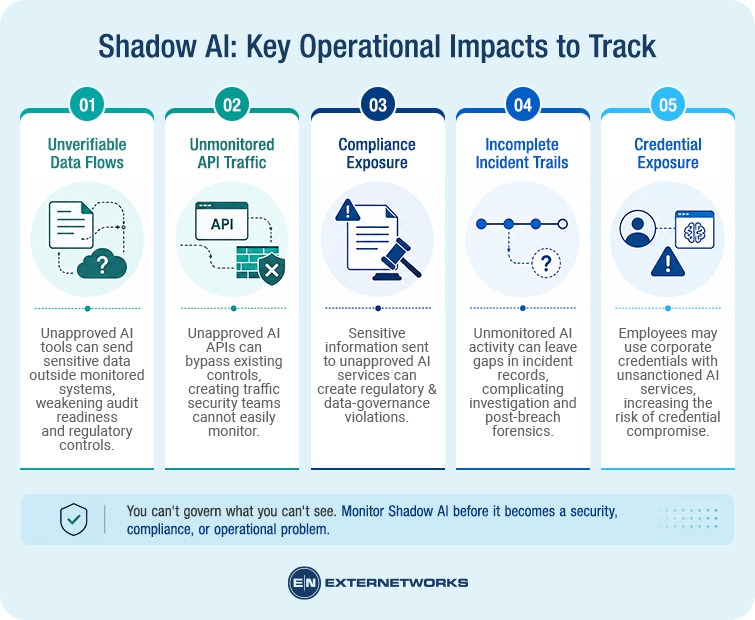
Key operational impacts to track include:
- Unverifiable data flows that compromise audit readiness and regulatory standing
- Shadow API traffic that evades firewall rules and generates no internal alerts
- Compliance violations triggered the moment regulated data touches an unapproved LLM
- Incomplete incident timelines that make post-breach forensics nearly impossible
- Credential exposure when employees use corporate accounts to authenticate with unsanctioned AI tools
What makes shadow AI uniquely dangerous compared to traditional shadow IT is the velocity of harm. A rogue SaaS app creates a policy problem. An employee pasting client contracts into a public AI model creates a breach. The gap between action and consequence is measured in seconds, not weeks.
But here’s what’s worth examining: shadow AI rarely emerges from malicious intent. It emerges from operational friction: teams who need faster answers and don’t see a sanctioned path to get them. That pattern points to something deeper, which is worth unpacking next.
Shadow IT in the Age of AI: A Symptom of Operational Isolation
Shadow AI risk doesn’t start with a malicious actor; it starts with a frustrated employee waiting six weeks for a software approval.
That’s the uncomfortable reality behind most shadow AI adoption. When procurement cycles are slow and official IT channels feel like obstacles, users don’t wait. They find their own tools, create their own workflows, and quietly solve their own problems. As Chronus Research puts it:
“Shadow AI is a symptom of isolation. It happens when employees feel they can’t get the tools they need through official channels.”
This is the isolation gap. When IT is perceived as the “Department of No,” users go underground not out of malice, but out of necessity. The pressure to deliver faster, do more with less, and stay competitive doesn’t pause for procurement reviews. And AI tools lower the barrier to entry so much that bypassing official channels takes about 30 seconds.
Blocking ChatGPT isn’t a strategy. It’s a delay tactic. Determined users will find a workaround, a personal device, or a different AI platform by the end of the day. The Cloud Security Alliance flags that this directly reactive blocking creates a false sense of control while the real exposure continues to grow beneath the surface.
A smarter shift is from control to visibility. Rather than asking “how do we stop this?” infrastructure managers need to ask “where is it happening, and what data is leaving?” That mindset change is foundational, and it’s exactly where proactive NOC-level monitoring capabilities become a practical operational lever. Understanding what you can’t see is the first step to closing the gap, which is precisely what the right monitoring strategy can deliver.
Practical Security Strategies: Moving from Blocking to Monitoring
Tackling shadow AI in practice means shifting your posture from blunt restriction to intelligent, continuous visibility because you can’t govern what you haven’t discovered.
The first step is always inventory. As Orca Security notes, effective security strategy demands you identify every AI model in use before governance can begin. That’s where automated discovery earns its place, continuously scanning your environment to surface new AI tool connections before they calcify into unmanaged risk. Without it, you’re reacting to incidents rather than preventing them.
Cloud Access Security Brokers (CASBs) are the practical enforcement layer here. They intercept traffic between your users and cloud-based AI services, flagging unauthorized tools and giving your team real visibility into what’s leaving your network. Pair that with NOC-level monitoring specifically watching for anomalous outbound data flows to known AI domains, and you move from guesswork to a defensible, documented posture.
But enforcement without an alternative pushes behavior further underground. An Approved AI registry solves this: a curated, IT-sanctioned list of tools employees can actually use. It reduces friction, steers users toward vetted solutions, and shrinks the shadow. Think of it as removing the motivation to go rogue in the first place.
These strategies don’t operate in isolation; they require sustained operational oversight that most internal teams can’t sustain alone. That’s exactly where a proactive managed partner becomes a force multiplier, which is the angle MSPs are increasingly leaning into.
The MSP Perspective: Managing AI Complexity for Clients
MSPs sit at the exact intersection where shadow IT in the age of AI becomes both a client risk and a service opportunity, and the ones who recognize that first will pull ahead.
Your clients aren’t waiting for permission to adopt AI tools. They’re already using them, quietly, across browsers, personal accounts, and browser extensions you never approved. That’s not a failure of user discipline; it’s a failure of visibility. And visibility is precisely what MSPs are built to provide.
Proactive network monitoring is your most powerful tool for identifying rogue AI integrations before they become a compliance or data breach event.
Think about what you already have access to: traffic flows, endpoint behavior, application usage patterns. A managed NOC operation running continuously, not just during business hours, can surface unauthorized AI connections the same way it catches any other unauthorized data exfiltration. The infrastructure signals are already there. It’s a matter of knowing what to look for. Managed IT services reduce operational burden by providing proactive network-level monitoring that internal teams don’t have the bandwidth to execute, and that’s the gap MSPs can fill directly.
The real opportunity here is reframing the conversation with clients. Don’t position AI governance as a restriction you’re enforcing. Position it as a transition from unmanaged, risky AI sprawl to a structured, auditable AI environment. That’s a service with measurable business value: reduced risk, cleaner data handling, and auditability that compliance teams actually care about. It’s a legitimate expansion of your managed services portfolio, not a one-time remediation project.
And that’s exactly the role an MSP should occupy: the extension of the team that handles complexity clients don’t even know they’re creating. The next section pulls all of this into a sharper focus on what IT leaders and MSPs need to take away from the shadow AI conversation.
What You Need to Know About Shadow AI
Shadow AI is the unauthorized use of AI tools by employees who don’t wait for IT approval, and it’s already reshaping your infrastructure risk profile. According to the Microsoft and LinkedIn 2024 Work Trend Index, 78% of AI users bring their own tools to work. That number isn’t a warning sign on the horizon. It’s a condition that almost certainly exists inside your environment right now.
The core risks fall into three categories: data provenance, security vulnerabilities, and compliance failures. When sensitive business data flows into an unsanctioned model, you lose control over where it’s stored, how it’s processed, and whether it ever leaves. That’s not a theoretical exposure; it’s a direct threat to regulatory standing and customer trust. As Proofpoint notes, shadow AI introduces data leakage pathways that standard security controls weren’t designed to catch.
Visibility is the non-negotiable first step. Managing unauthorized AI tools is impossible without network-level monitoring that surfaces what’s actually running. You can’t write a policy around a tool you don’t know exists. And you can’t remediate risk you’re not measuring. The previous sections covered the shift from blocking to monitoring for exactly this reason: governance only works when it’s built on a foundation of continuous observability.
But visibility alone doesn’t cure the underlying behavior. Shadow AI is, at its core, a symptom of friction between what employees need and what IT has sanctioned. The Splunk Shadow AI overview reinforces that closing this gap requires deliberate collaboration between IT and business units, creating approved pathways fast enough that workarounds lose their appeal.
Taking control of this problem requires more than policy updates. It requires the kind of proactive, 24/7 infrastructure oversight that turns hidden risk into managed, visible, and addressable conditions.
Taking Control: From Chaotic Infrastructure to Proactive Advantage
Shadow AI doesn’t have to be a crisis waiting to happen; it becomes manageable the moment you replace fear with structured, continuous visibility. The challenge isn’t that your employees are malicious. It’s that the tools exist, the pressure to perform is real, and the gaps in your oversight architecture let unauthorized AI quietly take root. Recognizing that pattern is the first step. Acting on it is where operational confidence is built.
A managed NOC approach eliminates those gaps by providing 24/7 oversight across your entire infrastructure, not just the tools you approved. Still, traffic, data flows, and anomalous behaviors signal that something unauthorized is running beneath the surface. According to Palo Alto Networks, shadow AI thrives precisely in environments where visibility is inconsistent. Consistent, around-the-clock monitoring closes that window. Our engineers, following your specific escalation playbooks, identify deviations before they become breaches or compliance failures.
And this is where the framing shifts from reactive damage control to proactive business advantage. You’re not just plugging holes; you’re building an infrastructure posture that scales with the AI era rather than scrambling to keep up with it. That’s the difference between managing chaos and engineering stability.
Uncertainty about what’s running on your network is itself a risk. Request an operational audit to surface hidden exposures, map unauthorized AI tool usage, and establish the visibility framework your team needs without adding headcount or overnight staffing pressure. We work as a specialized extension of your team, so you reclaim focus while we keep watch.
Related on ExterNetworks Right Now!




Most Recent Posts