 NOC Services
Offshore vs. Onshore NOC Services: The 2026 Hybrid Guide



Downtime Draining Your Business? Fix It Before It Costs More
Missed alerts turn into outages, outages turn into lost revenue. ExterNetworks Inc. delivers 24/7 NOC & Help Desk support to keep everything running smoothly.
Get 24/7 IT Support NowThe Evolution of NOC Outsourcing in 2026
The pressure to scale global infrastructure without scaling operational risk has made NOC outsourcing one of the most strategically consequential decisions an IT leader can make in 2026.
The managed services market reflects that reality. Worldwide IT and business services revenues grew 5.7% year-over-year in 2023. That momentum has only accelerated as enterprises push deeper into hybrid cloud, distributed edge infrastructure, and multi-vendor network environments. More complexity means more exposure and more demand for network operations support that goes well beyond traditional “eyes on glass” monitoring.
The shift from monitoring to remediation is where the stakes get serious. Traditionally, a NOC team’s primary value was detection: spot the alert, log the ticket, notify the engineer. In practice, that model simply transfers the burden. Enterprise environments now require a partner with the technical authority to isolate a fault, reroute traffic, or restore a failed link at 2:00 a.m. without waiting for approval from a time zone away. That distinction between monitoring and remediation is not a nuance; it’s the difference between a four-minute recovery and a four-hour outage.
Trust is a deciding factor in how IT leaders select that partner. According to Forrester research, trust is the single most important criterion cited by 47% of buyers when selecting a strategic service provider. Not price. Not headcount. Trust. That finding reframes the entire offshore-versus-onshore conversation: the real question isn’t where your NOC team sits; it’s whether they have the authority, the seniority, and the institutional alignment to protect your infrastructure when it matters most.
And that question, it turns out, requires a shared vocabulary before it can be answered clearly.
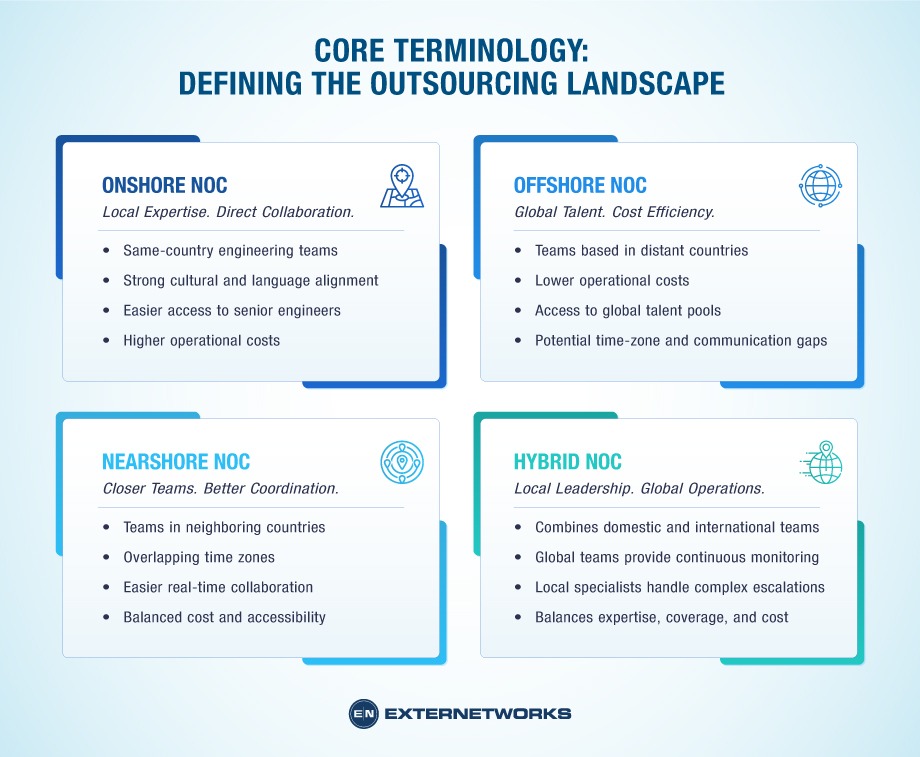
Core Terminology: Defining the Outsourcing Landscape
Before you can evaluate any NOC outsourcing model, you need a shared vocabulary because the difference between “monitoring” and “remediation” alone can determine whether an outage gets resolved or just documented.
When IT leaders compare managed NOC services providers, the conversation often simplifies to offshore or onshore. But that framing misses a more nuanced reality. Four distinct delivery models exist, and each carries different implications for coverage, authority, and cost.
- Onshore NOC: Services delivered by engineers located within the same country as the client. You get cultural alignment, minimal language friction, and direct access to senior staff during business hours.
- Offshore NOC: Services sourced from distant international hubs, often chosen for their 24/7 labor availability and lower operational cost. The trade-off typically involves time zone gaps and, as we’ll explore throughout this guide, authority constraints.
- Nearshore NOC: Services provided from neighboring countries that share overlapping time zones. This model balances cost reduction with the scheduling compatibility that fully offshore teams often lack.
- Hybrid NOC: A blended delivery model that combines domestic and international resources. Rather than forcing a binary choice, it layers onshore senior engineers over a global monitoring base.
And then there’s the distinction that matters most operationally: monitoring versus remediation. Monitoring is the act of detecting and reporting a problem. Remediation is the act of fixing it. These are not interchangeable. A team with strong monitoring capability but limited remediation authority, whether due to policy restrictions, access controls, or skill gaps, still leaves your infrastructure exposed. Knowing an outage is happening isn’t the same as stopping it.
That gap between detection and resolution is where outsourcing decisions either pay off or fall apart. Understanding which model closes that gap starts with examining what onshore delivery actually provides.
Onshore NOC Services: The Premium for Proximity
When the pressure is highest, and the clock is running, onshore outsourced NOC services eliminate the communication friction that turns a manageable incident into a prolonged outage.
Language and cultural alignment aren’t soft benefits; they’re operational ones. During a critical incident, your engineers and your NOC team need to share context instantly, without ambiguity. Accents, idiomatic phrasing, and cultural shorthand all factor into how quickly a bridge call reaches a decision. In practice, the difference between a clean handoff and a miscommunicated escalation path can add meaningful minutes to your mean time to resolve. In high-stakes environments, those minutes carry real business risk.
Senior-level availability is where onshore delivery earns its premium. Because US-based NOC teams operate within the same time zones as your infrastructure stakeholders, your highest-tier engineers are accessible during peak business hours, not midway through their overnight shift. That alignment matters when a network event requires cross-functional judgment, a call with your security team, or a vendor escalation that can’t wait for a morning handoff.
Compliance and data sovereignty add another dimension, particularly for regulated industries. Healthcare, finance, and government environments often carry strict requirements around where data is processed, who can access it, and how incidents are documented. An onshore team operates within the same regulatory jurisdiction, simplifying audit trails and reducing legal exposure without requiring a separate compliance layer to bridge geographic gaps.
Institutional knowledge retention is an underappreciated advantage. Onshore NOC teams typically experience lower turnover than their offshore counterparts, which means the engineers monitoring your environment today are more likely to remember the context of last quarter’s routing anomaly tomorrow. That continuity compounds over time into faster diagnosis, fewer repeated escalations, and a team that genuinely understands your infrastructure.
But proximity and continuity come at a cost. For many organizations, the operational expenditure gap between onshore and offshore delivery is significant enough to force a closer look at what offshore models actually offer.
Offshore NOC Services: Cost Efficiency and the 24/7 Myth
In the offshore vs onshore NOC debate, the cost argument for offshore delivery is real, but the assumption that lower cost equals equivalent 24/7 coverage is where the math quietly breaks down.
The OpEx reduction is genuine. Offshore NOC arrangements can substantially lower operational expenditure by leveraging lower regional labor costs and follow-the-sun staffing models. For budget-constrained IT leaders, that reduction is often the deciding factor, and it’s a reasonable starting point for evaluation.
But here’s where the model deserves harder scrutiny.
The “24/7 Myth” is about seniority, not headcount. Offshore teams typically maintain round-the-clock staffing; that part is accurate. What’s often missing from the conversation is which engineers are on shift at any given hour. Tier 3 specialists the engineers capable of diagnosing complex routing failures, infrastructure loops, or multi-system cascades tend to work their local daytime hours. That’s a reasonable personnel policy. But it creates a predictable vulnerability.
Consider what that means operationally:
- US peak business hours roughly 9 a.m. to 6 p.m. Eastern frequently overlap with offshore night shifts
- Night shifts are typically staffed by junior engineers with monitoring authority but limited remediation capability
- Complex incidents that emerge during US business hours when user impact is highest land in front of the least senior team on duty
- Resolution timelines stretch not because the problem is harder, but because the right engineer isn’t available until their local morning.
In practice, you’re not buying 24/7 expertise. You’re buying 24/7 presence, and those aren’t the same thing. The gap between detecting a critical infrastructure fault and having the authority and skill to resolve it is where downtime accumulates.
And that gap has a name, one worth examining closely before you sign any outsourcing agreement.
The ‘Permission Gap’: Why Offshore Teams Often Only Log Tickets
The single biggest operational risk in offshore NOC arrangements isn’t a skill deficit; it’s an authority deficit, and those two problems have very different fixes.
This distinction matters. Many offshore engineers are technically competent. They understand routing protocols, can read SNMP traps, and recognize the signature of a failing interface. But recognizing a problem and being authorized to fix it are completely separate. In practice, offshore staff often operate under tightly scoped access policies, restricted VPN tunnels, read-only system credentials, and change management windows that require senior sign-off before anyone can touch configuration. The engineer knows what needs to happen. They don’t have the keys.
This is the Permission Gap: the administrative and policy distance between detecting an infrastructure fault and having the authority to resolve it. It’s a structural condition, not a performance failure. Organizations implement these restrictions for legitimate security reasons, limiting the blast radius of a bad change, maintaining compliance boundaries, or protecting multi-tenant environments. But the unintended consequence is a NOC team that can only document the emergency, not end it.
The operational result is ticket punching: a cycle where offshore staff log an alert, escalate it upward, and wait. That waiting directly adds to your Mean Time to Resolution (MTTR). Every handoff across a permission boundary adds latency to an incident that’s already costing you. And because those escalations often cross time zones, the next authorized engineer may not be available for hours.
A well-designed hybrid NOC model closes this gap by deliberately anchoring remediation authority with onshore senior engineers while using global coverage for detection and triage. Without that design, you’re not buying managed operations. You’re buying a very expensive logging service.
And that logging service has a hidden cost that most procurement conversations don’t account for: one tied directly to who stays, who leaves, and what institutional knowledge walks out the door with them.
The Hidden Costs of High Staff Turnover
The Hybrid Reality: Blending Global Scale with Local Depth
The most effective network operations center outsourcing strategy in 2026 isn’t a binary choice between offshore cost savings and onshore depth; it’s a deliberate architecture that uses both, in the right roles.
The hybrid model works because it stops treating geography as a liability and starts treating it as a design variable. Tier 1 monitoring and initial triage suit globally distributed teams operating on a follow-the-sun rotation. Alert detection, ticket creation, basic filtering, and first-response notification don’t require senior authority; they require consistency, coverage, and speed. Offshore teams in compatible time zones can deliver all three.
But the model only holds when it’s anchored. Tier 2 and Tier 3 remediation authority stays with onshore senior engineers who carry the technical depth, client context, and escalation permissions to act, not just observe. Complex faults, multi-system failures, and incidents that cross into business-critical territory need engineers who can make decisions without waiting for a handoff across twelve time zones. That’s the structural difference between a hybrid model and a staffing workaround.
A unified management platform bridges the two layers: a single operational environment where alert data, ticket status, escalation history, and remediation steps are visible to every tier at once. Without that shared visibility, the handoff between offshore triage and onshore resolution becomes its own failure point. Gaps in context slow diagnosis. Repeated questions burn time you don’t have during an active incident.
The table below illustrates how the layers map across delivery models:
| Model | Tier 1 Location | Tier 3 Location | Primary Benefit |
|---|---|---|---|
| Fully Offshore | Offshore | Offshore | Lowest cost; highest authority risk |
| Fully Onshore | Onshore | Onshore | Highest depth; highest OpEx |
| Hybrid | Offshore | Offshore | Cost efficiency with remediation accountability |
Knowing the model exists is only half the work. The harder task is knowing which questions to ask before you commit.
Critical Evaluation Criteria for NOC Providers
Before you sign any NOC outsourcing agreement, the questions you ask during procurement will determine whether you’re buying operational confidence or an expensive ticket-logging service.
The hybrid model framework from the previous section gives you the architecture, but architecture delivers value only when the provider can execute within it. That means moving beyond SLA documents and headcount slides to audit the operational substance underneath.
Here’s what to pressure-test during every provider evaluation:
- Resolution rate vs. escalation rate. Ask directly: what percentage of tickets does your team resolve without escalating? A provider leaning heavily on escalations isn’t closing incidents; they’re passing them. High escalation rates signal a permission gap, not a skill gap, and the fix requires structural authority changes, not additional headcount.
- Tier 3 availability during your hours. “24/7 Tier 3 coverage” is a common claim. But ask specifically when your most senior engineers are on shift. If your business-critical window falls outside that overlap, you don’t have Tier 3 coverage; you have Tier 3 on call, which carries a very different response profile during an active incident.
- Staff retention and onboarding depth. High turnover doesn’t just create scheduling gaps. It erases institutional knowledge the context about your specific environment that makes the difference between a 10-minute resolution and a 90-minute war room. Ask how long the average engineer has been on the account, and what the structured handoff process looks like when someone leaves.
- Team integration vs. vendor posture. The right partner asks about your runbooks, your escalation preferences, and your change management processes before go-live. A vendor asks for your monitoring credentials.
And as you tighten your evaluation criteria, one more dimension deserves its own scrutiny because it touches every layer of this decision: how the provider manages data sovereignty, access controls, and compliance obligations across international delivery boundaries.
Security and Compliance in Outsourced Operations
Granting a third-party NOC provider access to your infrastructure isn’t just an operational decision; it’s a security posture decision that carries compliance consequences across every international delivery boundary.
As you evaluate providers against the criteria covered in the previous section, security and compliance deserve a dedicated lens. The moment network data traverses an international boundary, whether through remote monitoring sessions, log forwarding, or incident documentation, data sovereignty questions follow immediately. Which jurisdiction governs that data? Who can compel its disclosure? These aren’t hypothetical concerns; they’re contract-level obligations your legal and compliance teams must answer before go-live.
Certifications matter, but they’re a floor, not a ceiling. At minimum, any NOC provider operating in an outsourced model should hold:
- SOC 2 Type II: Demonstrates that security controls have been independently audited over an observation period, not just assessed at a point in time.
- ISO 27001: Establishes a formal information security management system with documented risk treatment processes.
These certifications show a provider has built a compliance framework. It doesn’t automatically tell you how they apply that framework to your specific environment, which is why your procurement conversation needs to go deeper.
Secure access architecture is where compliance meets the permission gap. Offshore engineers often require elevated credentials to perform even basic diagnostics. Without a structured access model role-based permissions, just-in-time provisioning, and explicit authorization tiers you risk either under-equipping engineers to resolve incidents or over-exposing sensitive network segments to accounts that shouldn’t hold standing access.
And audit trails close the loop. Session logging, change records, and escalation timestamps create the evidentiary chain your compliance team needs when an incident review or regulatory inquiry arrives. A provider that can’t produce granular access logs isn’t just a compliance risk; they’re an accountability gap inside your own infrastructure.
With security and compliance framed, you’re now positioned to pull every dimension of this decision together model, criteria, and risk controls into a clear strategic choice.
Key Takeaways: Choosing Your NOC Path
The right NOC outsourcing decision isn’t about picking the cheapest or closest option; it’s about matching technical authority, coverage model, and accountability structure to what your infrastructure actually demands.
Every dimension covered in this guide points back to a single operational truth: headcount doesn’t equal capability, and coverage doesn’t equal remediation. Before you finalize any outsourcing direction, keep these core arguments in focus:
- Onshore delivers depth, not just proximity. When a P1 (Priority 1) incident hits at 2:00 a.m., you need engineers who hold change authority and understand your environment, not engineers who need three approval layers to restart a service. Onshore delivery provides that technical depth and cultural alignment, but it carries a higher operational cost that you must weigh honestly against your budget constraints.
- Offshore scale is real, but don’t confuse presence with expertise. A team monitoring your infrastructure around the clock adds value only if it can act on what it sees. Without senior engineers available during US business hours, the 24/7 promise becomes 24/7 logging.
- The Permission Gap is a policy problem, not a skill problem. It won’t resolve itself through better tooling or more headcount. You have to negotiate it explicitly, defining escalation authority, change thresholds, and runbook ownership before signing any contract.
- Hybrid models deliver the strongest ROI for enterprises that need both scale and remediation. Offshore Tier 1 triage combined with onshore senior technical leadership closes the authority gap without surrendering cost efficiency.
- Trust is the ultimate performance metric. Transparency through audit trails, escalation visibility, and proactive reporting is what separates a genuine operational partner from a vendor you’re constantly chasing for answers.
The resources in the next section go deeper on each of these dimensions, from scaling infrastructure to auditing your current NOC’s real operational depth.
Related Resources for Infrastructure Leaders
The decision you make about your NOC outsourcing model carries consequences that reach far beyond cost, and the resources below are designed to help you go deeper on the dimensions that matter most.
Each resource below addresses a specific layer of the offshore vs. onshore evaluation: scaling infrastructure without adding headcount, closing remediation gaps, managing the compliance exposure that comes with global access, and auditing what your current coverage actually delivers.
- Guide to Scaling IT Infrastructure in 2026. Infrastructure growth creates new alert surface, new escalation complexity, and new authority gaps. This guide walks through the operational frameworks IT leaders use to scale network oversight without proportionally scaling staff and where a hybrid NOC model fits into that architecture.
- Reducing MTTR through Proactive Remediation. Mean time to resolution is the metric that separates monitoring services from genuine operational partners. This article examines how proactive remediation, not just detection, compresses incident timelines and reduces the downstream business impact of infrastructure faults.
- The Security Implications of Global NOC Access. Granting cross-border access to your infrastructure raises questions of data sovereignty, access control, and regulatory exposure. This whitepaper outlines the compliance considerations infrastructure teams should evaluate before extending standing credentials to any international delivery team.
- Conducting an Operational Audit of Your Current NOC. Before you can fix a coverage gap, you need to see it clearly. A checklist gives IT leaders a structured framework for auditing escalation authority, shift depth, ticket resolution rates, and accountability trails inside their existing NOC arrangement.
And if the audit surfaces gaps you’re not sure how to close, the next section brings every thread of this guide together model selection, security controls, evaluation criteria into a single, actionable path forward.
Building a Predictable, Proactive Business Advantage
The offshore vs. onshore NOC decision ultimately comes down to one question: do you want a vendor that logs alerts, or a partner that closes incidents before they become outages?
Every dimension this guide has covered the permission gap, the myth of 24/7 coverage, the hidden costs of turnover, and the security challenges of cross-border access points toward the same conclusion. Reliability isn’t a function of headcount. It’s a function of technical authority, escalation design, and the institutional knowledge held by the engineers on shift when your infrastructure is under stress.
A hybrid model addresses each of those pressure points directly. Offshore Tier 1 coverage absorbs alert volume and handles triage around the clock. Onshore senior technical leadership holds the remediation authority to act, not just log, escalate, and wait. Together, they replace the chaos of reactive firefighting with a structured, repeatable operational rhythm that your business can actually depend on.
That’s the shift ExterNetworks is built to deliver. We operate as an extension of your team, following your escalation playbooks, working within your defined change windows, and surfacing proactive reporting that gives your internal leadership visibility without pulling them into every incident. You don’t manage us. We manage the infrastructure so that you can manage the business.
But even the right model can’t fix gaps you haven’t identified yet. An operational audit is a practical starting point: a structured look at your current coverage depth, escalation authority, shift composition, and accountability trails. It surfaces exactly where your current arrangement is leaving risk on the table before that risk becomes downtime.
If the gaps are there, you deserve to see them clearly. Talk to an ExterNetworks expert about your 2026 NOC strategy and get a clear-eyed view of what it actually takes to turn infrastructure management into a predictable business advantage.
Related on ExterNetworks Right Now!