
Missed alerts turn into outages, outages turn into lost revenue. ExterNetworks Inc. delivers 24/7 NOC & Help Desk support to keep everything running smoothly.
Get 24/7 IT Support NowEvery second, your enterprise network generates millions of data points. Most are harmless noises. A few are early warnings of catastrophic failure. The difference between a minor incident and a multi-million-dollar outage often comes down to one capability: knowing which is which, in real time.
So, what is anomaly detection? At its core, it’s the automated identification of items, events, or observations that deviate from an expected pattern within a dataset. In an enterprise context, that definition carries enormous weight. You’re not analyzing a tidy spreadsheet; you’re processing simultaneous streams of logs, user behavior, network traffic, and application performance across dozens of interconnected systems.
Distinguishing noise from signal is the foundational challenge. High-traffic enterprise environments are inherently messy. A sudden spike in API calls might be a routine batch job or the first sign of a breach. Without proper detection, those two scenarios look identical.
Security and observability professionals generally categorize anomalies into three distinct types:
Traditional threshold-based alerting was never built for this complexity. Static rules that “alert if CPU exceeds 90%” generate relentless false positives at scale, creating alert fatigue that causes teams to tune out genuine threats. They also miss contextual and collective anomalies entirely.
Understanding what an anomaly detector identifies is only half the story. The more revealing question is how it actually works under the hood.
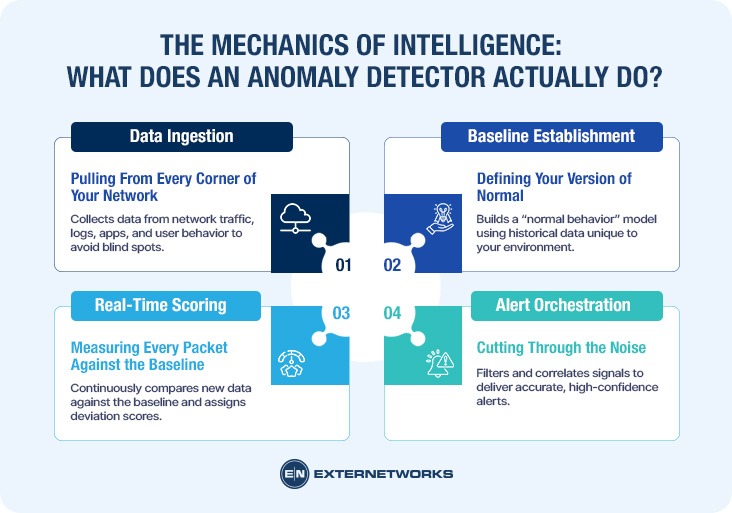
Understanding what anomaly detection is conceptually is one thing. Understanding how it actually works inside your infrastructure is where the real operational value becomes clear. At its core, a modern anomaly detector runs through four tightly integrated stages, each building on the last.
An anomaly detector’s first job is aggregation. It pulls continuously from disparate data sources, network traffic flows, system logs, application performance metrics, and user behavior patterns. The breadth of ingestion matters enormously here. A detector that only monitors one data stream creates blind spots that attackers and infrastructure failures are more than happy to exploit.
This is where the intelligence actually lives. Using historical data spanning weeks or months, the system builds a dynamic behavioral baseline unique to your enterprise environment. What’s normal for a healthcare network looks nothing like what’s normal for a financial services firm. That specificity is critical, and it’s what separates sophisticated anomaly detection in cybersecurity from simple threshold-based alerting.
Once the baseline is established, incoming data is continuously scored against it. Every login attempt, every traffic spike, every unusual API call receives a deviation score in milliseconds. The further a data point sits from baseline behavior, the higher its score and the more urgently it demands attention.
Raw scoring alone would bury your team in false positives. Alert orchestration layers filtering logic on top of scoring, correlating signals across multiple sources before triggering a notification. The result is fewer, higher-confidence alerts, a critical feature in environments where alert fatigue is already a real operational risk.
That operational efficiency has a direct financial dimension. When your team stops chasing noise, response times sharpen dramatically, and that’s where the real cost story begins.
The numbers are sobering. Industry research has consistently placed the average cost of IT downtime at roughly $1.4 million per hour for large enterprises. That figure isn’t just lost revenue; it encompasses productivity loss, recovery labor, emergency vendor fees, reputational damage, and missed SLA penalties. When you factor in the cascading effect across interconnected systems, a single undetected failure can trigger consequences that echo for weeks.
This is precisely where machine learning anomaly detection shifts from a “nice to have” to an operational necessity.
Traditional monitoring tools tell you that something broke. Anomaly detection tells you where, when, and why it started deteriorating, often before the break becomes visible. That distinction matters enormously in practice. What typically happens without intelligent detection is a manual triage cycle: alerts flood in, engineers chase symptoms, and the actual root cause sits quietly buried under noise.
Anomaly detection short-circuits that process. By continuously learning your network’s behavioral baseline and flagging statistically significant deviations, it collapses the distance between “something seems off” and “here is the precise component responsible.”
Two metrics define the real operational cost of any incident: Mean Time to Acknowledge (MTTA) and Mean Time to Resolve (MTTR). Every minute added to either metric translates directly into dollars lost. A common pattern in enterprises that adopt intelligent anomaly detection is a dramatic reduction in both MTTA and MTTR. MTTA drops because alerts are contextualized and precise rather than generic, and MTTR drops because engineers arrive at the incident already knowing where to look.
Preventing even one major outage can generate ROI that covers an entire year of monitoring infrastructure investment.
The math is straightforward. If a single hour of downtime costs $1.4 million and your monitoring platform runs a fraction of that annually, the business case essentially writes itself.
That financial logic becomes even more compelling when you examine the specific contexts where anomaly detection pays off, from cybersecurity threats to NOC operations.
Understanding how anomaly detection works mechanically is only half the picture. The real value emerges when you map those capabilities to the specific, high-stakes scenarios that enterprise teams face every day. Across cybersecurity, operations, application performance, and compliance, the use cases are both distinct and deeply interconnected.
Traditional perimeter defenses are built on known threat signatures. The problem? Sophisticated attackers don’t use known playbooks. Lateral movement, where a bad actor quietly pivots between internal systems after an initial breach, and data exfiltration patterns often generate traffic that looks completely normal to a static firewall rule.
Anomaly detection changes this dynamic. By establishing a behavioral baseline for every user, device, and service, the system flags deviations, such as a service account suddenly accessing file servers at 2 a.m. or an unusual spike in outbound data transfers. These are the subtle signals that rule-based systems routinely miss.
Anomaly detection for NOC monitoring addresses one of the most frustrating challenges in operations: failures that build slowly and invisibly. A switch degrading over weeks, a bandwidth bottleneck forming during off-peak hours, a memory leak accumulating across overnight batch jobs, none of these triggers an immediate alarm. By the time they do, user impact is already happening.
In practice, anomaly detection layers built on existing monitoring systems identify gradual drifts before they become outages. The result is a NOC team that’s reacting to early signals rather than scrambling during a crisis.
In cloud-native environments, microservice latency spikes are notoriously difficult to trace. Anomaly detection correlates latency data across distributed services, pinpointing which dependency is degrading and when it started.
On the compliance side, the same detection logic that flags security threats can automatically log unusual data access patterns, who accessed what, when, and how much, creating an audit trail that satisfies regulators without requiring manual review.
Each of these use cases relies on a fundamental question: what detection approach powers the system? That’s where the difference between machine learning and traditional rule-based methods becomes critical.
When evaluating enterprise network anomaly detection solutions, the first architectural decision most teams face is deceptively simple: rules or machine learning? In practice, the answer is rarely one or the other.
Rule-based systems set fixed boundaries, flag anything above X, and alert on anything below Y. That logic worked reasonably well in static on-premises environments. In today’s auto-scaling cloud infrastructure, it breaks down fast. Traffic patterns shift by the hour, workloads spike during product launches, and seasonal demand can triple baseline metrics overnight. Static thresholds don’t adapt. The result is a flood of false positives during normal scaling events and dangerous blind spots when genuinely abnormal behavior falls within an “acceptable” range.
Supervised models learn from labeled historical data, which is useful when you have well-documented incident logs. However, enterprise network data is often messy, inconsistently labeled, and full of novel threat patterns that no previous label covers. Unsupervised learning tends to be the stronger fit here, identifying deviations from baseline behavior without requiring predefined attack signatures.
ML models can be powerful and profoundly untrustworthy at the same time. Explainable AI addresses this directly. Enterprise security and operations teams won’t act on alerts they can’t understand or justify to leadership. Transparency into how security teams reached a detection decision isn’t a luxury; it’s a trust requirement.
A hybrid approach combining ML-driven pattern recognition with human-defined rules gives enterprises both adaptability and accountability. Automated models handle the volume; experienced engineers tune the guardrails and validate outputs.
Getting this architecture right requires a deliberate implementation strategy, which is exactly what the next section addresses.
Deploying anomaly detection without a clear roadmap is like installing a smoke alarm after the fire starts. The technology only delivers value when it’s anchored to deliberate strategy.
Start by auditing your data silos. Fragmented visibility is the single biggest obstacle to effective anomaly detection. Before selecting any tooling, map every data source, network telemetry, application logs, and infrastructure metrics, and ensure they feed into a unified monitoring layer. Gaps here translate directly to blind spots later.
Choose a partner, not just a product. Look for a Managed Service Provider that offers anomaly monitoring as a core service, not a bolt-on. The right MSP actively tunes detection models over time, reducing alert noise and improving signal quality as your environment evolves.
Prioritize actionable intelligence. Detection without an automated response is an incomplete solution. Build workflows that translate anomaly signals into immediate remediation actions.
Key Takeaways:
Real-time visibility isn’t a luxury; it’s the foundation of enterprise resilience. Organizations that treat anomaly detection as a living, managed capability will consistently outpace those still reacting to yesterday’s incidents.
See how ExterNetworks can help you with Managed NOC Services
Contact Us