What is SD-WAN?
The software-designed WAN (SD-WAN) is a specific application of Software-defined Networking (SDN) technology applied to WAN connections such as broadband internet services, 4G, LTE, or MPLS.
It allows enterprises to leverage any combination of data transport services – including branch offices and data centers – over large geographic distances to connect users securely.
Why Do Businesses Use SD-WAN?
Businesses use Software-Defined Wide Area Networking (SD-WAN) to improve application performance, simplify network management, reduce connectivity constraints, and support distributed operations. By intelligently managing traffic across multiple network connections, SD-WAN helps organizations connect branch offices, data centers, remote users, and cloud applications more efficiently.
Key benefits of SD-WAN include:
Improved application performance: SD-WAN uses application-aware routing to direct traffic over suitable network paths based on latency, jitter, packet loss, and bandwidth. This helps improve the responsiveness of business-critical applications, including video conferencing, VoIP, and cloud-based software.
Centralized network control: IT teams can manage network policies, configure devices, monitor performance, and troubleshoot issues through a centralized management platform. This reduces the need to configure each branch individually and helps maintain consistent network policies across locations.
Flexible connectivity options: SD-WAN supports multiple connection types, including broadband, MPLS, and cellular networks such as 4G and 5G. Businesses can combine these links based on performance, availability, and cost requirements, making it easier to expand connectivity to new locations.
Greater operational efficiency: Automated provisioning, centralized monitoring, and policy-based traffic management reduce repetitive administrative tasks. IT teams can identify network problems more quickly, simplify deployments, and spend less time managing routine WAN operations.
Improved network resilience: SD-WAN can detect degraded connections and redirect eligible traffic to alternative links, helping maintain application availability during network disruptions.
Potential cost optimization: Businesses can use lower-cost broadband connections alongside or instead of some MPLS circuits, depending on application requirements and service-level agreements. This can reduce connectivity expenses without sacrificing performance where policies and network conditions are properly configured.
Overall, SD-WAN helps businesses build more flexible, manageable, and resilient networks. The greatest benefits typically come from aligning routing policies, connectivity choices, and monitoring capabilities with the organization’s application priorities and operational requirements.
How Does SD-WAN Improve Network Security?
SD-WAN improves network security by enabling centralized security policies, encrypting traffic between sites, segmenting network access, and integrating threat protection across branch offices and cloud environments. However, security capabilities vary by vendor, so businesses should distinguish between features built into the SD-WAN platform, those integrated through third-party products, and those requiring separate subscriptions or appliances.
Encrypted connections: Many SD-WAN solutions natively support IPsec VPN tunnels to protect data transmitted between branch offices, headquarters, and cloud environments. Businesses should verify encryption standards, key management, and support for secure connectivity across all required locations.
Firewalls and threat prevention: Some vendors include stateful firewalls and basic traffic filtering in their SD-WAN appliances. Advanced capabilities, such as intrusion prevention, malware detection, sandboxing, and advanced threat protection, may require additional licenses, dedicated appliances, or integration with a separate security platform.
Network segmentation: SD-WAN can separate traffic into logical segments by department, application, location, or sensitivity level. This helps limit unauthorized access and contain potential threat spread between business systems.
Centralized security policy management: Administrators can define and distribute consistent access and traffic policies across multiple sites through a central management console. The extent of centralized security enforcement depends on the vendor’s architecture and its integration with other security tools.
Cloud and remote-user security: Some platforms provide native secure web gateways or cloud-based security services, while others integrate with Secure Access Service Edge (SASE) or Security Service Edge (SSE) providers. Businesses should confirm whether web filtering, zero-trust access, and cloud application protection are included or sold separately.
Monitoring and threat visibility: SD-WAN platforms typically offer network telemetry, logs, and traffic visibility. Advanced security analytics, centralized log correlation, security information and event management (SIEM), and managed threat detection may require separate tools or subscriptions.
Top 5 SD-WAN Vendors
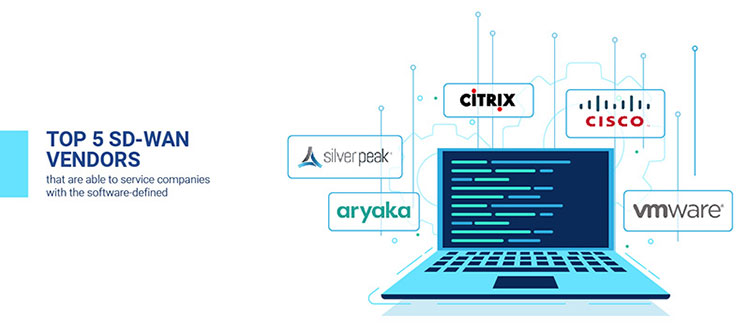
As businesses continue to make the transition from the old WAN architecture to the SD configuration, many vendors have taken on the mantle of serving as providers for these companies. Currently, there are top 5 SD-WAN vendors that are able to service companies with the software-defined: Cisco, Silver Peak, VMware, Citrix, and Aryaka.
Cisco DNA
What is Cisco SD-WAN
Cisco offers DNA (Digital Network Architecture) as its answer for the software-defined approach for WANs. The architecture utilizes a software-defined network (SDN) controller, which makes automation of network tasks easy and frees up IT personnel to handle other networking priorities. Existing Cisco switches and routers can support Cisco DNA capabilities with just a simple software push. The DNA platform is designed in such a way that it can scale businesses and their associated offices within a span of minutes.
Silver Peak Unity EdgeConnect
The Unity EdgeConnect is a proprietary product for Silver Peak. It is advertised to customers as a business-driven WAN designed to meet cloud-first enterprise needs. EdgeConnect continues to adapt intelligently according to the organization’s needs and will adjust network conditions accordingly. It delivers a quality of service experience that enables enterprises to leverage the capabilities of the cloud while transforming their business in the process. The Unity aspect of the platform describes the product combining software-defined WAN, segmentation, WAN optimization, firewall, routing, application control, and visibility into a consolidated package.
VMware NSX
An IT industry leader, VMware gives customers access to the NSX data center. It’s a network virtualization platform that delivers networking and security into a singular package, completely separated from the underlying hardware. It also comes with the Virtual Cloud Network, making it possible for end-to-end connectivity for data and apps anywhere.
Citrix SD-WAN (formerly known as NetSCaler)
Another company that is on par with other IT companies, Citrix’s product simplifies branch networking and offers a workspace that it flexible and high-performing. It combines essential network functions such as stateful firewalls, WAN optimization, quality of service, and intelligent path selection into a singular network package.
Aryaka SmartCONNECT
Aryaka’s solution offers companies the ability to manage their WANs with the SmartCONNECT platform. It is advertised to clients as a global and regional SD-WAN as-a-service, giving entities the ability to deploy networks anywhere in the world up to 48 hours. In addition, the platform gives customers secure enterprise-level communications.
In addition to the top 5, there are many other vendors that provide SD-WANs as a service to their clients, including 128 Technology, Cato Networks, and Barracuda Networks. Leadership will need to confer with their IT staffs to ensure the transition from MPLS to the SD architecture is seamless. Choosing the right company to help ease the transition will be a matter of preference along with what the company’s network is capable of supporting as the world moves farther into cloud-based technologies.